
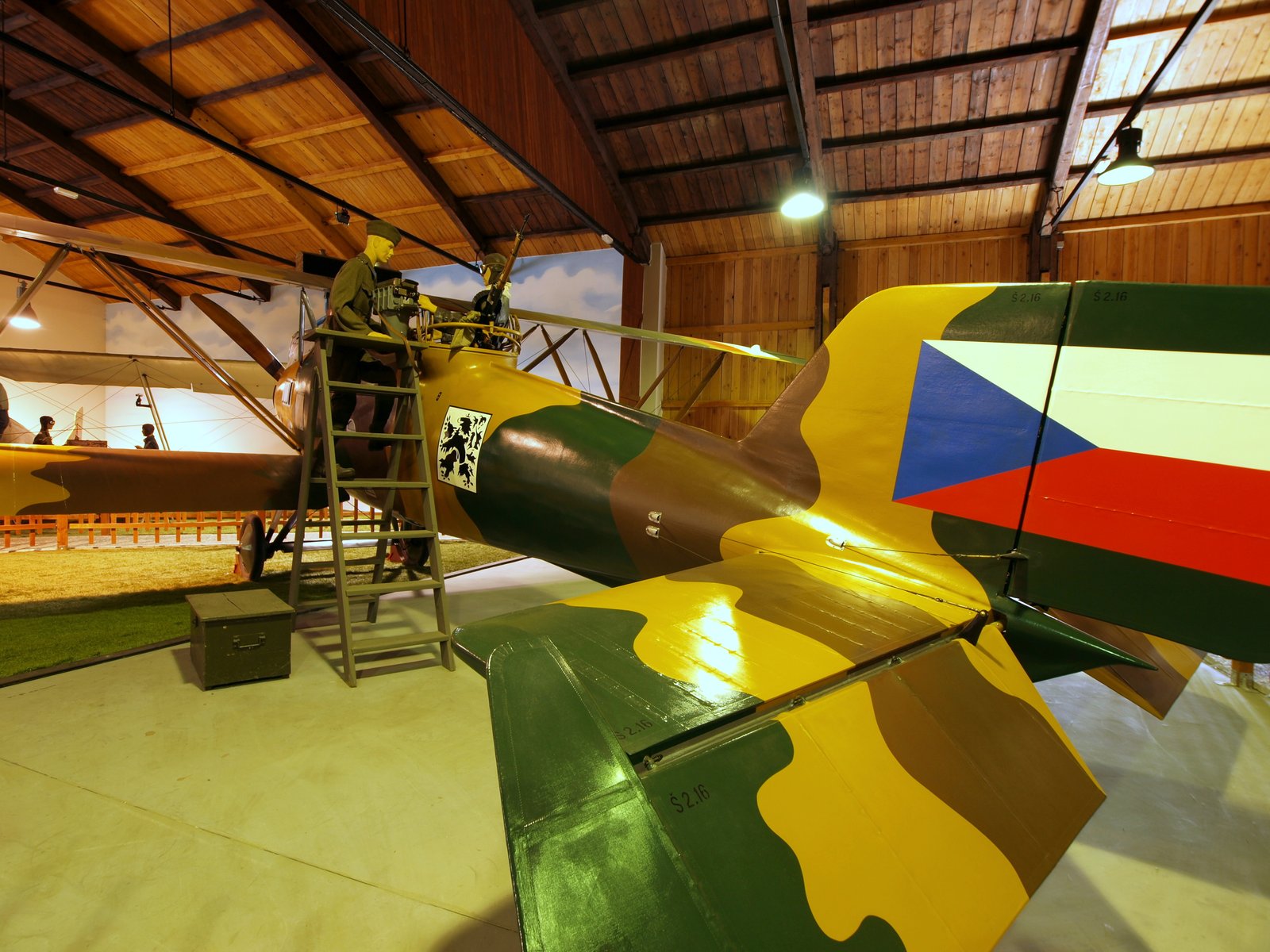
The Letov Š-12 was a single-seat fighter prototype developed in Czechoslovakia during the early 1920s. Designed by Alois Šmolík, who served as the chief designer and technical director at Letov, the aircraft was part of a series of experimental projects—including the Š-13 and Š-14—intended to explore new configurations for the burgeoning Czechoslovak aviation sector. The Š-12 was specifically derived from the Letov Š-4 biplane; Šmolík modified the design by removing the lower wing and installing a thick, deep wing in a parasol (high-wing) configuration above the fuselage.
Manufacturing took place in 1924 at the Vojenská továrna na letadla (Military Aircraft Factory) located in Kbely, Prague. The factory, which had been established in 1918 by the Czechoslovak Ministry of Defense, had evolved from a repair facility for World War I trophy aircraft into a producer of indigenous designs. Only one Š-12 prototype was ever constructed. The aircraft was powered by a single Hispano-Suiza 8Ba V-8 water-cooled piston engine, producing approximately 160–162 kW (220 hp) at 2,300 rpm, driving a two-blade fixed-pitch wooden propeller. While some later museum references suggest the use of Lorraine-Dietrich W12 engines, specialist aviation records consistently attribute the Hispano-Suiza powerplant to the 1924 prototype.
Technically, the Š-12 featured a wingspan of 9.40 meters and a wing area of 15.55 square meters, with a total length of 6.58 meters. It had an empty weight of 673 kg and a loaded takeoff weight of 983 kg. Performance data indicates a maximum speed of 220 km/h and a cruise speed of approximately 180 km/h, with a range of 470 km. The aircraft could reach a service ceiling of 6,000 meters and could climb to 5,000 meters in 19 minutes. The undercarriage was a fixed arrangement equipped with a tail skid.
Despite its experimental promise, the Š-12 never entered production or operational service. It was likely used for factory and military evaluations in 1924 before the program was abandoned. No examples of the aircraft survive today, and it is not present in the Kbely Aviation Museum. The legacy of the Š-12 persists through the history of its manufacturer; the Letov entity eventually evolved into LATECOERE Czech Republic s.r.o., which continues to produce aviation components in Prague today.