
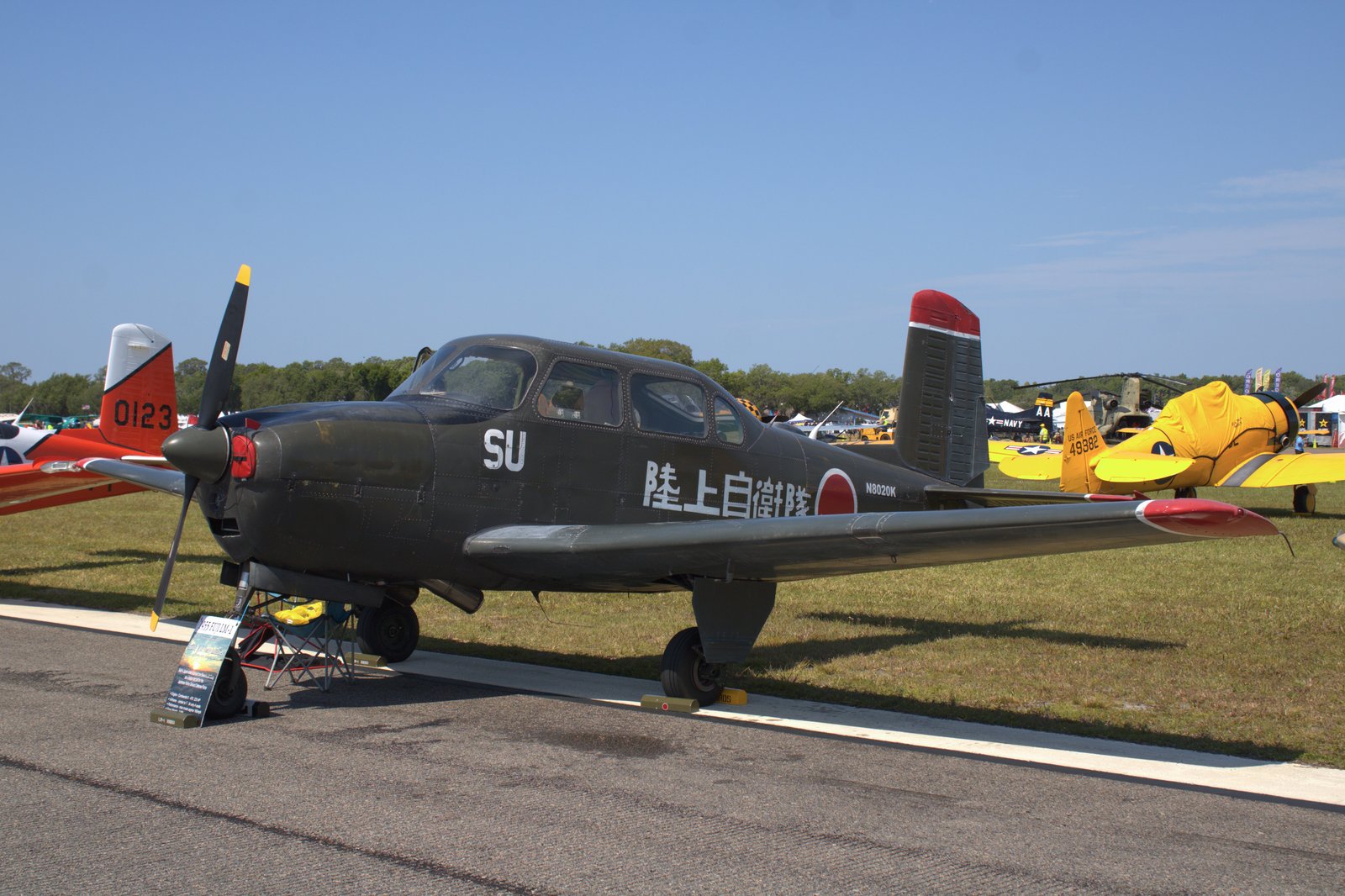
Service History
The LM-1 Nikko entered service with the Japan Ground Self-Defense Force in 1955, representing a significant milestone as Japan's first domestically designed aircraft following World War II. Only 27 aircraft were built during its brief production run from 1955 to 1956, making it one of the rarest post-war Japanese aircraft. The type served primarily in training and communications roles, bridging the gap between pure trainers and utility aircraft for the newly established Japanese defense forces.
The Manufacturer
Fuji Heavy Industries emerged from the ashes of the wartime Nakajima Aircraft Company, one of Japan's premier military aircraft manufacturers during World War II. Established in 1955, the company initially focused on license-building American designs, including the Beechcraft T-34 Mentor for the Japanese Self-Defense Forces. This collaboration provided valuable experience that directly led to the development of the LM-1 as an indigenous variant. The company later diversified into automotive manufacturing and eventually became Subaru Corporation, though it maintained aviation interests through various aircraft programs over the decades.
Design Evolution
Fuji engineers used the proven T-34 Mentor as their foundation, retaining the aircraft's aerobatic capabilities while completely redesigning the upper fuselage to accommodate four occupants instead of two. This transformation from tandem trainer to side-by-side communications aircraft demonstrated Japanese engineering expertise in adapting foreign designs to local requirements. The prototype, registered JA3098, successfully completed its maiden flight on June 7, 1955, validating the design approach that combined American reliability with Japanese manufacturing precision.
Engine and Technical Specifications
The Continental O-470-13A engine that powered the LM-1 was the same powerplant used in the T-34A Mentor, providing 225 horsepower through a two-bladed propeller. This six-cylinder engine, manufactured by Continental Motors, offered proven reliability essential for both training and communications missions. The engine choice reflected practical considerations, ensuring parts commonality with existing T-34 operations while providing adequate performance for the heavier four-seat configuration.
Variant Development
The basic LM-1 spawned several derivatives that extended the design's operational life well beyond the original production run. Three aircraft were converted to LM-2 standard between 1963 and 1966, receiving more powerful 340-horsepower Lycoming IGSO-480-B1A6 engines and eventually transferred to private owners in the United States. The XKM prototype, which first flew on December 1, 1958, explored civil applications with instrument flight rule capabilities, though development was ultimately halted.
The most successful variant became the KM-2 series, developed for the Japan Maritime Self-Defense Force beginning in 1962. These aircraft featured the same 340-horsepower Lycoming engine as the LM-2 but incorporated dual controls for training missions. Later KM-2 variants included 34 aircraft with enlarged air intakes and spinners, reflecting ongoing refinement of the basic design.
Operational Challenges
The LM-1's service record included several accidents that highlighted the risks inherent in military aviation training. Aircraft 21009 was lost on August 7, 1968, followed by aircraft 21005 on June 28, 1973. These losses, while tragic, were not uncommon for training aircraft of the era and reflected the demanding nature of military pilot preparation during the Cold War period.
International Recognition
Three LM-2 variants found their way to the United States after military service, where they joined the ranks of warbird collectors and enthusiasts. Aircraft N2104X operated in private hands until its loss on January 1, 1985, while others continued flying in civilian roles. This international interest validated the aircraft's design qualities and demonstrated its appeal beyond its original military mission.
Current Legacy
Today, approximately three LM-1 aircraft remain airworthy, making them among the rarest flying warbirds. Phil McLanahan operates 1955-built serial number 14 from Culpeper, Virginia, maintaining the aircraft in original factory paint and interior configuration. His participation in Commemorative Air Force events helps preserve the memory of this significant aircraft for future generations.
Another survivor, registered N8020K and nicknamed "SU," continues to fly in private hands, representing the dedication of owners who maintain these historically significant aircraft. The surviving examples serve as flying monuments to Japan's post-war aviation renaissance and the successful collaboration between American technology and Japanese manufacturing expertise.
The LM-1 Nikko's importance extends beyond its limited production numbers, symbolizing Japan's transition from wartime devastation to peaceful reconstruction through international cooperation and indigenous innovation.