
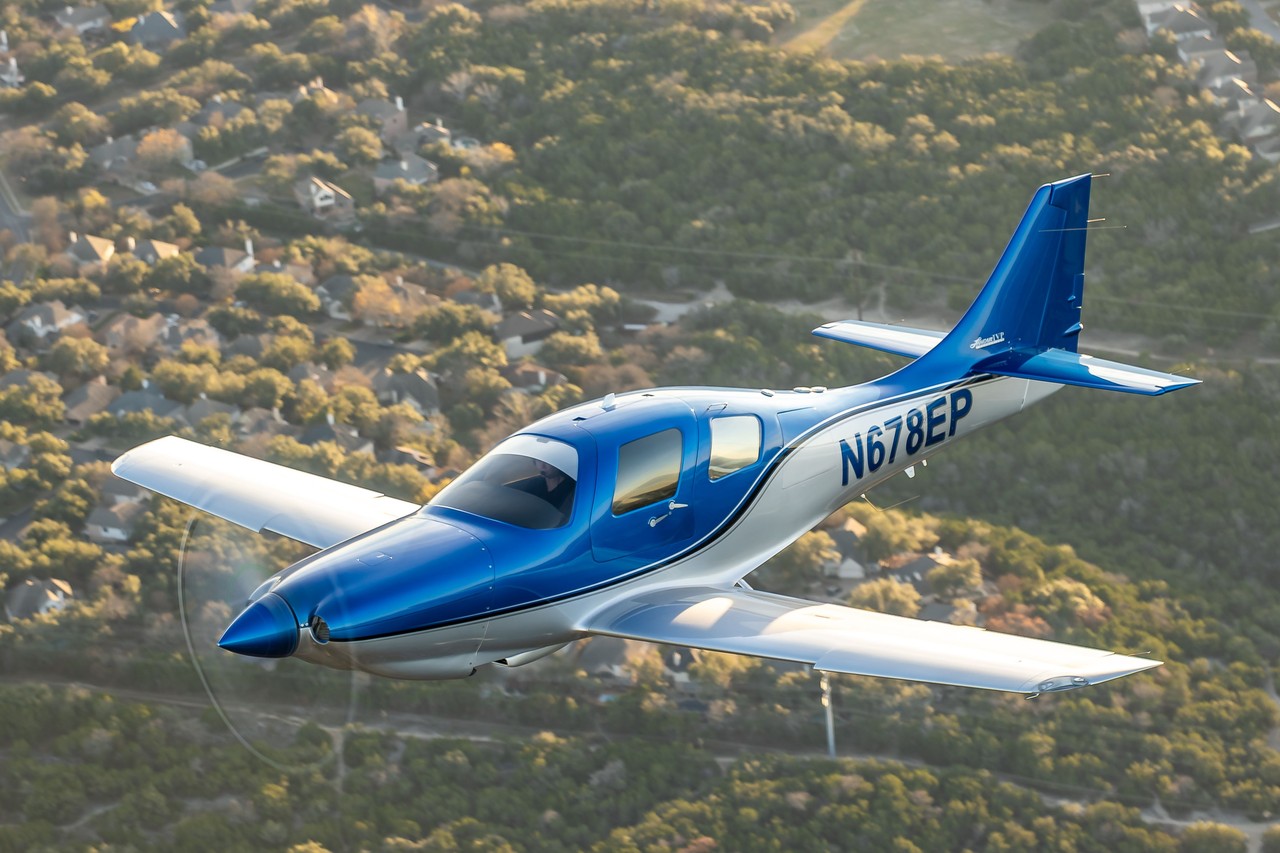
Service History
The Lancair IV transformed personal aviation by democratizing high-altitude pressurized flight for homebuilders. Between 1991 and 2012, builders completed 360 aircraft across both unpressurized and pressurized variants, with 110 Lancair IVs and 250 IV-Ps taking to the skies. The aircraft quickly established itself as the premier choice for serious cross-country travelers, offering airline-like performance at a fraction of the cost of certified alternatives.
Record-breaking flights validated the design's exceptional capabilities. In February 1991, a Lancair IV set a class speed record of 360.3 mph from San Francisco to Denver. More dramatically, in January 1999, Gary Burns and Peter Lindsay achieved 531 km/h on a Brisbane-Sydney round trip. The aircraft's ultimate endurance test came in 2014 when Bill Harrelson completed a solo polar circumnavigation in 175 hours, his modified Lancair IV carrying 361 gallons of fuel.
The Manufacturer
Lancair International emerged from the vision of Lance Neibauer, a graphic designer who revolutionized kitplane construction. After first flying his Lancair 200 prototype in 1984, Neibauer founded the company that would pioneer composite construction in experimental aviation. By 1990, Lancair had captured a 30% share of the kitplane market with over 600 kits sold across all models.
The company's Redmond, Oregon facility employed 40 workers by August 1998, producing increasingly sophisticated designs. Lancair collaborated with Advanced Composite Technology, which built kits under license starting in 1990 and delivered the first pressurized Lancair IV that same year. Philippine Aerospace Development Corporation also manufactured two units under license.
In July 2016, Lancair sold its older product lines, including the IV series, to focus exclusively on the turboprop Evolution. The company rebranded as Evolution Aircraft Company, while the buyer continued operations as Lancair International, LLC, maintaining support for legacy aircraft.
Engine & Technical Innovation
The Continental TSIO-550 twin-turbocharged engine formed the heart of the Lancair IV's performance envelope. This 550-cubic-inch powerplant generated 350 horsepower at sea level, enabling the aircraft to cruise at 24,000 to 29,000 feet where thin air allowed true airspeeds approaching 300 knots. The engine's twin turbochargers maintained sea-level power at altitude, a critical capability for the IV-P's pressurized operations.
Lancair's construction methodology represented a quantum leap in amateur-built aircraft sophistication. The vacuum-formed, oven-cured prepreg carbon fiber airframe required approximately 2,500 hours to complete but delivered strength-to-weight ratios impossible with traditional aluminum construction. The pressurized IV-P variant incorporated a cabin differential of sufficient capability to maintain sea-level pressure at service ceilings approaching 29,000 feet.
Performance and Pilot Experience
Pilots discovered an aircraft that delivered on Lancair's ambitious performance promises while demanding respect for its capabilities. The IV typically cruised between 265 and 300 knots true airspeed, with maximum speeds reaching 395 mph under optimal conditions. Fuel capacity ranged from 78 to 110 gallons in standard configurations, though modifications could extend this to 361 gallons for extreme-range missions.
Handling characteristics reflected the aircraft's high-performance nature. Stall speeds around 61 knots in landing configuration at 2,900 pounds gross weight required pilots accustomed to more forgiving designs to adapt their techniques. The combination of speed, altitude capability, and relatively modest dimensions created an aircraft ideally suited to serious cross-country flying but less appropriate for casual recreational use.
Variants and Development
Beyond the standard IV and pressurized IV-P, Lancair explored turbine conversions that pushed performance even further. The Lancair Propjet, powered by either Walter 601E or Pratt & Whitney PT6 turboprops, achieved cruise speeds exceeding 300 knots at 30,000 feet. First tested in 2000 and flying by 2001, these variants demonstrated the basic airframe's adaptability to different powerplants.
The ambitious Tigress variant promised 405 mph cruise speeds using the Orenda OE600 V-8 engine producing 600 horsepower. However, cancellation of the engine program limited this variant to prototype status, illustrating the challenges facing experimental aircraft manufacturers dependent on specialized powerplants.
Legacy and Current Status
The Lancair IV's influence extended far beyond its production numbers. As the first pressurized kit aircraft, it established design and certification precedents that continue influencing experimental aviation. The aircraft's composite construction techniques, later refined in subsequent Lancair designs, demonstrated that amateur builders could successfully complete sophisticated airframes previously requiring factory production.
Today, the majority of completed Lancair IVs remain active, tracked through FlightAware's LNC4 designation system. However, the aircraft's performance capabilities have contributed to a concerning safety record, with NTSB documentation showing 20 crashes and 18 fatalities across all IV variants through June 2014. Recent incidents, including a November 2023 runway overrun in Texas, underscore the ongoing challenges of high-performance experimental aircraft operation.
Lancair International, LLC continues supporting existing aircraft while the design's legacy influences modern experimental aviation. The IV's combination of speed, altitude capability, and builder accessibility established templates that subsequent manufacturers continue following, cementing its position as a watershed design in personal aviation history.