
Development and Design
The LS-10 project originated under the direction of Wolf Lemke, with Werner Scholz developing the prototype designated LS10-a. The aircraft was conceived as a successor to the successful LS-6, targeting the competitive 18-meter sailplane class with enhanced performance characteristics. The design team incorporated a modified FX 81-K-130 airfoil section with turbulator tape to improve rain and bug resistance, while the triple-tapered wing planform offered manufacturing advantages over elliptical designs while maintaining excellent aerodynamic efficiency.
The prototype achieved its maiden flight at Egelsbach, Germany, quickly demonstrating its competitive potential by winning contests at Hockenheim and Bayreuth in 2004, followed by victory at the German Nationals at Lüsse in 2005. The aircraft's performance credentials were further validated with a second-place finish at the 2005 European Championships in Nitra, Slovakia.
Manufacturing Challenges and Production
DG Flugzeugbau inherited the LS-10 project following Rolladen-Schneider's receivership around 2003, but legal disputes over asset acquisition delayed production by nearly two years. These protracted delays proved costly, with approximately two-thirds of potential customers canceling their orders as competing designs like the ASG-29 and JS-1 captured market share in the 18-meter class.
When production finally commenced, DG Flugzeugbau achieved certification in January 2010, but the limited market demand resulted in exactly 25 units being completed before the program ended. The first prototype reached the United States in 2006, with various examples subsequently delivered worldwide, including aircraft registered as N122NM and OY-RIX in Denmark.
The Manufacturer
DG Flugzeugbau traces its origins to 1972 as Glaser-Dirks Flugzeugbau, establishing itself in the sailplane industry with the DG-100, which saw 105 initial units plus 222 license-built examples at Elan. The company expanded its portfolio with the DG-300 series (484 units produced) and the DG-500 two-seat trainer, which first flew in 1987 and spawned the motorized DG-500M variant.
Following the acquisition of Rolladen-Schneider's assets, the company continued operations and now trades as DG Aviation GmbH. The firm maintains active production with modern designs including the DG-1000 series and DG-1001e neo, with recent deliveries including serial 10-296E7 in 2023.
Technical Innovation
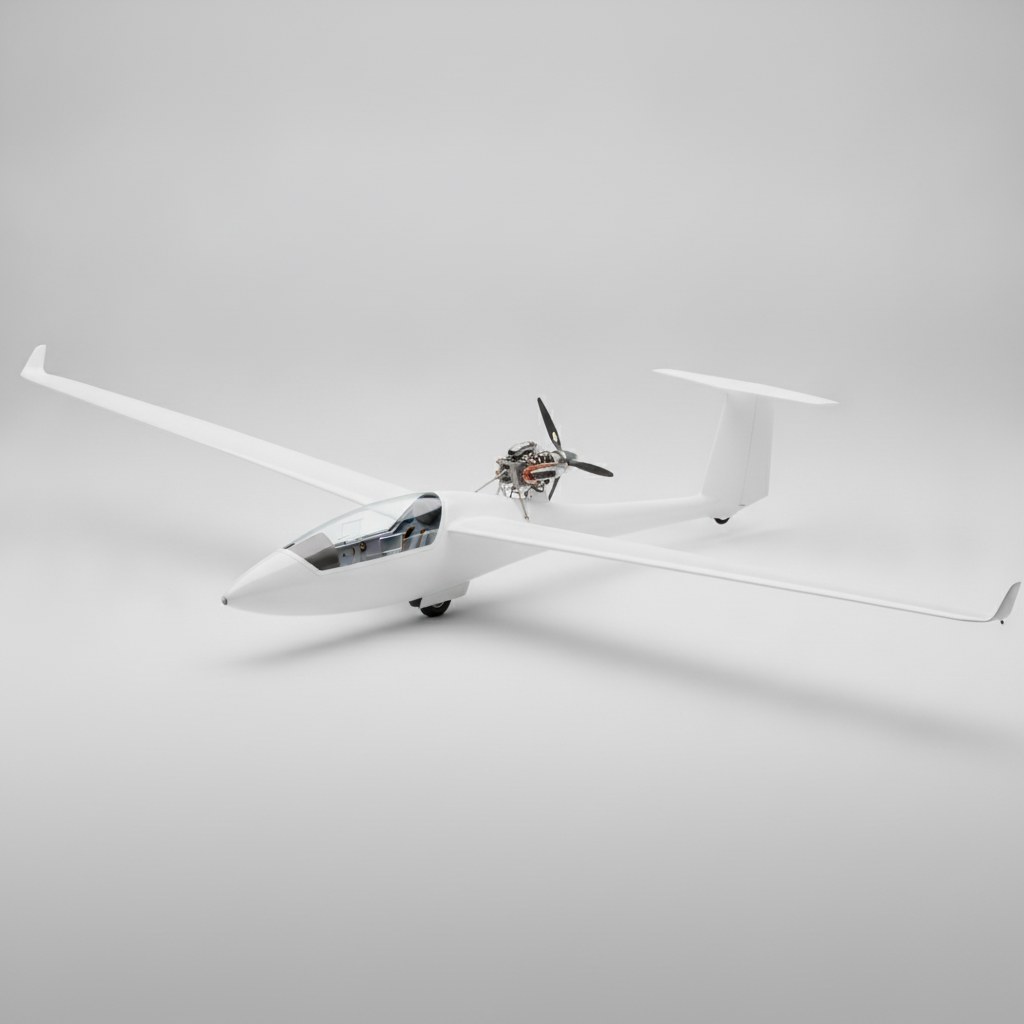
The LS-10ST variant incorporated a self-sustaining engine system identical to that used in the LS8-st, featuring a mid-wheel mounted installation with retractable propeller. This inline piston powerplant enables short powered flights for positioning in weak thermal conditions, distinguishing it from pure sailplanes while maintaining the aircraft's primary soaring mission.
The wing design featured innovative construction techniques, including a thicker root profile to manage fuselage turbulence effects similar to contemporary designs like the ASW-28 and DG-1000. The four-part wing construction allowed for both 15-meter and 18-meter configurations through interchangeable wing tips, with an inboard partition system optimizing rigging procedures.
Performance and Specifications
Measuring 6.72 meters in length with an 18-meter wingspan, the LS-10ST achieved an impressive aspect ratio of 28.4 across its 11.4 square meter wing area. The aircraft's empty weight of 305 kilograms allowed for 190 kilograms of water ballast, bringing maximum gross weight to 600 kilograms. The design demonstrated superior high-speed glide performance compared to rivals while exhibiting reduced sensitivity to turbulence and precipitation.
Legacy and Current Status
Despite its technical merits and competition victories, the LS-10 program represents a cautionary tale of timing in niche aviation markets. The two-year production delays allowed competitors to establish market dominance, relegating the LS-10 to a footnote in 18-meter sailplane development. The 25 completed aircraft remain scattered across global soaring communities, with examples still active in the United States, Denmark, and other countries.
The program's limited production run reflects the challenges facing specialized aviation manufacturers, where development costs for advanced composite sailplanes can exceed market demand, ultimately contributing to Rolladen-Schneider's financial difficulties. Today, several examples continue flying in private hands, serving as reminders of the aircraft's unrealized potential in competitive soaring.