
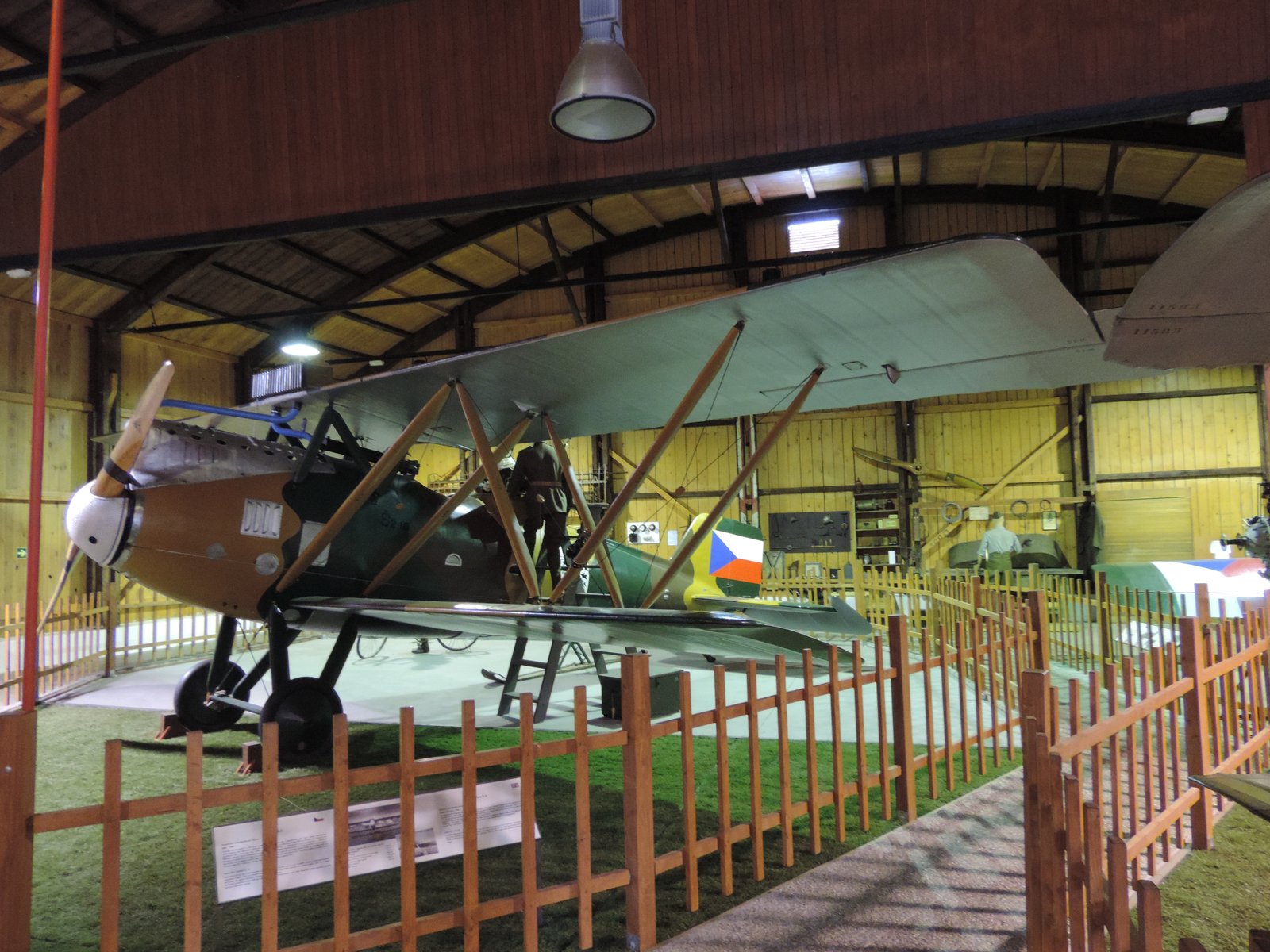
The Letov Š-1 holds a prominent place in aviation history as the first military aircraft designed and manufactured within Czechoslovakia following the nation's establishment in 1918. Developed by the state aircraft works Letov Kbely at the Kbely airfield near Prague, the aircraft was the creation of leading designer Alois Šmolík. The aircraft's designation, Š-1, specifically incorporates the initial of Šmolík's surname, a naming convention that continued with subsequent Letov designs.
First flown in April 1920, the Š-1 was configured as a single-engine, two-seat biplane intended for surveillance, reconnaissance, and light bombing. The airframe featured an all-wood construction, most notably utilizing a moulded plywood fuselage. While this design choice provided superior aerodynamic smoothness, it was considered unusual for the era and created challenges for maintenance crews. The wing cellule was a two-bay biplane arrangement.
Power was provided by a single Austrian-designed Hiero L engine, a water-cooled, 6-cylinder in-line piston engine. This powerplant produced approximately 230 hp (172 kW) and drove a two-bladed fixed-pitch propeller. In terms of performance, the Š-1 reached a maximum speed of 194 km/h and possessed a service ceiling of 6,000 meters, with an operational range of roughly 715 km.
For military operations, the Š-1 was equipped with a synchronized 7.7 mm Vickers machine gun for the pilot and two 7.7 mm Lewis machine guns on a ring mount for the observer/gunner in the rear cockpit. It was capable of carrying a bomb load of up to 120 kg. The primary operator was the Czechoslovak Air Force, which integrated the type into its early fleet. While the Š-1 served during the inter-war period, there are no documented records of it participating in specific combat actions.
Production figures vary by source; one estimate suggests 28 Š-1 airframes were built, while a combined total of over 100 aircraft is cited when including the Š-2, a re-engined derivative utilizing a 260 hp Maybach Mb.IVa engine. A civil variant known as the SM A 1 was also developed to carry one or two passengers. The Š-1 established the foundation for future indigenous Czechoslovak military aviation, leading to later types such as the Š-16 and Š-328.