
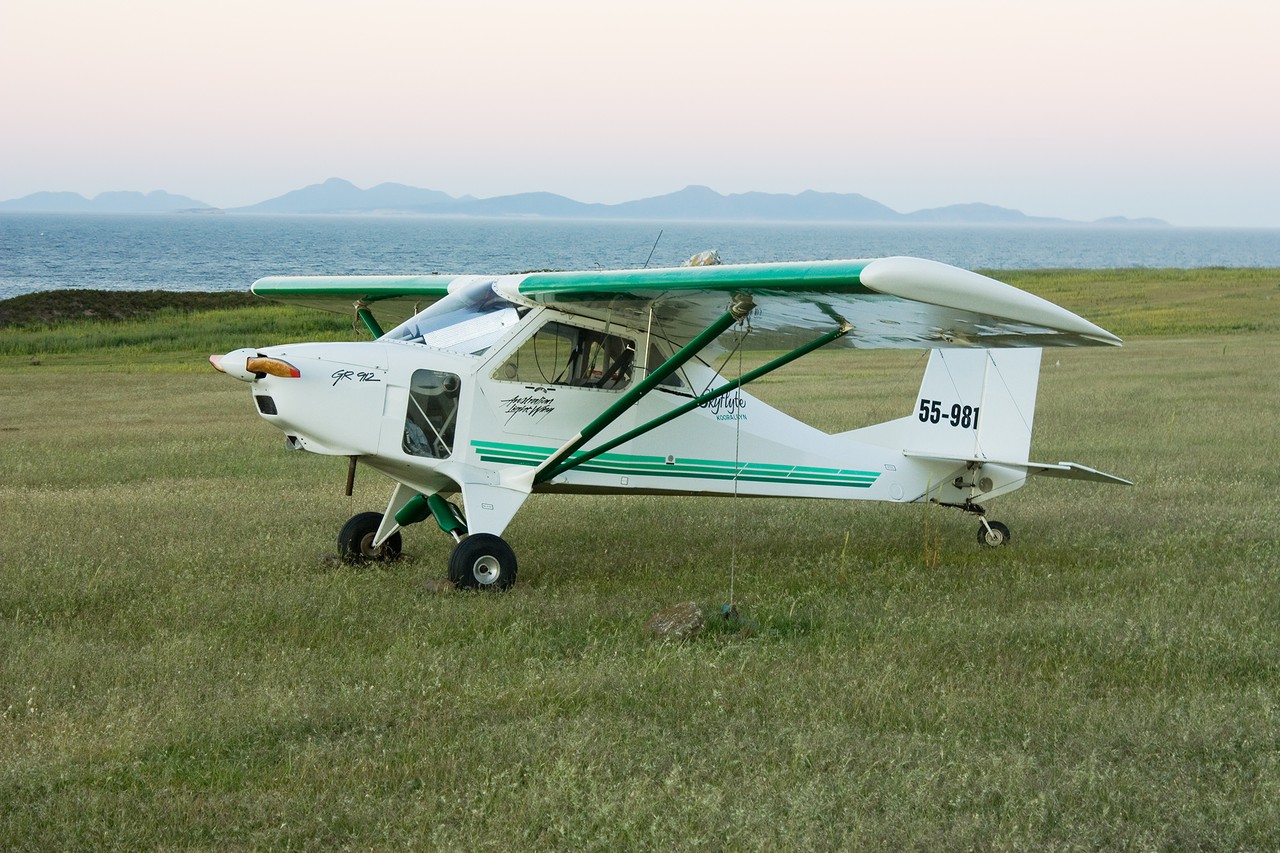
Development and Design Innovation
The GR-912 emerged from Howard Hughes Engineering's expansion into aircraft manufacturing during the mid-1980s ultralight aviation boom. Originally established in West Ballina, Australia as a boat-building operation in the mid-1970s, the company pivoted to aircraft design in 1985 when new ultralight regulations created market opportunities. The design team developed the GA-55 prototype, which completed its maiden flight in June 1986, followed by the amateur-built GR-912 prototype (registration VH-OVW, construction number 155) in March 1987.
The aircraft's most significant innovation lay in its structural approach. While most 1980s ultralights relied on aluminum tubing and Dacron sailcloth, Hughes Engineering chose welded 4130 steel tubing for the fuselage and tail unit, covered with Ceconite fabric. This construction method provided superior durability for bush operations while maintaining the weight requirements for microlight certification under Australia's ANO 101-28 regulations.
Manufacturing and Production
Production commenced in earnest following the prototype flights, with the first kit-built aircraft taking to the air in 1988. The Ballina facility established consistent manufacturing output, with documented production reaching manufacture number 100 by January 18, 1993, and continuing through the 1990s with aircraft number 116 completed on November 17, 1994. By 2014, Howard Hughes Engineering had delivered more than 150 LightWing series aircraft across nearly three decades of continuous production.
The company's manufacturing philosophy centered on providing complete kits for amateur construction, supporting Australia's growing homebuilt aircraft community. Each aircraft featured a fuel capacity of 60 liters (13.2 Imperial gallons) and offered remarkable configuration flexibility with options for tailwheel, tricycle gear, floats, or skis depending on operational requirements.
Powerplant and Performance
The GR-912 designation reflects its primary powerplant: the Austrian-manufactured Rotax 912 engine. This four-cylinder, horizontally-opposed engine produces 80 horsepower (60 kW) through liquid and air cooling systems. The reliable four-stroke design represented a significant advancement over earlier two-stroke engines like the Rotax 532 and 582, eliminating the need for fuel-oil premixing and providing improved reliability for extended operations.
Engine variants included the 912UL at 80 horsepower and the more powerful 912ULS producing 100 horsepower (75 kW). The dual ignition system and proven durability made the Rotax 912 series ideal for the demanding conditions of Australian bush flying, where aircraft often operate from unprepared airstrips far from maintenance facilities.
Operational Service
The GR-912 found its primary market among private pilots and amateur builders throughout Australia. Registration records from 1988 to 1994 show aircraft operating across New South Wales, Queensland, Victoria, South Australia, and Tasmania, with tail numbers ranging from 25-0158 to 55-981. The type proved particularly popular for recreational flying and bush operations, where its short-field capabilities and rugged construction provided distinct advantages.
One notable variant, dubbed the "Pocket Rocket," featured single-seat configuration for demonstration purposes. The aircraft's versatility extended to float operations, with several examples configured as amphibians for Australia's extensive coastal and inland waterways.
International Recognition
In 1996, Howard Hughes Engineering achieved international recognition when Shanghai Feiten Light Plane Company negotiated licensing rights to manufacture the related GR-582 variant in China as the SB-582. This agreement demonstrated the design's global appeal and technical merit beyond the Australian market.
Company Evolution
Howard Hughes Engineering evolved into Australian Lightwing, continuing aircraft production into the 21st century. The company expanded its offerings to include the GR-912-LSA variant, meeting light sport aircraft certification requirements introduced in the 2000s. This adaptation ensured the design's continued relevance as aviation regulations evolved.
Legacy and Current Status
The GR-912's legacy lies in its successful integration of marine-industry construction techniques into ultralight aviation. The steel-tube fuselage approach influenced subsequent designs and demonstrated that durability need not compromise ultralight aircraft performance. Examples remained active well into the 2000s, with aircraft number 023 documented operating from Cobar and Moruya, New South Wales in 2003.
The design's significance extends beyond production numbers to its role in establishing Australian ultralight manufacturing capabilities. As one of the earliest successful microlight designs to achieve sustained production, the GR-912 helped prove the viability of the amateur-built aircraft market in Australia and demonstrated that small manufacturers could compete effectively in the emerging sport aviation sector.