
Development and Design Origins
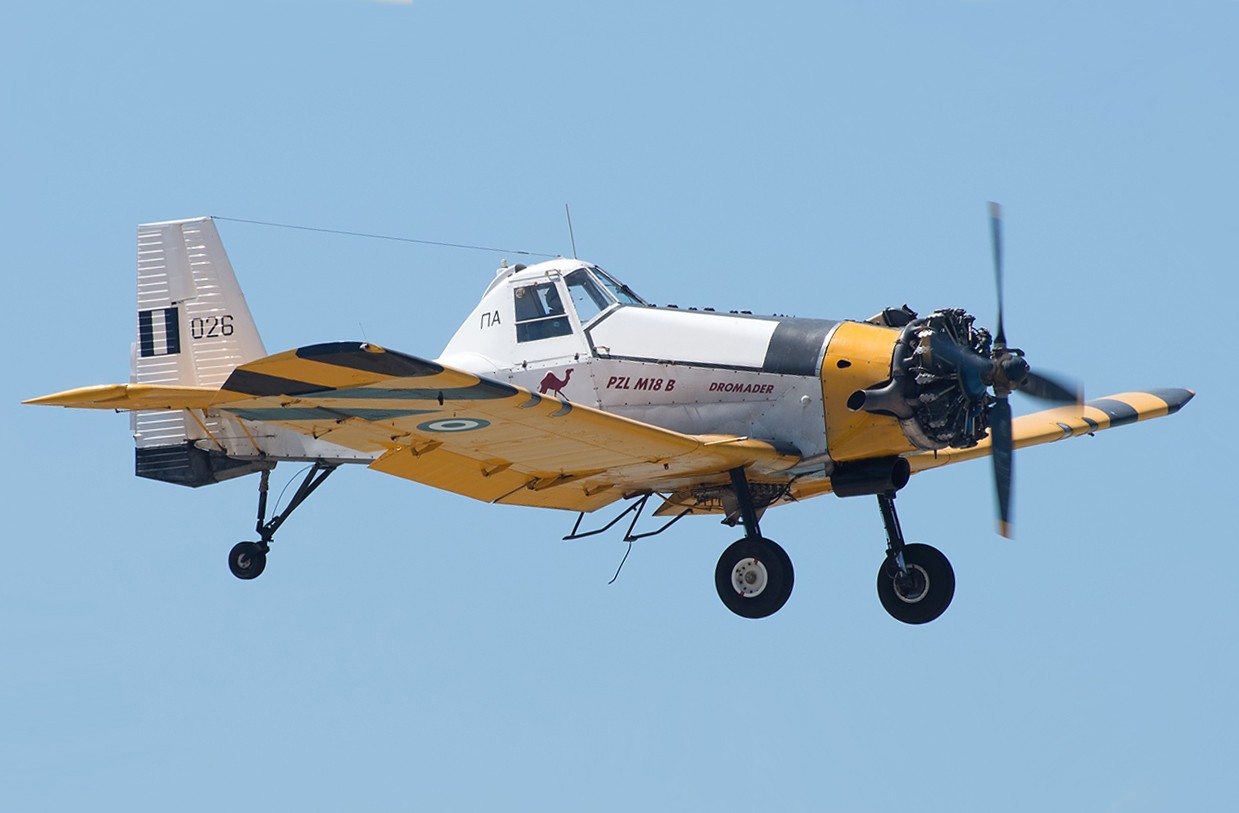
The M-18 Dromader emerged from an ambitious collaboration between Polish state enterprise WSK-Mielec and American manufacturer Rockwell International during the mid-1970s. The partnership aimed to create a heavy-duty agricultural aircraft by adapting Rockwell's Thrush Commander design with Polish engineering expertise. The development team incorporated the powerful ASz-62 radial engine manufactured by WSK "PZL-Kalisz" and significantly enlarged the airframe to achieve unprecedented payload capacity for the agricultural aviation market.
Experimental test pilot Andrzej Pamuła conducted the maiden flight on August 27, 1976, at Rzeszów-Jasionka airport, marking the beginning of what would become Poland's most internationally successful aircraft program. The prototype was publicly unveiled at the 1977 Paris Air Show, generating immediate international interest. Polish certification followed on September 1, 1978, with serial production commencing the same year.
Technical Innovation and Performance
The M-18's design centered around the robust PZL Kalisz ASz-62 nine-cylinder air-cooled radial engine, delivering 731 kilowatts (980 horsepower) through a four-bladed PZL Warszawa AW-2-30 constant-speed aluminum propeller measuring 3.3 meters in diameter. This powerplant configuration provided exceptional lifting capability for the aircraft's primary mission of carrying heavy chemical loads to remote agricultural areas.
The standard M-18 accommodates a single pilot, while variants like the M-18A and M-18BS feature two-seat configurations for pilot training or technical specialist transport. The aircraft's chemical hopper can handle up to 2,500 liters of liquid or 2,200 kilograms of dry chemicals, with fuel capacity reaching 510 kilograms maximum. The M-18T turbine variant, developed by Melex USA and operational since 1986, substitutes the radial engine with a Pratt & Whitney PT6A TPE331-10A turboprop for enhanced performance.
Manufacturing and Production Success
WSK-Mielec, later renamed Polskie Zakłady Lotnicze Mielec (PZL-Mielec), manufactured between 759 and 765 M-18 series aircraft at their Mielec, Poland facility from 1978 through the 1990s. Production variants included the baseline M-18, improved M-18A, advanced M-18B (first flown in 1993), and the M-18C (introduced in 1995). The M-18BS trainer variant featured reduced payload capacity of 700 kilograms to accommodate instructional equipment.
Sales continued as late as 2012 for M-18B and M-18BS models, though production officially ceased by 2017. The company, acquired by Lockheed Martin in 2007, continues offering refurbishment services with new ASz-62 engines from WSK "PZL-Kalisz." Production rights renewal has been planned by WZL-2 in Bydgoszcz, indicating potential future manufacturing resumption.
Global Market Penetration
The Dromader achieved remarkable international success, with exports reaching over 20 countries and establishing Poland as a significant player in specialized aviation markets. The United States became the largest operator with more than 200 aircraft, while China acquired 15 units in 2008. Other major operators included Argentina, Australia, Brazil, and Canada. A 1996 contract aimed to establish a Brazilian assembly plant, demonstrating the aircraft's global appeal.
Poland's own firefighting service, ZUA, purchased 84 units beginning in 1980, retaining 25 aircraft as of recent records. Australian operators have performed notable conversions, including the turbine-powered VH-FVF converted from former East German registration DDR-TLT by Delta Turbine Conversions.
Operational Legacy and Current Status
The M-18 Dromader proved particularly valuable in firefighting operations due to its ability to carry substantial water or fire retardant loads while operating from rough, unprepared airstrips. The aircraft's robust construction and reliable powerplant made it suitable for demanding agricultural operations in remote locations worldwide, often under challenging weather conditions and limited maintenance infrastructure.
More than 200 M-18s remain active globally as of recent assessments, with many receiving engine and avionics upgrades to extend operational life. The aircraft's success inspired several derivative projects, including the unproduced M-21, M-24, and M-25 variants, and influenced Iran's AVA-303 license-built version. The Dromader stands as testimony to Eastern Bloc engineering capability competing successfully in Western markets during the Cold War era, representing one of Poland's most significant contributions to international aviation.