
Service History
The MB.308 dominated Italy's post-war aviation training programs, with the Italian Air Force receiving 81 aircraft in 1948 for primary training and liaison duties. These aircraft served continuously until 1954, when they were retired from military service. Beyond military operations, the Italian Air Force leased MB.308s to the nation's aeroclubs, creating a comprehensive pilot training network that helped rebuild Italy's aviation capabilities after World War II.
International operators recognized the aircraft's training value, with the Egyptian Air Force, Lebanese Air Force, and Argentine National Gendarmerie all adopting the type for pilot instruction and liaison missions. The aircraft's simple design and reliable Continental powerplant made it particularly suitable for nations seeking cost-effective training solutions.
The Manufacturer
Aeronautica Macchi, founded in Varese, Italy, emerged from World War II seeking to rebuild its reputation through civilian aircraft production. The company had established itself as a significant manufacturer of seaplanes and fighters during the war years, but the MB.308 represented its transition to peacetime aviation markets.
The manufacturer underwent significant changes in subsequent decades. In July 2003, Aeronautica Macchi merged with Finmeccania and was renamed Aermacchi within Alenia. At the beginning of 2016, Alenia Aermacchi was fully integrated into Leonardo S.p.A.'s Aeronautics sector, where it continues operations as part of one of Europe's major defense and aerospace companies. This evolution from a standalone Italian manufacturer to a division of a multinational corporation reflects the consolidation trends in European aerospace.
Design and Engineering
Ermanno Bazzocchi, the chief engineer at Aeronautica Macchi, designed the MB.308 as part of a series that would later include the MB.323 and the highly successful MB.326 jet trainer. The "MB" designation honored both the manufacturer (Macchi) and the designer (Bazzocchi), establishing a naming convention that would continue throughout the company's product line.
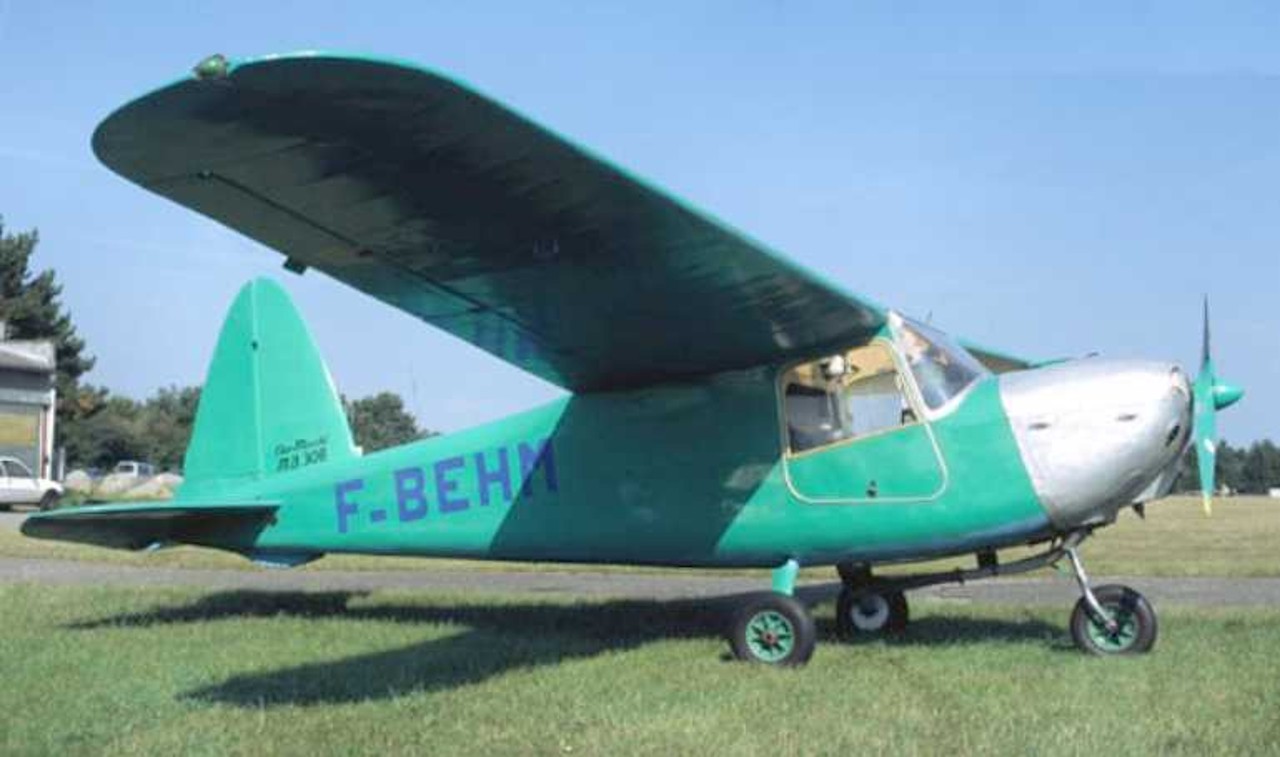
Bazzocchi's design philosophy emphasized practicality and cost-effectiveness. The MB.308 featured conventional high-wing configuration with fixed tricycle landing gear, providing excellent stability for student pilots. The all-wood construction reduced manufacturing costs while maintaining structural integrity, though this choice would later prove problematic for long-term durability in varying climates.
Engine and Technical Specifications
The MB.308 utilized Continental air-cooled flat-four piston engines across its variants. The original MB.308 was powered by either an 85-horsepower or 90-horsepower Continental engine, providing adequate performance for training missions. The improved MB.308G featured a 90-horsepower Continental C90, while the Argentine MB.308-100 variant incorporated a more powerful 100-horsepower Continental O-200-A engine.
With an empty weight of 410 kilograms and maximum gross weight of 650 kilograms, the MB.308 achieved a maximum speed of 197 kilometers per hour and cruised at 164 kilometers per hour at 70 percent power. The aircraft's 80-liter fuel capacity provided a range of 760 kilometers, sufficient for extended training flights. Its service ceiling of 4,500 meters and ability to reach 1,000 meters altitude in six minutes demonstrated adequate performance for its intended role.
Production Variants and International Development
Macchi produced 137 examples of the original two-seat MB.308 variant between the late 1940s and early 1950s. The company also developed the MB.308 Idro, a seaplane version that expanded the aircraft's operational versatility, and the MB.308G, which added a third seat behind the main side-by-side configuration.
The most significant international development occurred in Argentina, where German Bianco, a sailplane manufacturer, produced the MB.308-100 under license. This variant featured the more powerful Continental O-200-A engine and incorporated local manufacturing techniques. Approximately 46 Argentine examples were completed, representing about 25 percent of total MB.308 production.
Legacy and Impact
The MB.308's significance extended beyond its production numbers, serving as a foundation for Italy's post-war aviation recovery. The aircraft provided essential training for hundreds of pilots across multiple nations, contributing to the rebuilding of aviation expertise that had been disrupted by World War II.
More importantly, the MB.308 established Macchi's credibility in the international training aircraft market. This reputation proved crucial for the later success of the MB.326 jet trainer, which became Italy's first major post-war aviation export success with over 760 aircraft produced and sold worldwide. The MB.326's international dominance in the training aircraft sector for over two decades can be traced directly to the foundation established by the humble MB.308.
Today, surviving MB.308 examples are rare, with most having been retired due to the deterioration of their wooden structures. However, the aircraft's contribution to aviation training and its role in establishing Italy as a significant player in the international aerospace market ensures its place in aviation history.