
Service History
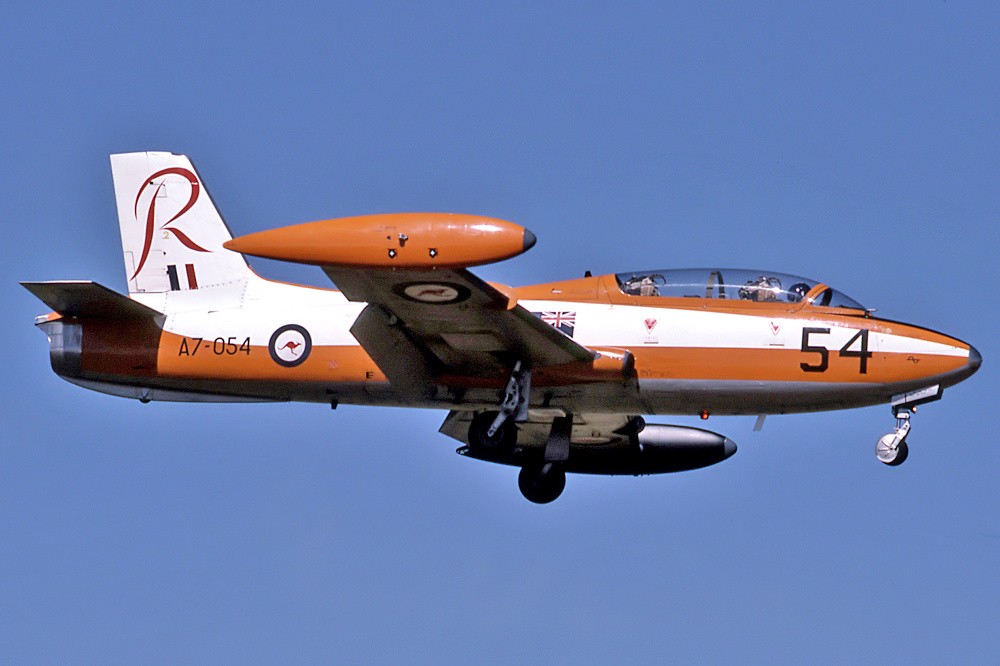
The MB-326 achieved remarkable international success, serving with more than 10 air forces across four continents. The Italian Air Force received 118 aircraft starting in 1962, followed by major operators including Australia with 97 units (1967-1972), South Africa with 151 aircraft from 1966, and Brazil with 166 examples beginning in 1971. The type also equipped the air forces of Argentina, Dubai, Ghana, Tunisia, Zaire, and Zambia, demonstrating its versatility and reliability in diverse operating conditions.
South Africa's MB-326Ms, designated Impala, saw combat during border conflicts in the 1970s and 1980s, operating as light attack aircraft with underwing weapons pylons. The South African Air Force also selected the type for their prestigious Silver Falcons aerobatic demonstration team, showcasing the aircraft's exceptional handling characteristics.
The Manufacturer
Aermacchi (Officine Aeronautiche Macchi) of Varese, Italy, launched the MB-326 as a private venture in 1953. Founded in 1912, the company had produced over 7,000 aircraft throughout its history, including renowned World War II fighters like the MC.202 and MC.205. During the 1960s, Fiat acquired Aermacchi, later forming Aeritalia through various mergers. The company's lineage continues today under Leonardo S.p.A. (formerly Finmeccanica), which remains active in aerospace manufacturing.
The success of the MB-326 led to extensive licensed production agreements. Commonwealth Aircraft Corporation manufactured the type in Australia, Atlas Aircraft Corporation produced it in South Africa, and Embraer built variants in Brazil, demonstrating the design's international appeal and adaptability to different manufacturing environments.
Design and Development
Ermanno Bazzocchi led the design team at Aermacchi, creating an aircraft specifically intended as an affordable advanced jet trainer with light strike capability. The Italian Air Force's need for a modern training aircraft during the jet transition era drove the initial 1950 proposal. Bazzocchi's team selected a lightweight all-metal structure featuring tandem seating with ejection seats and a pressurized cockpit for high-altitude operations.
The first prototype took flight on December 10, 1957, followed by the second aircraft in September 1958. Tragically, the program suffered an early setback when the first prototype crashed on April 22, 1959, killing test pilot Nicola Macchia. Despite this loss, development continued successfully.
Engine and Technical Innovation
The MB-326 utilized various marks of the Rolls-Royce Viper turbojet engine series, originally developed by Armstrong Siddeley before Rolls-Royce's acquisition of the company. The prototype employed the Viper 8 producing 794 kg of thrust, while production aircraft used progressively more powerful variants including the Viper 11 (1,134 kg thrust), Viper 20 (1,547 kg/3,410 lbf), and specialized versions like the Viper 20-540 and Viper 632-43.
These engines proved remarkably reliable, far exceeding their original design expectations as powerplants for short-life drones. The uprated Viper 20 enabled later variants to carry double the external ordnance load through larger air intakes and reinforced airframe structures.
Performance and Variants
The MB-326 demonstrated impressive performance capabilities, achieving a maximum speed of 750 mph at high altitude and 375 mph at low level. On March 18, 1966, the aircraft set an altitude record of 56,807 feet (17,315 meters), showcasing its exceptional climb performance and robust pressurization system.
Multiple variants emerged to meet different operational requirements. The basic MB-326 served as the foundation, while the MB-326H was developed for Australia, the MB-326K featured cannon armament for export customers, and the MB-326M was produced for South Africa. The MB-326G and MB-326GC variants, built primarily for Brazil, incorporated uprated engines and could carry ordnance on up to six underwing pylons.
Military variants could be equipped with British Aden or French DEFA cannons with 125 rounds per gun, transforming the trainer into an effective light attack aircraft. This dual-role capability made the MB-326 particularly attractive to air forces seeking maximum versatility from their aircraft investments.
Production and Legacy
Production spanned nearly 25 years from the late 1950s into the early 1980s, with manufacturing distributed across four countries. Italy produced the majority of aircraft at Aermacchi facilities, while licensed manufacturers contributed significantly: Atlas built 105 of South Africa's 151 aircraft, Commonwealth Aircraft Corporation produced 67 of Australia's 97 examples (with 9 more assembled from kits), and Embraer manufactured 130 of Brazil's 166 aircraft.
The MB-326's success directly influenced subsequent trainer designs, most notably Aermacchi's own MB-339 successor. Today, examples continue flying as warbirds, with preserved aircraft displayed at institutions like the Estrella Warbirds Museum in the United States. The type's cultural impact extends beyond aviation, with appearances in various films documented by the Internet Movie Plane Database, cementing its place in both military and popular history.