
Service History
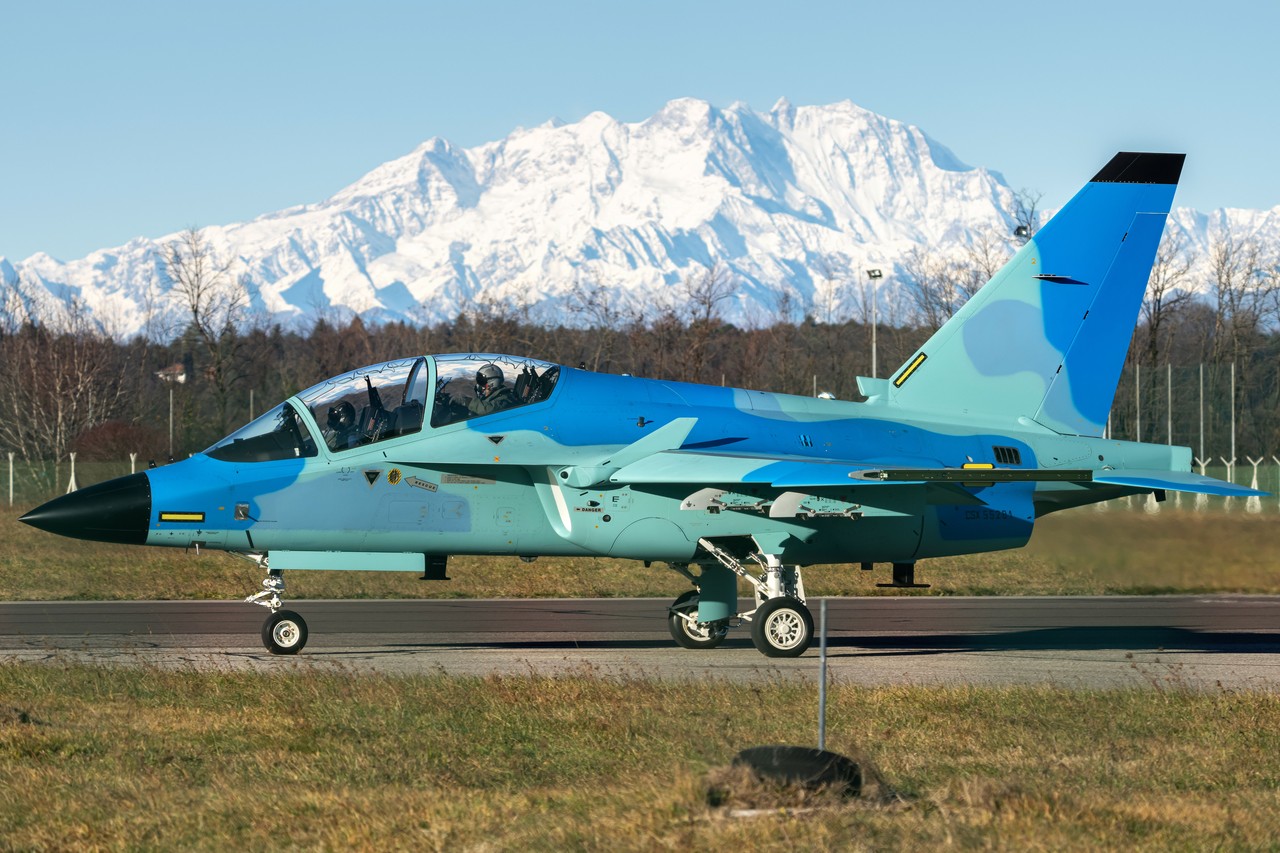
The M-346 Master has established itself as a premier advanced jet trainer across multiple air forces worldwide. Since entering service in 2015 with the Italian Air Force's first training course, the aircraft has proven its effectiveness in preparing pilots for fourth and fifth-generation fighters. Seven nations currently operate the type, including Italy with 22 aircraft in service, Israel where it flies under the designation "Lavi," and Singapore, Poland, Greece, Qatar, and Turkmenistan.
The aircraft's operational significance reached new heights in September 2024 when Italy's elite Frecce Tricolori aerobatic demonstration team selected the M-346 to replace their aging MB-339 aircraft. This prestigious assignment required Italy to order 15 specialized T-346 PAN variants specifically configured for aerobatic display work, alongside five additional T-346A trainers, bringing the Italian Air Force's total commitment to 42 aircraft.
Development Origins
The M-346's development began as an international collaboration between Italy's Alenia Aermacchi and Russia's Yakovlev design bureau in the mid-1990s. Initially designated the Yak/AEM-130D, the project received Russian funding in February 1996, with Moscow pledging to purchase up to 200 aircraft for the Russian Air Force. However, the partnership dissolved in 2000, leading to divergent development paths: Yakovlev continued with the Yak-130 while Aermacchi independently developed the M-346.
The first prototype rolled out on June 7, 2003, at Alenia Aermacchi's Venegono Superiore facility. Following extensive ground testing, chief test pilot Quirino Bucci lifted the M-346 into the air for its maiden flight on July 15, 2004. The test program proved rigorous, with development aircraft completing 200 flights and over 3,300 test points within five months.
Technical Achievement
On December 18, 2008, the M-346 achieved a historic milestone by reaching Mach 1.15 (780 mph), becoming the first all-Italian aircraft to break the sound barrier in 50 years. This supersonic capability distinguishes the M-346 from most advanced trainers, allowing student pilots to experience transonic flight characteristics in a controlled training environment.
The aircraft's twin Honeywell F124-GA-200 turbofan engines each produce 6,250 pounds of thrust, providing a combined 12,500 pounds of power. These non-afterburning engines offer excellent fuel efficiency while delivering the performance necessary for advanced tactical training scenarios. The side-by-side seating configuration allows instructors to closely monitor student progress while maintaining full aircraft control.
The Manufacturer
Alenia Aermacchi, the M-346's original manufacturer, traces its heritage to the legendary Macchi company that produced fighter aircraft during both world wars. Through a series of mergers and acquisitions, the company became part of Finmeccanica in 2016, which subsequently rebranded as Leonardo S.p.A. in 2017. Today, Leonardo stands as one of Europe's largest aerospace and defense contractors, with the M-346 representing a cornerstone of its military aircraft portfolio.
Leonardo's Venegono Superiore facility continues M-346 production, having delivered 80 aircraft as of recent counts. The company has invested heavily in advanced manufacturing techniques and continues to develop new variants, including a light attack version capable of carrying external ordnance.
Operational Characteristics
Pilots praise the M-346's fighter-like handling characteristics and modern glass cockpit, which features multifunction displays and hands-on-throttle-and-stick (HOTAS) controls similar to frontline combat aircraft. The aircraft's 1,243-mile range allows for extended training missions without refueling stops, while its 44,948-foot service ceiling enables high-altitude tactical training scenarios.
The M-346's fly-by-wire flight control system provides artificial stability and protection against departure from controlled flight, allowing student pilots to safely explore the aircraft's performance envelope. Advanced simulation systems can replicate the handling characteristics of various fighter aircraft, providing cost-effective training that would otherwise require expensive operational fighters.
Production Success
The Italian Air Force led M-346 procurement with an initial order for six aircraft in June 2009, followed by additional contracts that have grown their fleet to 22 operational aircraft. The program achieved military type certification from Italy's Ministry of Defence on June 20, 2011, clearing the way for international sales.
Production has remained steady since 2004, with Leonardo delivering aircraft at a rate of approximately four to six units annually. The December 2024 Italian order for 20 additional aircraft demonstrates continued confidence in the platform and ensures production will continue well into the next decade. International interest remains strong, with several nations evaluating the M-346 for their advanced training requirements.