
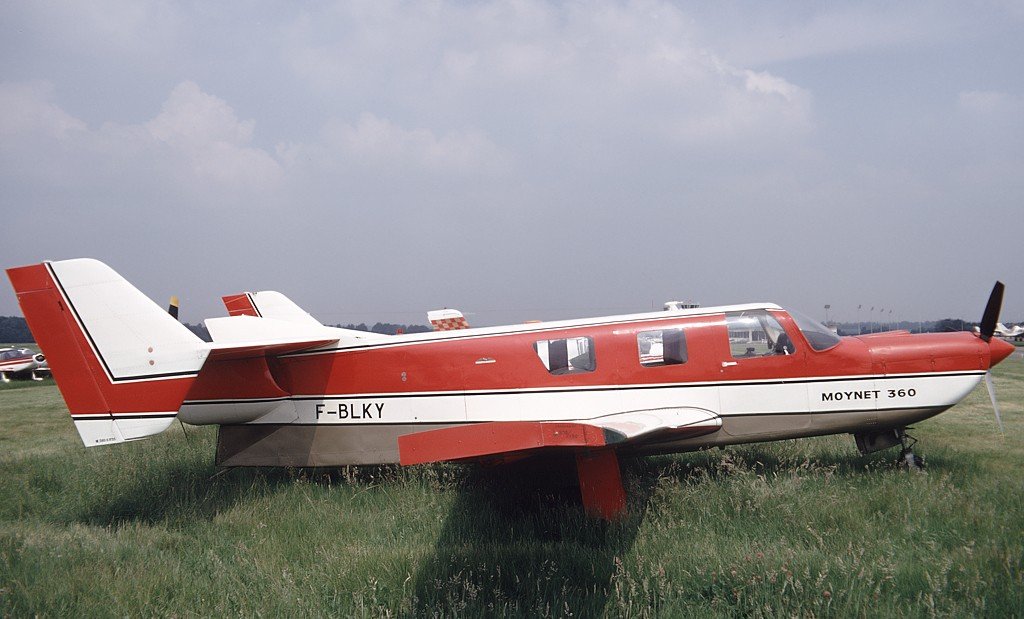
Design Innovation
The M-360 Jupiter emerged from the creative mind of André Moynet, a French Member of Parliament, test pilot, and former government minister who sought to create a safer alternative to conventional twin-engine aircraft. Moynet's centerline thrust design placed one Lycoming engine in the nose pulling the aircraft forward, while a second engine mounted in the rear fuselage pushed from behind. This configuration eliminated the asymmetric thrust problems that plagued conventional twins during single-engine operations, making the Jupiter significantly safer for pilots with limited twin-engine experience.
The design drew inspiration from the Cessna 336 Skymaster but emphasized superior single-engine performance and simplified construction. Moynet incorporated a wide tailplane spanning 44 percent of the aircraft's wingspan, strategically positioned to avoid propeller wash from either engine. The cabin featured advanced soundproofing, air conditioning, and provisions for optional pressurization in planned variants.
Development and Testing
S.A. Engins Matra constructed the first prototype, designated M 360-4, in just five months during 1963. The aircraft made its public debut as a static display at the Paris Air Show in May 1963, generating considerable interest from potential customers. On December 17, 1963, test pilot André Moynet and co-pilot Lucien Tieles conducted the maiden flight from Villacoublay, with the prototype registered as F-WLKE.
The initial M 360-4 featured twin 200-horsepower Lycoming IO-360-A1A four-cylinder engines driving two-bladed propellers. This configuration provided seating for four to five passengers in addition to the pilot. Performance testing revealed a maximum speed of 211 mph, a service ceiling of 22,474 feet, and a range of 1,013 miles with a climb rate of 1,457 feet per minute.
Matra soon began work on an enlarged variant, the M 360-6, initially designated Moynet 700. This stretched version increased the fuselage length by 25 inches and extended the wingspan by 15 inches to accommodate six to seven passengers. More powerful 290-horsepower Lycoming IO-540 six-cylinder engines replaced the smaller powerplants, driving three-bladed Hartzell constant-speed propellers. The M 360-6 prototype, registered F-WLKY, completed its first flight on May 25, 1965.
The Manufacturer
S.A. Engins Matra originated as an automotive and aerospace firm founded in 1937 by Marcel Chassagny. Following World War II, Matra expanded aggressively into missiles, space technology, and aircraft manufacturing, establishing a reputation for innovative engineering. The company contributed to France's prestigious Concorde supersonic transport program through various subsidiaries and maintained significant involvement in the European space program.
Despite Matra's technical capabilities, the company's corporate structure underwent dramatic changes during the following decades. Matra Aerospace merged with British Aerospace Corporation to form Matra Marconi Space in 1990. Through subsequent acquisitions and reorganizations, the entity eventually became part of EADS, now known as Airbus. The original Matra company ceased independent aircraft production, though its legacy continues through modern Airbus divisions.
Production Challenges
Despite initial enthusiasm and advanced engineering, the Jupiter program faced insurmountable commercial obstacles. Sud-Aviation received a contract for series production of the M 360-6, including a pre-production order from the French government. However, these arrangements collapsed before any production aircraft were completed. Marketing efforts in Europe and the United States failed to generate sufficient orders to justify tooling costs for mass production.
The cancellation proved particularly disappointing given the aircraft's innovative design and promising performance characteristics. Planned variants included the M 360-P with cabin pressurization, the ambitious Moynet 2000 combining a Turboméca Astazou turboprop with a Pratt & Whitney JT12A-6 turbojet, and the Sud-Aviation Présidence executive variant. None of these derivatives progressed beyond the planning stage.
Legacy and Preservation
The Jupiter's legacy rests primarily on its demonstration of centerline thrust feasibility in light aircraft design. While Cessna's later success with the Skymaster series validated the basic concept, Moynet's approach offered several theoretical advantages that never received full commercial exploration.
Both Jupiter prototypes survive today as historical artifacts. The M 360-4, re-registered as F-BLKE, resides in the reserve collection of the prestigious Musée de l'Air et de l'Espace at Le Bourget Airport near Paris. The M 360-6 underwent restoration at the Musée Regional de l'Air at Angers-Loire Airport, returning to flying condition in 2018 as the world's only airworthy Jupiter. A 2013 restoration project aimed to have the aircraft flying by 2015 to commemorate the 50th anniversary of its first flight.
The Jupiter represents a fascinating chapter in French experimental aviation history, demonstrating how innovative engineering concepts can succeed technically while failing commercially. Its preservation ensures that future generations can study this unique approach to twin-engine aircraft design.