
Development and Design Innovation
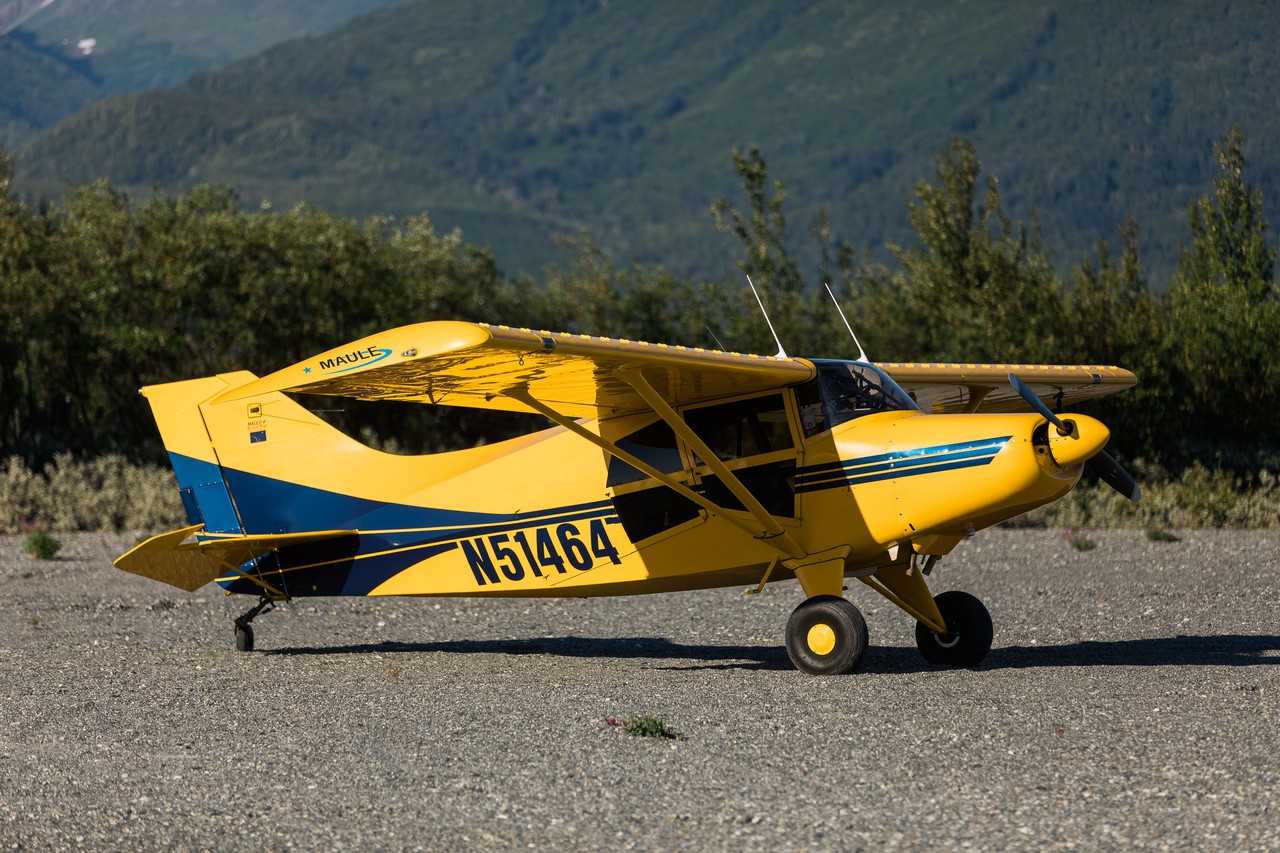
Belford D. Maule designed the M-5 series in the early 1970s as an evolution of his successful M-4 design, incorporating significant improvements that would define modern STOL aircraft. Two prototypes took to the skies in 1971, one powered by a 210-horsepower engine and another with 220 horsepower, leading to type certification on December 28, 1973. The design featured a 30 percent increase in flap area compared to the M-4, enlarged tail surfaces, and innovative battery relocation that dramatically improved the center-of-gravity range.
The M-5's steel-tube fuselage construction, covered with a combination of fabric and metal, provided exceptional durability for rough-field operations. The swept-back fin and rudder design, combined with 18-inch-longer flaps than its predecessor, delivered the superior slow-speed handling characteristics that made the aircraft legendary among bush pilots. Four cabin doors provided unprecedented cargo access, while the fixed tailwheel configuration maintained simplicity and reduced maintenance requirements.
Production Success
Maule Aircraft Corporation launched M-5 production in 1974 alongside the M-4 series, establishing the aircraft as a cornerstone of American general aviation. Initial production ran until 1975, with a redesigned version entering production in 1979 and continuing through at least 1988. The most successful variant, the M-5-235C Lunar Rocket, accounted for more than 379 aircraft alone, while the M-5-210C contributed 206 units and the M-5-220C added 57 aircraft to the total.
By 1974, growing demand from bush pilots and law enforcement agencies created a backlog extending into November, with annual production reaching 120 units. The aircraft's reputation for ruggedness and STOL performance drove consistent orders throughout the 1970s and 1980s, contributing to the overall Maule family production total of approximately 1,600 to 1,700 aircraft by 1991.
Engine Variants and Performance
The M-5 series offered remarkable versatility through multiple engine options, each optimized for specific mission requirements. The M-5-180C Lunar Rocket utilized a 134-kilowatt Avco Lycoming O-360-C1F carbureted engine, delivering a power-to-weight ratio of 12.8 pounds per horsepower and climb rates of 900 feet per minute. The M-5-220C variant featured a fuel-injected 164-kilowatt Franklin 6A-350-C1 engine with 350 cubic inches of displacement, achieving impressive climb rates of 1,250 feet per minute and service ceilings of 19,000 feet.
The flagship M-5-235C Lunar Rocket employed a 175-kilowatt Lycoming O-540-J1A5D or IO-540-W1A5D engine with 541.5 cubic inches of displacement, paired with a 6-foot 6-inch Hartzell constant-speed propeller. This configuration achieved a power loading of 9.8 to 10.6 pounds per horsepower, representing the pinnacle of the series' performance capabilities. All variants maintained maximum speeds of 156 knots and cruise speeds of 126 knots, with never-exceed speeds establishing safe operational parameters.
The Manufacturer Legacy
Maule Aircraft Corporation traced its roots to Belford D. Maule's first aircraft, the M-1, constructed around 1930-1931 with a 27-horsepower Henderson motorcycle engine. The company operated from Moultrie, Georgia, after relocating there in 1968, where the M-series design first flew in 1958 from prototype roots. By 1974, when M-5 production began, Maule had already built 472 total aircraft in Georgia, establishing a reputation for quality and innovation.
The company initially planned kit production in 1960 but shifted to complete aircraft manufacturing, a decision that proved crucial to the M-5's success. Maule Aircraft evolved through various iterations, producing the M-6 series until 1991, briefly manufacturing the M-8 in 1993, and continuing with newer models. Today, the company operates as Maule Air, Inc., maintaining production facilities in Georgia and preserving the legacy of American STOL aviation.
Operational Excellence
The M-5 series found its primary market among private owners, bush pilots, and law enforcement agencies who valued its exceptional short-field capabilities and cargo versatility. The aircraft's ability to operate from unprepared strips with landing stall speeds around 32 knots opened previously inaccessible territories to aviation. Standard fuel capacity of 43 gallons, expandable to 63 gallons with auxiliary tanks, provided the range necessary for extended backcountry operations.
Typical operations included one pilot and three to four passengers in two side-by-side rows, with 250 pounds of baggage capacity distributed through the four-door cargo access system. Wing loading of 14.6 to 15.8 pounds per square foot contributed to the aircraft's gentle handling characteristics and ability to operate safely at slow airspeeds.
Continuing Legacy
Hundreds of M-5 aircraft remain active today, testament to the design's durability and continuing relevance in modern aviation. Notable examples include M-5-235C registration VH-BRW (construction number 7229C) operating in Australia and N221X serving in Alaska, representing the global reach of Maule's influence on utility aviation. The success of the M-5-235C variant, with its production total exceeding 379 aircraft, established benchmarks for affordable, rugged STOL taildraggers that continue to influence aircraft design today.
The M-5 series pioneered the concept of accessible backcountry aviation, making remote locations reachable for recreational and commercial operators worldwide. Its influence extends through Maule's continuing production lineage, inspiring generations of pilots and demonstrating that innovative design and practical engineering create lasting aviation legacies.