
Design Evolution and Innovation
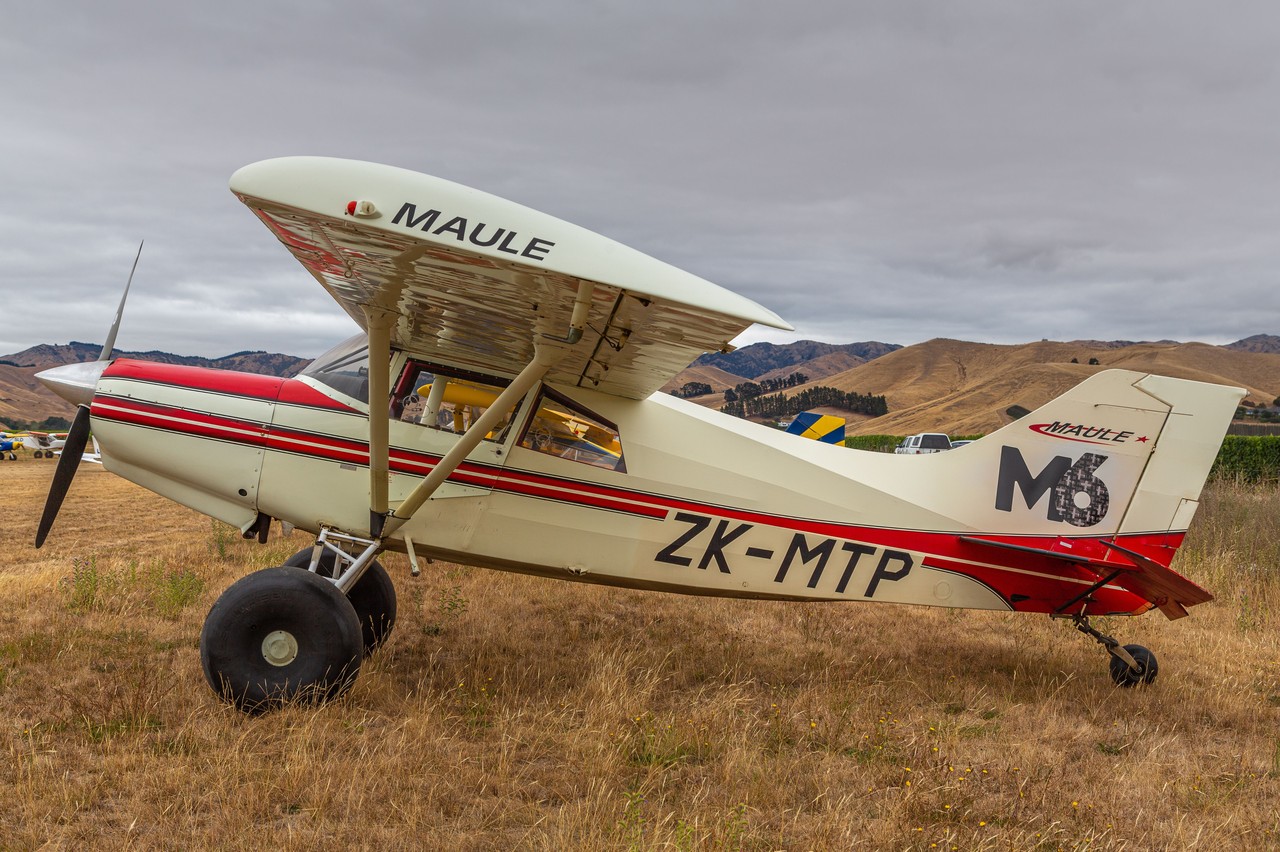
The M-6 Super Rocket emerged from Belford D. Maule's response to pilot demands for enhanced performance beyond what the successful M-5 Lunar Rocket could provide. Maule's design philosophy centered on adding "more wing" to achieve superior short-field capabilities, resulting in wings that stretched two feet four inches longer than the M-5's span. This extension reduced stall speed by 10.5 knots and transformed the aircraft's low-speed handling characteristics.
The M-6's flap system represented a significant advancement over its predecessor, featuring four distinct positions at 24, 40, and 48 degrees, plus a negative seven-degree cruise setting for drag reduction. This compared favorably to the M-5's simple two-position system and provided pilots with precise control over the aircraft's approach characteristics. With the M-6's certification, Maule produced comprehensive performance charts for the first time in the company's history, reflecting the aircraft's more sophisticated design approach.
The Manufacturer's Legacy
Maule Air, Inc. traced its origins to Belford D. Maule's entrepreneurial vision, beginning aircraft production in 1957 with the M-4 model. The company initially manufactured tailwheels and fabric testing equipment before transitioning to complete aircraft production. Maule's design philosophy consistently emphasized rugged construction and exceptional short-field performance, establishing the company as a leader in the specialized STOL aircraft market.
The company's production history demonstrates steady evolution, with the M-6 representing a mature phase in Maule's development. Following the M-6's production run from 1981 to 1991, Maule briefly manufactured the M-8 model in 1993 before introducing the more recent M-9 variant. Across all models, Maule produced 2,579 aircraft, testament to the enduring appeal of their specialized designs.
Engine and Technical Specifications
The M-6 Super Rocket offered operators two Continental engine options, with the 235-horsepower O-540 six-cylinder powerplant serving as the primary production variant. This engine displaced 541.5 cubic inches and featured either carburetor or fuel injection systems paired with constant-speed propellers. A smaller 180-horsepower Continental four-cylinder option provided an alternative for operators prioritizing fuel economy over raw performance.
The aircraft's structural design supported a gross weight of 2,500 pounds while maintaining an empty weight of just 1,400 pounds. This combination yielded favorable power and wing loading figures of 9.79 pounds per horsepower and 13.2 pounds per square foot respectively. These specifications directly contributed to the M-6's exceptional short-field capabilities, enabling operations from confined landing areas that challenged conventional aircraft.
Performance and Pilot Experience
Test data revealed the M-6's extraordinary capabilities, with takeoff distances measuring as short as 45 feet under optimal conditions and landing rolls of 100 feet. More conservative figures showed consistent takeoff and landing performance over 50-foot obstacles within 500 feet, making the aircraft practical for backcountry operations where precise distance calculations proved critical.
The extended wingspan and sophisticated flap system provided pilots with exceptional low-speed control authority. The negative flap setting for cruise flight demonstrated Maule's attention to efficiency, reducing drag during cross-country operations. This versatility allowed the M-6 to excel both in confined mountain strips and during longer flights between remote destinations.
Operational History and Current Status
The M-6 Super Rocket found its primary market among bush pilots, backcountry enthusiasts, and operators requiring reliable STOL performance. Unlike commercial airliners, the M-6 served specialized roles where conventional aircraft could not operate effectively. Its robust tailwheel configuration and high-wing design proved ideally suited to unprepared landing surfaces and challenging operating conditions.
Registry data confirms that M-6 aircraft remain active today, with examples registered in Canada, the United Kingdom, and other countries. Aircraft spanning the model's production years from the early 1980s through 1991 continue serving operators who value the type's unique capabilities. The aircraft's ongoing operational status reflects both its durable construction and the continuing demand for specialized STOL performance in modern aviation.
Legacy in STOL Aviation
The M-6 Super Rocket represented the culmination of Maule's early design philosophy, bridging the gap between the company's pioneering M-5 Lunar Rocket and later, more sophisticated models. Its ten-year production run established design principles that influenced subsequent Maule aircraft, particularly the emphasis on extended wingspan and sophisticated flap systems for enhanced STOL performance.
Today, the M-6 remains valued among pilots who prioritize short-field capability over speed or payload. Its continued operation in demanding environments worldwide validates Belford D. Maule's design decisions and confirms the aircraft's position as a significant contributor to specialized aviation operations.