
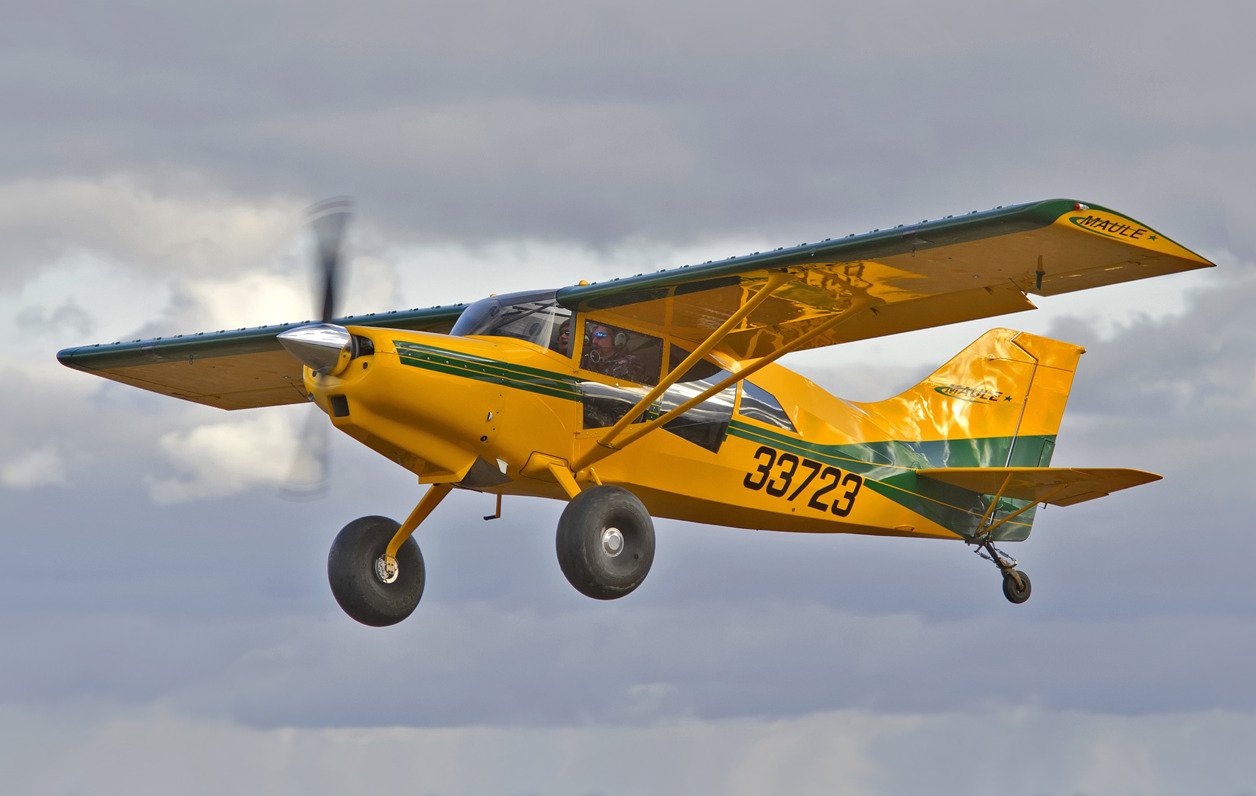
Development and Design Philosophy
The M-8 emerged during a period of experimentation at Maule Air, as the company sought to expand beyond their successful M-7 series introduced in 1983. Unlike its predecessors, the M-8 incorporated design elements that would prove controversial within Maule's traditional customer base. The aircraft featured the robust Lycoming IO-540-W1A5D powerplant, a 540-cubic-inch fuel-injected engine that delivered significantly more power than earlier Maule models.
Maule's decision to offer the M-8 with EDO float compatibility reflected the company's understanding of the bush flying market, where amphibious capability remained highly valued. However, the aircraft's brief production window suggests that market reception fell short of company expectations.
The Maule Air Legacy
Maule Air's story began with Belford D. "B.D." Maule, who received the company's first FAA type certificate in 1961. The family business delivered its inaugural production aircraft, the Jetasen M-4, in April 1962, establishing a reputation for rugged, reliable tailwheel aircraft. In 1968, recognizing the need for expanded manufacturing capacity, the company relocated to Spence Air Base in Moultrie, Georgia, a former World War II training facility that provided the space necessary for increased production.
By 2006, Maule Air had manufactured more than 2,300 aircraft, building a loyal following among bush pilots, flight training schools, and recreational aviators who valued the company's commitment to conventional landing gear configurations. This dedication to tailwheel aircraft set Maule apart in an industry increasingly dominated by tricycle-gear designs.
Technical Specifications and Performance
The M-8's IO-540-W1A5D engine represented a significant power increase over earlier Maule models, though specific performance figures remain undocumented in available records. The fuel-injected Lycoming powerplant provided reliable operation across a wide range of altitudes and temperatures, characteristics essential for the bush flying operations where Maule aircraft excelled.
The availability of EDO floats transformed the M-8 into an amphibious aircraft capable of operations from both conventional runways and water surfaces. This versatility appealed to operators in Alaska, Canada, and the northern United States, where seasonal access to remote locations often depends on amphibious capability.
Production Challenges and Market Response
Despite its technical capabilities, the M-8 failed to achieve sustained market success. Production ceased after the brief 1993 run, with total numbers remaining undocumented. The model's commercial failure led Maule Air to reconsider their product strategy, ultimately abandoning sequential model numbering for nearly a decade.
This production gap lasted until 2003, when Maule introduced the M-9-230, marking a significant departure from traditional powerplants. The M-9 became notable as the first aircraft from a U.S. manufacturer to utilize the SMA SR305 Jet A-powered diesel engine, demonstrating the company's willingness to embrace technological innovation despite the M-8's commercial disappointment.
Industry Context and Competition
The early 1990s presented significant challenges for general aviation manufacturers, as the industry struggled with liability concerns, economic recession, and changing pilot demographics. Many established companies faced financial difficulties, and experimental models like the M-8 often became casualties of conservative market conditions.
Maule's decision to discontinue the M-8 reflected broader industry trends, as manufacturers focused resources on proven designs rather than experimental variants. The company's survival through this difficult period, unlike many competitors, demonstrated the strength of their core product line and customer loyalty.
Legacy and Continuing Operations
While the M-8 represents a brief chapter in Maule Air's history, the company's willingness to experiment contributed to their long-term success. The lessons learned from the M-8's commercial failure likely influenced the more conservative approach taken with subsequent models, ensuring the company's continued operation into the 21st century.
Today, Maule Air continues manufacturing aircraft from their Moultrie facility, maintaining their position as one of the few remaining producers of new tailwheel aircraft. The M-8's brief existence serves as a reminder of the challenges facing aviation manufacturers attempting to balance innovation with market demands in an industry where proven designs often outweigh technological advancement.