
Development and Design Innovation
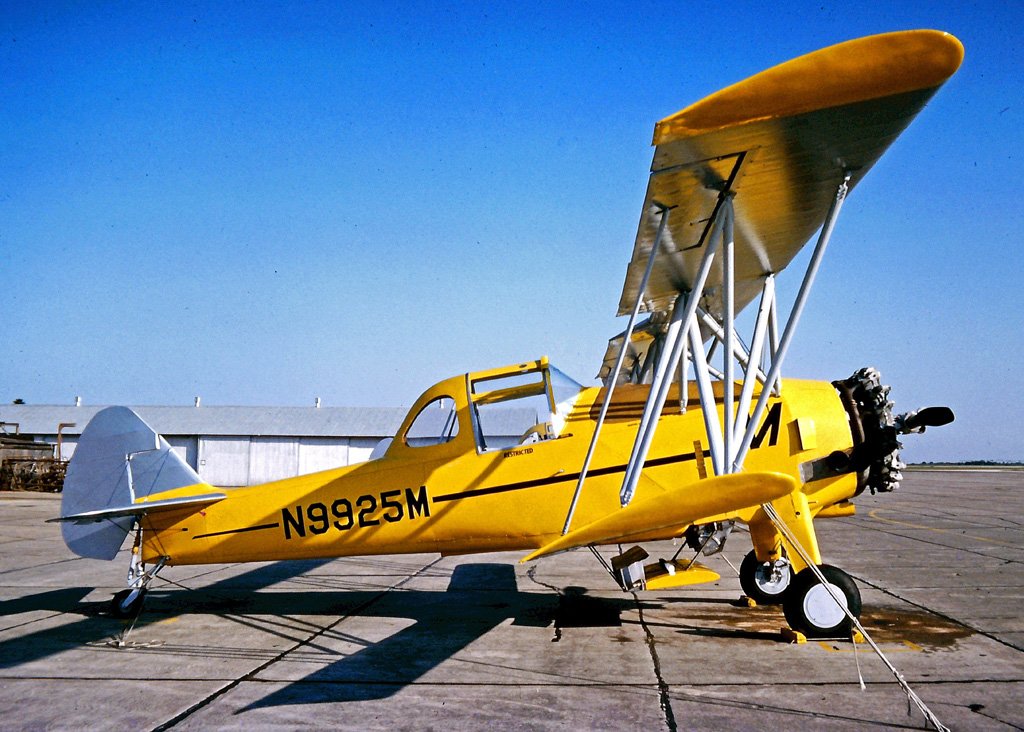
The MA-1 Paymaster emerged from an ambitious international collaboration between Hawaii-based Murrayair Ltd. and Air New Zealand, who contracted to build the prototype aircraft. The project aimed to address the growing demand for purpose-built agricultural aircraft by extensively modifying the proven Boeing Stearman 75 Kaydet airframe. Engineers replaced the original flying wires with aerodynamically efficient aerofoil-shaped struts and inserted a new aluminum center section into the upper wing, increasing total wing area from 297 to 408 square feet.
The prototype N101MA first flew on July 27, 1969, at Mangere Airport in Auckland, New Zealand, before being dismantled and shipped to Honolulu for Federal Aviation Administration certification trials. The aircraft achieved Restricted Category Type Approval on April 14, 1970, clearing the path for commercial production.
Manufacturing and Production
EMAIR operated as a manufacturing subsidiary of Murrayair Ltd., establishing production facilities in Harlingen, Texas. The company built between 25 and 28 MA-1 Paymaster aircraft from 1968 to 1976, with construction numbers ranging from 002 to 029. In the mid-1970s, George A. Roth acquired Murrayair, and EMAIR subsequently operated as a division of Emroth Co.
The improved MA-1B Diablo 1200 variant entered production in 1975, featuring the more powerful Wright R-1820 radial engine producing 1,200 horsepower, though derated to 900 horsepower for agricultural operations. EMAIR manufactured 23 examples of the Diablo 1200 through 1980, when the company ceased operations entirely.
Engine and Performance Specifications
The standard MA-1 Paymaster utilized the reliable Pratt & Whitney R-1340-AN1 Wasp nine-cylinder radial engine, producing 600 horsepower. These engines were typically sourced from retired North American Harvard trainers, providing a cost-effective powerplant solution. The aircraft achieved a maximum speed of 148 mph, stall speed of 59 mph, and impressive climb rate of 1,700 feet per minute when fully loaded.
The chemical hopper system could accommodate 450 gallons or 3,000 pounds of fluid, powder, or granular agricultural products. The redesigned forward fuselage incorporated a raised pilot cockpit for improved visibility during low-level operations, with a jump seat for a loader or mechanic. Maximum takeoff weight reached 7,000 pounds, representing a significant increase over the original Stearman's military configuration.
Operational Service
All production MA-1 Paymaster aircraft served exclusively with American agricultural operators, with no examples remaining in New Zealand despite the prototype's origins there. The aircraft operated throughout agricultural regions of the United States, providing crop-dusting services during the critical expansion period of aerial application in the 1970s.
The MA-1's design proved particularly effective for agricultural operations, combining the Stearman's proven reliability with modern crop application capabilities. The strengthened undercarriage handled the increased operational weights, while the enlarged wing area provided improved low-speed handling characteristics essential for precise chemical application.
Legacy and Preservation
Approximately 48 examples of both MA-1 and MA-1B variants were completed through the combined conversion and production programs, though exact numbers of currently airworthy aircraft remain unclear. The Pacific Aviation Museum in Honolulu, Hawaii, houses three examples, including N88910, though these aircraft are stored without engines or wings.
The MA-1 Paymaster represents a successful example of military-to-civilian aircraft conversion, extending the operational life of nearly 9,000 Stearman trainers built during World War II. The international development effort, spanning New Zealand prototype construction and Texas production, demonstrated the global nature of specialized aviation manufacturing during the agricultural aviation expansion of the 1960s and 1970s.
The aircraft's significance extends beyond mere numbers, representing the ingenuity of aircraft designers in repurposing proven airframes for emerging market needs. While EMAIR's relatively short production run limited the MA-1's widespread adoption, the aircraft successfully bridged the gap between makeshift agricultural conversions and purpose-built crop-dusting aircraft that would dominate the market in subsequent decades.