
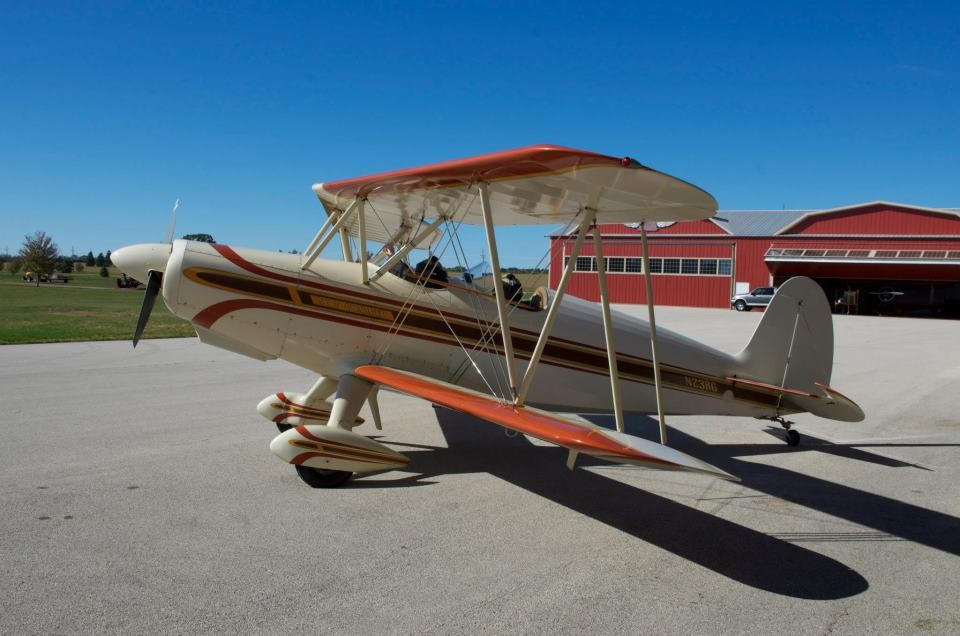
Development and Design Philosophy
Ed Marquart conceived the MA-5 Charger as an evolution of his single-seat MA-4 Lancer, expanding the design to accommodate two occupants in tandem open cockpits. The aircraft represented Marquart's philosophy of providing capable aerobatic performance to homebuilders through detailed construction plans rather than manufactured kits. Daniel W. Fielder Jr. constructed and test-flew the first prototype at Flabob Airport, with the maiden flight occurring in October 1970 after seven years of development.
Construction and Technical Innovation
The Charger employed mixed construction techniques optimized for amateur builders. Its welded steel tube fuselage provided structural strength while remaining within the skill range of experienced homebuilders. Wooden wing spars and ribs created the constant-chord wings, swept 10 degrees and covering 170 square feet of wing area. The entire structure received doped aircraft fabric covering, maintaining traditional biplane construction methods while incorporating modern design principles.
Marquart's engineering achieved impressive performance specifications: the 1,000-pound empty weight aircraft could reach 145 mph maximum speed with the 180-horsepower Lycoming O-360-A1G6 engine, while maintaining gentle handling characteristics with stall speeds as low as 38 mph. The design's 1,800 feet per minute climb rate and 14,000-foot service ceiling provided excellent performance for recreational aerobatics.
Engine Configurations and Performance
While early prototypes utilized 125-horsepower Lycoming O-290 and Continental engines, the standard configuration evolved around the 180-horsepower Lycoming O-360-A1G6. Some builders opted for the 160-horsepower fuel-injected Lycoming IO-320, providing a middle ground between power and operating costs. The 26-gallon fuel capacity delivered a 450-mile range, enabling cross-country flights while maintaining aerobatic capability.
Competition Success and Recognition
The MA-5 Charger achieved remarkable success at EAA AirVenture Oshkosh, earning Grand Champion Plans-built Aircraft awards in 1982 with Jim Smith's example, 1987 with Remo Galeazzi's aircraft, 2009 with Mark Gilmore's Charger, and 2015 with Ken Orloff's machine. This consistent recognition over three decades demonstrated the design's enduring appeal and the craftsmanship quality achievable by dedicated builders.
The aircraft's most famous achievement occurred in 1991 when 70-year-old Dave Davidson became the oldest pilot to fly solo across the Atlantic Ocean in his modified Charger. Davidson's aircraft featured two drop tanks mounted between the landing gear, extending range for the transatlantic crossing and proving the design's versatility beyond sport aerobatics.
Plans Distribution and Legacy
Marquart's business model focused exclusively on plans sales rather than kit manufacturing, though Ken Brock offered fabricated metal brackets for several years to simplify construction. Nearly 500 sets of plans were distributed during Marquart's lifetime, with approximately 100 aircraft reaching completion and first flight. The lengthy construction time, often requiring several years for amateur builders, contributed to the relatively low completion rate typical of plans-built aircraft.
Following Ed Marquart's death in 2007 at age 85, the MA-5 plans were placed in the public domain and became available as free PDF downloads. This decision ensured the design's continued availability to future generations of homebuilders, though it eliminated any financial incentive for promoting construction.
Current Status and Flying Population
An estimated 80 or more MA-5 Chargers remain airworthy today, representing a significant portion of completed aircraft still in active service. The type continues attracting builders drawn to its traditional biplane configuration, proven aerobatic capabilities, and the satisfaction of scratch-building from plans. Modern builders benefit from decades of construction experience shared through online forums and builder networks.
The Charger's reputation as a "modern Bucker Jungmann" reflects its position among aerobatic biplanes—offering contemporary performance and reliability while maintaining classic open-cockpit flying characteristics. Its 400-foot takeoff run and 800-foot landing distance suit operations from shorter grass strips, enhancing its appeal for recreational flying.
The Designer's Legacy
Ed Marquart's aircraft design career encompassed multiple projects, from the early MA-1 and MA-2 concepts through the single-seat MA-3 Maverick and MA-4 Lancer. The MA-5 Charger, presented at Oshkosh in 1971, represented the culmination of his design philosophy emphasizing practical construction methods, solid engineering, and genuine aerobatic capability. His commitment to the homebuilt movement through plans distribution rather than commercial manufacturing reflected the grassroots spirit of experimental aviation during the 1970s growth period.