
Design Philosophy and Development
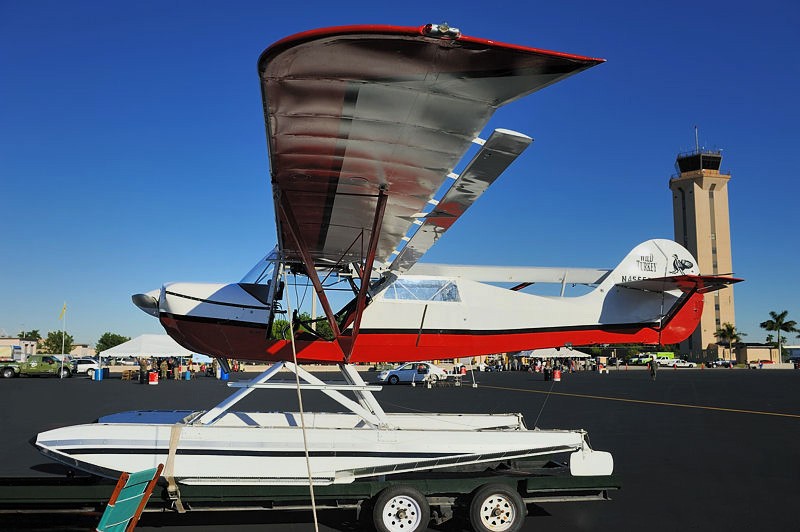
The Magnum represented AVID Aircraft's ambitious expansion beyond ultralight aviation into the realm of serious cross-country aircraft. Designer Dean Wilson conceived the Magnum as an enlarged version of his successful Flyer design, specifically engineered to accommodate the power and weight of substantial Lycoming engines. Unlike its lighter predecessors, the Magnum featured a welded steel tube fuselage structure capable of handling the stresses imposed by engines producing up to 180 horsepower.
The aircraft's wing design utilized aluminum spars combined with wooden ribs, all covered in Ceconite fabric. This hybrid construction approach balanced weight considerations with structural integrity, while the high-wing configuration provided excellent low-speed handling characteristics. The 32-foot wingspan generated 140.3 square feet of wing area, giving the Magnum impressive short-field performance with takeoff runs of just 150 feet.
Manufacturing Turbulence
AVID Aircraft's corporate history proved as eventful as its aircraft designs. Dean Wilson established the company as Light Aero Inc in 1983, achieving immediate recognition when the original Flyer design captured the Best New Design award at Oshkosh that same year. However, financial difficulties plagued the operation, leading to bankruptcy in 1998.
Jim Tomash acquired the bankrupt company and relocated operations to an unusual facility: a converted 61,000-square-foot greenhouse in Ennis, Montana. This arrangement lasted only five years before the company closed again in November 2003, with management citing the need to relocate to a more populated area. The corporate instability didn't end there - the company was re-established once more in 2017.
During AVID's dormant periods, Airdale Sportplane and Supply stepped into the void, beginning parts production for existing AVID models in 1999. Airdale eventually developed its own derivatives, including the Airdale Avid Plus kitplanes, before itself succumbing to business closure in 2017. By 2010, the Airdale Flyer Company of Rhinelander, Wisconsin had assumed Magnum production, introducing modifications including enlarged landing gear and optional tricycle gear configuration.
Engine Specifications and Performance
The Magnum's powerplant options centered on proven Lycoming horizontally-opposed engines, with the four-cylinder O-320 producing 150 horsepower serving as the most popular choice. This engine selection provided pilots with 112 kW of reliable power, enabling cruise speeds of 130 mph and maximum velocities reaching 155 mph. The aircraft's fuel capacity of 106 liters supported a useful range of 450 miles.
Performance characteristics reflected the aircraft's versatility. The Magnum demonstrated an impressive initial climb rate of 1,800 feet per minute and achieved a service ceiling of 17,500 feet. Stall speeds remained remarkably low at 40 mph in clean configuration and 36 mph with full flaps deployed, contributing to the aircraft's reputation for forgiving handling characteristics.
Production and Safety Record
By 2001, approximately 100 Magnum aircraft had been completed by builders worldwide. The kit-built nature of the aircraft meant construction times and quality varied significantly among individual projects. Builders could choose between tricycle or conventional tailwheel landing gear configurations, and the wings incorporated a folding feature for hangar storage efficiency.
Safety analysis revealed concerning trends within the AVID fleet. A comprehensive 10-year study of homebuilt aircraft accidents determined that most big-engine AVID accidents involved Magnums rather than the lighter Flyer variants. However, investigators noted that the Magnum's longer wing span potentially provided pilots with improved stall margins compared to shorter-winged models.
International Examples
The Magnum attracted international attention, with examples registered in multiple countries. New Zealand saw its first Magnum registration in October 2007, when ZK-CLC (construction number 83M) was certified at Collingwood. This particular aircraft, powered by a Lycoming O-360 engine, exemplified the type's appeal to pilots seeking capable cross-country performance in the homebuilt category.
Legacy and Current Status
Despite the turbulent corporate history of its manufacturer, the Magnum design proved influential in bridging the gap between ultralight aircraft and certified general aviation planes. The aircraft demonstrated that homebuilt designs could achieve Cub-like performance while providing modern amenities like enclosed cabins and side-by-side seating.
Today, surviving Magnums continue operating in the hands of private owners who appreciate the type's combination of short-field capability and cross-country performance. The aircraft's design influence persists in subsequent homebuilt developments, and aviation safety researchers continue studying the type's operational characteristics to improve future light aircraft designs.