
Naval Service Excellence
The Mars dominated U.S. Navy cargo operations in the Pacific from 1944 to 1956, providing the only reliable means of transporting heavy equipment and large numbers of personnel across vast ocean distances. Operating primarily with squadron VR-2, the Mars flying boats established numerous cargo records, including a demonstration flight on January 23, 1944, when one aircraft carried 20,500 pounds of cargo to Hawaii and back in 27 hours and 36 minutes. The type regularly ferried supplies between the mainland United States and Pacific island bases, with the Marshall Mars setting a passenger record by carrying 301 people plus seven crew members on a single flight.
Wartime Development and Variants
Originally conceived as a long-range patrol bomber and ordered by the Navy on August 23, 1938, the Mars program shifted focus to transport duties in December 1943 after America's entry into World War II demonstrated the critical need for cargo capacity over patrol aircraft. The prototype XPB2M-1 first flew on July 3, 1942, after initial taxi tests were delayed by an engine fire in December 1941. Five production JRM-1 aircraft followed, along with one JRM-2 variant featuring more powerful engines. Each aircraft received a Pacific theater name: Hawaii Mars, Marianas Mars, Philippine Mars, Marshall Mars, and Caroline Mars.
The Glenn L. Martin Company
Founded in 1912 by aviation pioneer Glenn L. Martin, the Glenn L. Martin Company established itself as America's premier flying boat manufacturer through innovations like the PBM Mariner, of which 1,366 were produced starting in 1937. The company operated from its Middle River, Maryland facility until merging with American-Marietta Corporation in 1961 to form Martin Marietta, which later became part of Lockheed Martin in 1995. The Mars represented the culmination of Martin's flying boat expertise, incorporating lessons learned from earlier designs while pushing the boundaries of size and capability.
Engineering and Powerplant
The production JRM-1 Mars aircraft were powered by four Wright R-3350-24WA Cyclone radial engines, each producing 2,300 horsepower and driving four-bladed propellers. Wright Aeronautical's R-3350 proved highly reliable for long-range operations, with more than 18,000 units produced across all variants during the 1940s and 1950s. The final JRM-2 Caroline Mars received four Pratt & Whitney R-4360-4 radial engines producing 3,000 horsepower each, enabling higher gross weights and improved performance for potential postwar airline service.
Performance and Capabilities
With its 200-foot wingspan and 118-foot length, the Mars dwarfed all contemporary aircraft and required a crew of seven for operation. The aircraft's 34-ton empty weight grew to over 75 tons when fully loaded, yet it maintained excellent handling characteristics on water and demonstrated remarkable range capabilities. Design innovations included a lengthened hull compared to the PBM Mariner, overhead cargo-handling equipment, and fewer internal bulkheads to maximize cargo space. The type's ability to operate from protected harbors worldwide made it invaluable for Pacific operations.
Production Limitations and Postwar Plans
The Navy's original order for 20 JRM-1 aircraft was reduced to just five due to the war's end, plus one JRM-2, making the Mars one of the rarest production aircraft in history. Martin had developed plans for a 79-seat Model 170-24A airliner variant, but the postwar collapse of the civilian flying boat market led to the program's cancellation. The prototype Hawaii Mars was lost in a Chesapeake Bay accident just weeks after its first flight in June 1945, leaving only five aircraft to serve the Navy through 1956.
Water Bomber Legacy
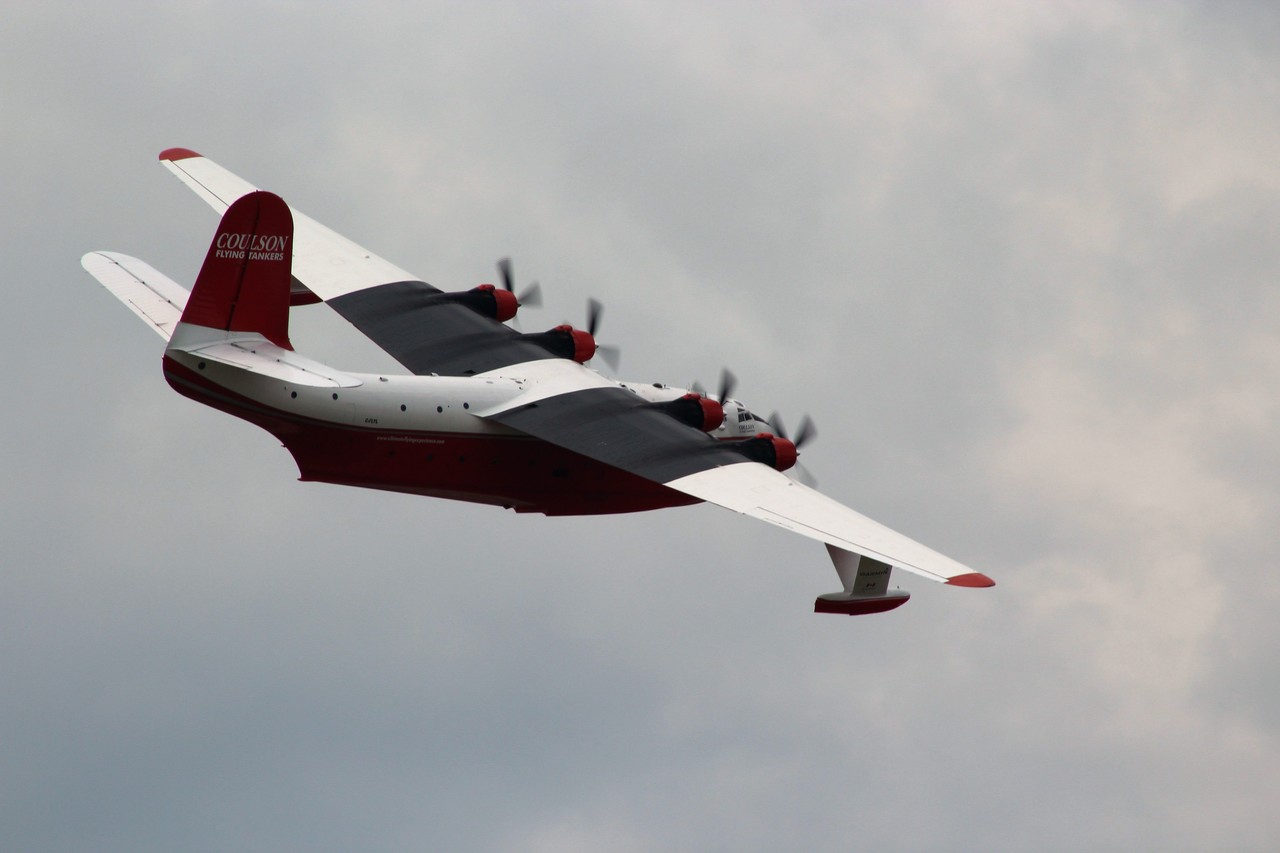
Four surviving Mars aircraft were sold to Fairey Aviation of Victoria, British Columbia, in 1959 for conversion to aerial firefighting tankers. These conversions could carry 27,000 liters of water or fire retardant, which could be loaded in just 22 seconds while taxiing. The water bomber Mars operated for decades with various forestry services, though accidents and age eventually claimed most examples. The Hawaii Mars crashed in 1961, while other aircraft suffered similar fates over the years.
Museum Preservation
No Martin Mars aircraft remain airworthy today, and preservation efforts have been limited due to the aircraft's enormous size and specialized flying boat configuration. Naval aviation museums maintain photographic records and artifacts from the Mars program, while scale model builders continue to commemorate the type's unique place in aviation history. The Mars stands as a testament to American engineering ambition and the brief era when flying boats represented the pinnacle of long-range aviation capability.