
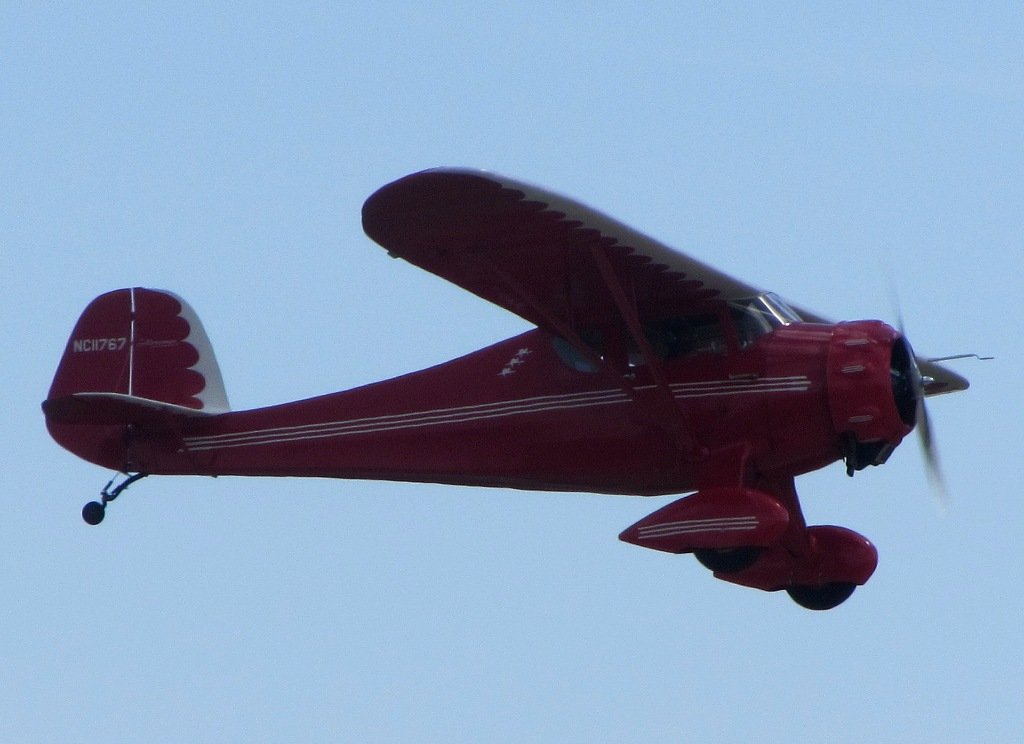
Racing Dominance and Civil Success
The Monocoupe 90 established itself as the premier racing aircraft of its era, with Monocoupes dominating air races throughout the early 1930s. Notable among racing pilots was Harold Neumann, an airline pilot who purchased a Monocoupe 90A and converted it for aerobatic competition. Flying his aircraft nicknamed "Little Mulligan" with a 145-horsepower Warner engine, Neumann captured the prestigious 1935 Thompson Trophy and continued competing in IAC Sportsman category events well into his seventies.
Despite the economic challenges of the Great Depression, the Model 90 sold quite well through 1931, marketed as "a good, solid bargain for the money." The aircraft's refined lines and slightly longer, wider fuselage compared to earlier Monocoupe variants attracted private owners seeking both performance and elegance.
Military Service Challenges
World War II brought the Monocoupe 90 into military service, though not without complications. The United States Army Air Forces purchased 20 Model 90AF aircraft, designating them Universal L-7, for transfer to the Free French Forces. These aircraft, powered by 115-horsepower Franklin engines, were delivered by sea to Abu Sweir, Egypt, in early 1943, where RAF Maintenance Unit 109 reassembled them.
The primary military use was establishing flying school GE 11 at Rayak, Syria, which opened on September 1, 1943. However, the Monocoupe 90 proved too sensitive for basic training operations. The aircraft's responsive controls, valued by experienced racing pilots, caused numerous accidents among student pilots. The training program disbanded on January 4, 1944, after just four months of problematic operations.
Manufacturing Evolution
Monocoupe Corporation's history reflected the turbulent aviation industry of the era. Originally established as Central States Aero Company in 1926 in Bettendorf, Iowa, the company relocated to Robertson, Missouri, where it produced the Model 90 series. In 1941, Monocoupe combined with three other companies to form Universal Molded Products Corporation, with Monocoupe operating as a separate division.
Production ceased during World War II but resumed from 1948 to 1950 under the name Monocoupe Airplane and Engine Corporation, operating from Melbourne, Florida. The company's assets changed hands multiple times, with a West Virginia aviation group reorganizing it as Monocoupe Aircraft of Florida, Inc. in 1955. The brand briefly re-emerged as Mono Aircraft, Inc. in Cheney, Kansas in 1992, and most recently as Monocoupe Aeroplane Corporation in Grantville, Pennsylvania in 2016.
Engineering Excellence
Donald Luscombe's design philosophy emphasized both structural integrity and aesthetic appeal. The Model 90 featured a welded steel tubing fuselage in rigid truss form, heavily faired with dural metal sheet formers and wooden fairing strips. The wings incorporated solid spruce spars with basswood web ribs and spruce cap-strips, topped by dural metal leading edges and fabric covering.
Engine options provided flexibility for different missions and budgets. The standard Model 90 and 90A used the 90-horsepower Lambert R-266 radial engine, while the Model 90AF featured a 115-horsepower Franklin engine. The Model 90J utilized a 90-horsepower Warner Scarab Jr engine, and high-performance variants like the Model 90AW incorporated 145-horsepower Warner engines for racing applications.
Design Innovations
The Model 90 DeLuxe introduced several aerodynamic refinements, including trailing edge flaps, wheel speed fairings, and an improved engine cowling. These innovations contributed to the aircraft's reputation for combining performance with elegant appearance. The soft, round curves and delicately graceful lines established design patterns that influenced Monocoupe variants throughout the 1930s and 1940s.
Measuring 20 feet 5.75 inches in length with a 32-foot wingspan, the high-wing configuration provided excellent visibility for both pilots while maintaining ground clearance for operations from rough airfields. The side-by-side seating arrangement facilitated instruction and shared flying experiences.
Surviving Legacy
Several Monocoupe 90 aircraft remain airworthy today, testament to the design's enduring quality. A 1932-built example with registration N119V operates from Creve Coeur airfield in Missouri. NC11760, a Model 90A manufactured in November 1934, has been maintained in flying condition since 2020. NC38905, a Model 90AF built in October 1941, continues active operations.
The EAA AirVenture Museum preserves Harold Neumann's famous "Little Mulligan" (N38904), a 1941 Monocoupe 90AW donated to the museum in 1994. This aircraft represents the pinnacle of Monocoupe racing achievement and serves as a tribute to the type's competitive success.
The Monocoupe 90's influence extended beyond its production years, establishing design principles and performance standards that shaped light aircraft development for decades. Its combination of structural soundness, aesthetic appeal, and spirited performance created a template for personal aircraft that remains influential in general aviation design philosophy.