
Design and Development
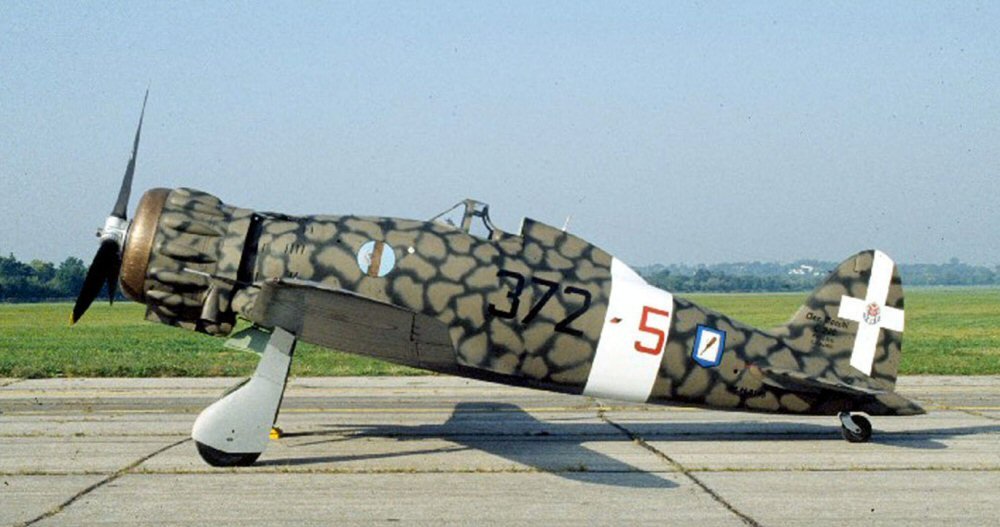
Designed by engineer Mario Castoldi, the Macchi C.200 Saetta was developed in response to a 1935 Regia Aeronautica requirement for a modern monoplane fighter. The aircraft represented a significant leap in Italian aviation, moving away from biplane configurations to an all-metal, low-wing monoplane with retractable landing gear. The prototype first flew on 24 December 1937 at Lonate Pozzolo, piloted by Giuseppe Burei. While early models featured an open cockpit, later production versions incorporated a fully enclosed canopy to enhance aerodynamics and pilot comfort.
Production and Manufacturing
Series production began in June 1939 and continued until 1943, with no further aircraft built after the Italian armistice on 8 September 1943. A total of 1,153 aircraft were produced, including prototypes. While Aeronautica Macchi was the primary manufacturer based in Varese, production was shared with licensed manufacturers Società Italiana Ernesto Breda (Breda) and SAI Ambrosini. The original company, Aeronautica Macchi, eventually became part of the Finmeccanica conglomerate (now Leonardo S.p.A.) under the Alenia Aermacchi brand.
Technical Specifications
The standard C.200 was powered by a Fiat A.74 R.C.38 14-cylinder, air-cooled radial piston engine producing approximately 870 hp. This engine, a derivative of the Pratt & Whitney R-1830, was chosen for its robustness and damage tolerance in combat. The aircraft reached a maximum speed of approximately 500–505 km/h with a service ceiling between 9,000 and 10,500 meters. Its armament consisted of two 12.7 mm Breda-SAFAT machine guns in the nose, typically carrying 370 rounds per gun. An experimental variant known as the C.200 "bis" tested a Piaggio P.XIX R.C.45 engine producing 1,160 hp, which increased the top speed to roughly 535 km/h, though this version did not enter series production.
Operational History
From Italy's entry into World War II on 10 June 1940 until mid-1943, the C.200 was the backbone of the Italian fighter force. It saw action in nearly every major theater, including the 1940 campaign in France, operations over Malta, the Greco-Italian War, and the Yugoslav campaign. In North Africa, the aircraft was equipped with desert dust filters and utilized as a fighter, bomber escort, and fighter-bomber; it even participated in naval strikes, including the sinking of a British destroyer. On the Eastern Front over Russia and Ukraine, the C.200 performed effectively, achieving a kill-to-loss ratio of 88 to 15. Following the 1943 armistice, some aircraft served with the Aeronautica Nazionale Repubblicana (ANR) primarily as advanced trainers. The type was finally retired from service in 1947.
Legacy
The C.200's structural layout and aerodynamics served as the foundation for the more advanced C.202 Folgore and C.205 Veltro. Today, only two intact aircraft and one fuselage survive globally. One of these restored examples is held by the National Museum of the United States Air Force in Dayton, Ohio.