
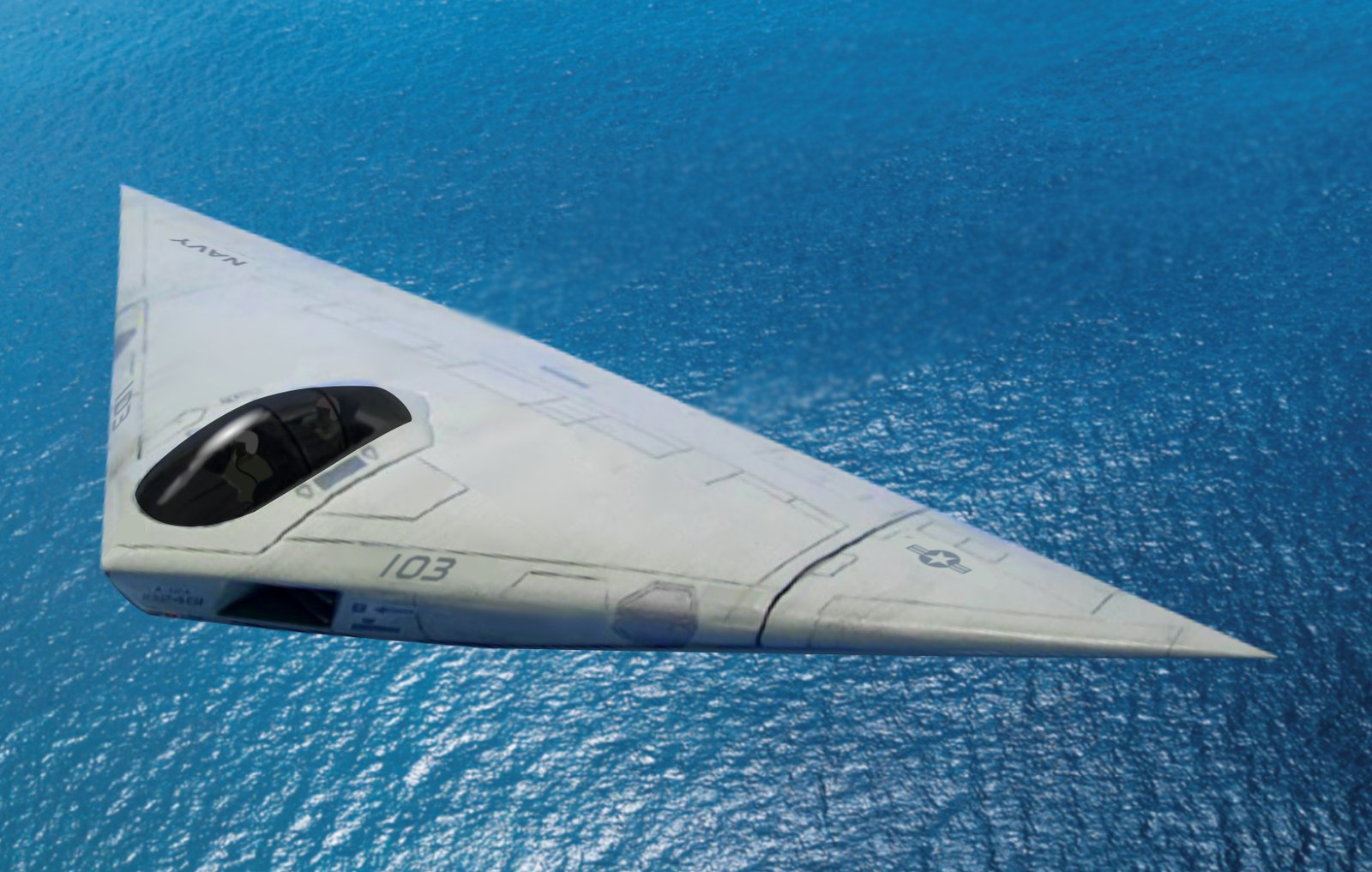
The A-12 Avenger II was developed as part of the Advanced Tactical Aircraft (ATA) program, which the U.S. Navy initiated in 1983. The program's goal was to create a stealthy, long-range attack aircraft to replace the Grumman A-6 Intruder. Following a competition that began with concept design contracts in November 1984, a joint team from McDonnell Douglas and General Dynamics was awarded the development contract on January 13, 1988. The aircraft was designated the A-12 Avenger II, a name paying homage to the World War II-era Grumman TBF/TBM Avenger.
Designed for all-weather, deep-strike precision attacks, the A-12 featured a low-observable, isosceles triangle planform that earned it the nickname "Flying Dorito." To maintain its stealth profile, the aircraft utilized internal weapons bays capable of carrying 5,160 lb of ordnance, including AGM-88 HARM anti-radiation missiles, precision-guided bombs, and AIM-120 AMRAAM for self-defense. The design called for a crew of two, consisting of a pilot and a Weapon Systems Officer (WSO). Power was provided by two non-afterburning General Electric F412-GE-D5F2 turbofan engines, each producing 13,000 lbf of thrust.
Planned performance specifications included a maximum speed of approximately 580 mph, a service ceiling of 40,000 ft, and a combat radius between 800 and 920 miles. The aircraft had a maximum take-off weight of 80,000 lb and a wingspan of 70 ft 3 in, which could be folded to 36 ft 3 in for carrier deck operations. While the U.S. Navy planned to procure 620 aircraft and the Marine Corps 238, the U.S. Air Force also studied the possibility of ordering 400 derivatives to replace the F-111.
Despite these ambitions, the program was plagued by severe weight growth and manufacturing difficulties associated with its advanced composite structures. Although the first flight was scheduled for December 1990, the aircraft never flew. On January 7, 1991, Secretary of Defense Richard “Dick” Cheney canceled the program, citing cost growth and failure to meet specifications. This termination, described as the largest project termination in U.S. Defense Department history, resulted in approximately $5 billion in spent research and development and years of litigation over the return of $2 billion. The A-12's legacy persists through the GE F414 engine used in the F/A-18E/F Super Hornet, which evolved from the F412 technology, and through exhibits at the Fort Worth Aviation Museum.