
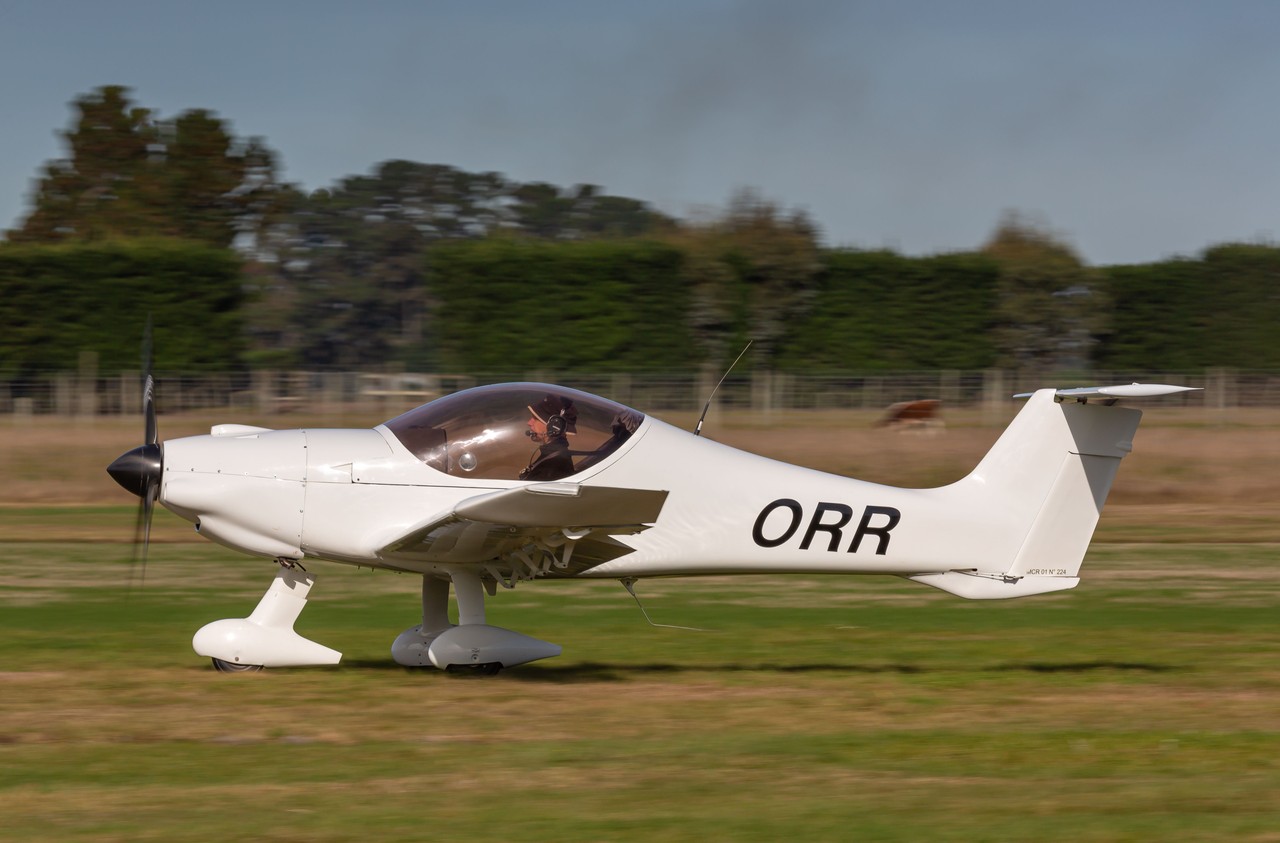
Design Innovation
The MCR-01 emerged from the collaboration between Michel Colomban, designer of the original MC-100 Ban-Bi, and Christophe Robin, son of Robin Aircraft founder Pierre Robin. The "MCR" designation reflects this partnership (Michel Colomban/Christophe Robin). Colomban's design philosophy centered on creating an all-composite evolution of his earlier metal aircraft, incorporating carbon fiber construction throughout the wings and monocoque fuselage structure.
The aircraft's innovative design featured a distinctive T-tail configuration with 3-degree wing dihedral and double-slotted flaps that enabled remarkably low stall speeds despite high cruise performance. The modular construction allowed the entire airframe to be disassembled by a single person in just four minutes, addressing both transportation and storage concerns for kit builders.
Manufacturing History
DYN'AÉRO was founded in 1992 by Christophe Robin, establishing operations in France to produce composite light aircraft. The company's prototype F-PECH completed its maiden flight in 1995, followed by the first production MCR-01 Club variant (F-PCLB) in June 1998. By January 2003, the company had sold over 224 kits, with production continuing through various certification milestones.
The MCR-01 Sportster received JAR-VLA certification on June 26, 2001, while the ultralight MCR-01 ULC variant gained DGAC approval on March 1, 2001. Production expanded internationally, with aircraft registered across Europe, New Zealand, and North America. However, financial difficulties led to DYN'AÉRO's bankruptcy in early 2012, after which the French Artzaïmak Industrial Group acquired the company, continuing production under the SE Aviation banner.
Technical Excellence
Powered primarily by the Rotax 912UL engine producing 80 horsepower, the MCR-01 achieved exceptional performance parameters that challenged conventional ultralight limitations. The standard configuration carried 80 liters of fuel, with optional tanks extending capacity to 264 liters for long-range missions. Alternative powerplants included the Rotax 914 and Jabiru engines, with the Jabiru variant completing its first flight on April 19, 2002.
The aircraft's carbon fiber wing structure utilized carbon spars with cellular ribs and bonded aluminum skins, creating exceptional strength-to-weight ratios. This construction enabled the MCR-01 ULC to maintain a maximum takeoff weight of just 490 kilograms while achieving cruise speeds up to 271 km/h. The wing area of 8.13 square meters provided adequate lift for the ultra-low stall speed of 63 km/h.
Variant Development
Multiple variants addressed different market segments and regulatory requirements. The MCR-01 Club focused on training applications, while the ULC (Ultra Light Class) variant complied with European microlight regulations. The tailwheel MCR M variant, certified on June 26, 2002, appealed to pilots preferring conventional landing gear configuration.
North American markets received variants designated as Lafayette I Sportster, II Touring, and III Bushplane, each optimized for specific operational requirements. A motor glider version achieved an impressive 30:1 glide ratio, expanding the aircraft's versatility beyond pure touring applications.
Global Operations
International acceptance demonstrated the MCR-01's broad appeal across diverse aviation markets. New Zealand registered ZK-ORR in 2011, while multiple Belgian registrations appeared between 2001 and 2013, including OO-H24 delivered in 2013. The United Kingdom's G-BZXG completed its first flight on November 30, 2001, marking successful penetration of the British ultralight market.
Scandinavian operators embraced the type, with Denmark's OY-JIB (2001), Sweden's SE-VLV (2008), and Norway's LN-YWD (2005) representing successful Nordic operations. However, a 2001 crash in Peru involving nose gear failure due to fatigue and design faults led to temporary grounding and subsequent redesign efforts.
Construction Philosophy
The kit-building approach targeted 500 to 1,000 construction hours, significantly reducing assembly time compared to traditional homebuilt aircraft. Modular components arrived pre-manufactured to tight tolerances, enabling builders to achieve professional-quality results without extensive fabrication skills. This philosophy democratized access to high-performance aviation, making sophisticated composite aircraft available to a broader community of aviation enthusiasts.
Current Status
By 2013, production records indicate at least 310 DYN'AÉRO aircraft had been manufactured across all variants, though exact MCR-01 numbers remain unspecified. Recent photographic evidence from Denmark in 2025 confirms continued operation of at least some airframes, including construction number 380. The acquisition by Artzaïmak Industrial Group ensures ongoing support for existing aircraft and potential new production, maintaining the MCR-01's position in the contemporary ultralight market.
The MCR-01's legacy represents successful integration of advanced composite construction techniques with regulatory compliance across multiple international certification standards, establishing a template for modern kit aircraft development.