
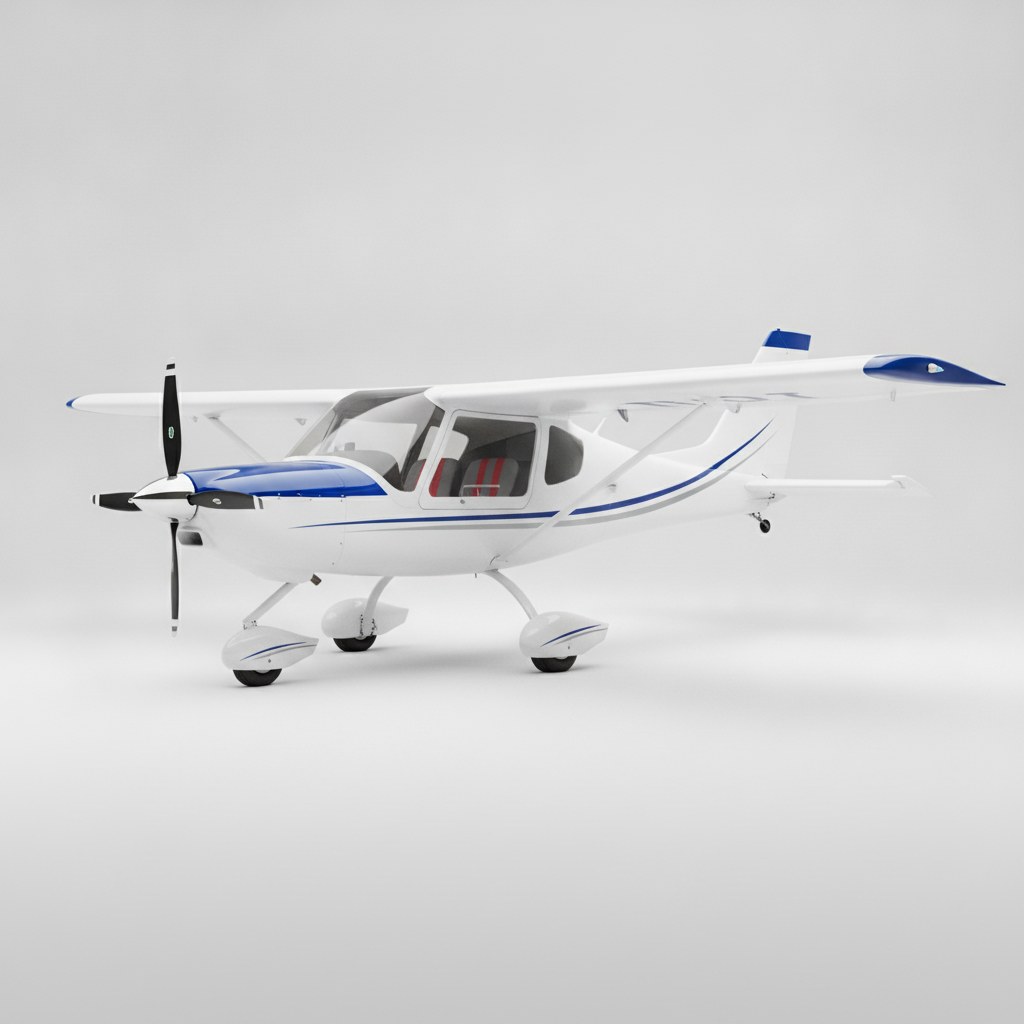
Design and Development
The MD-3 Rider emerged from the Czech Republic design expertise of Jaroslav Postal, who created the aircraft to meet both light sport aircraft regulations and Fédération Aéronautique Internationale microlight standards. The prototype OK-JUR-06 completed its maiden flight on February 25, 2004, at Kunovice in the Czech Republic, followed by the first production aircraft on August 7, 2004. This rapid progression from prototype to production demonstrated the design's maturity and market readiness.
Postal's design emphasized practical construction methods, utilizing a welded steel tube fuselage combined with semi-monocoque aluminum alloy components joined through bonding and riveting techniques. The aircraft featured composite construction for the engine cowling and fairings, while carbon-fiber cockpit doors reduced weight and enhanced the modern aesthetic. A factory-optional wing folding capability addressed storage and transport concerns for recreational operators.
Manufacturing Evolution
Production initially commenced in the Czech Republic at Gelnice, with assembly operations planned for Pibram, but FLYITALIA of Dovera, Italy, quickly relocated manufacturing to Italy to capitalize on European market opportunities. The company maintained production from 2004 until ceasing operations in 2011, establishing the MD-3 Rider's reputation in the light sport aircraft segment.
The aircraft's design proved sufficiently viable that Next Aircraft of Rivanazzano acquired the rights and resumed production in 2013, continuing operations for over a decade. Most recently, SD Aviation Srl obtained all licensing rights at the beginning of 2024, establishing current production facilities in Mornago, Italy. This succession of three manufacturers over two decades demonstrates the enduring market appeal of Postal's original design.
Technical Specifications and Performance
The MD-3 Rider's powerplant options centered on proven Rotax four-cylinder horizontally-opposed engines, with the UL variant utilizing the 60-kilowatt Rotax 912 and the Sport variant employing the 80-kilowatt Rotax 912S. Current production models feature the 80-horsepower Rotax 912UL and 100-horsepower Rotax 912ULS four-stroke engines, providing fuel consumption rates of 11-14 liters per hour for the lower-powered variant and 13-17 liters per hour for the 100-horsepower configuration.
The aircraft's dimensions reflect its light sport aircraft classification, with a wingspan ranging from 8.5 to 9.0 meters and an overall length of 5.7 to 5.9 meters. Wing area of 9.5 to 9.9 square meters supports a maximum takeoff weight between 520 and 600 kilograms, while the empty weight ranges from 295 to 297 kilograms. The 117-centimeter-wide cockpit accommodates two occupants in side-by-side configuration with dual controls.
Performance specifications include a maximum speed of 275 kilometers per hour, cruising speed of 210 kilometers per hour, and a climb rate of 360 meters per minute. The aircraft demonstrates excellent low-speed handling with stalling speeds of 82 kilometers per hour in clean configuration and 62 kilometers per hour with flaps deployed. Structural limits of +4/-2 G provide adequate margins for recreational aerobatic maneuvers.
Certification and International Recognition
The MD-3 Rider achieved Czechoslovakian certification on May 31, 2006, followed by United States LSA certification in 2011, opening key international markets for the aircraft. These certifications validated the design's compliance with modern safety standards and construction requirements for light sport aircraft operations.
International acceptance materialized through various registrations, including aircraft ZK-MDT (construction number 031) registered in New Zealand on December 7, 2006, to Aerosport Aviation Ltd of Cambridge. This aircraft subsequently changed ownership multiple times, transferring to Gentle Properties Ltd in April 2007, Arnold GP Ltd in February 2010, and finally the MDT Syndicate of Mercer in March 2012, indicating active secondary market interest.
Current Status and Legacy
The MD-3 Rider's production continuity spanning from 2004 to present reflects successful adaptation to light sport aircraft market demands. SD Aviation Srl's recent acquisition of complete manufacturing rights ensures continued availability with current base pricing at $99,995. The company evaluated a float variant in 2015, demonstrating ongoing development interest in expanding the aircraft's operational capabilities.
The aircraft's fixed tricycle landing gear, electric flaps, electric elevator trim, and hydraulic disc brakes represent modern conveniences expected in contemporary light sport aircraft. Integral wing fuel tanks and comprehensive instrumentation packages support both training and recreational flying missions, while the optional wing folding capability addresses hangar space limitations common to general aviation operators.
Today, the MD-3 Rider continues serving recreational pilots across multiple continents, with its all-metal construction providing durability advantages over fabric-covered competitors. The design's longevity through three manufacturing transitions demonstrates Jaroslav Postal's successful balance of performance, construction practicality, and market positioning within the competitive light sport aircraft segment.