
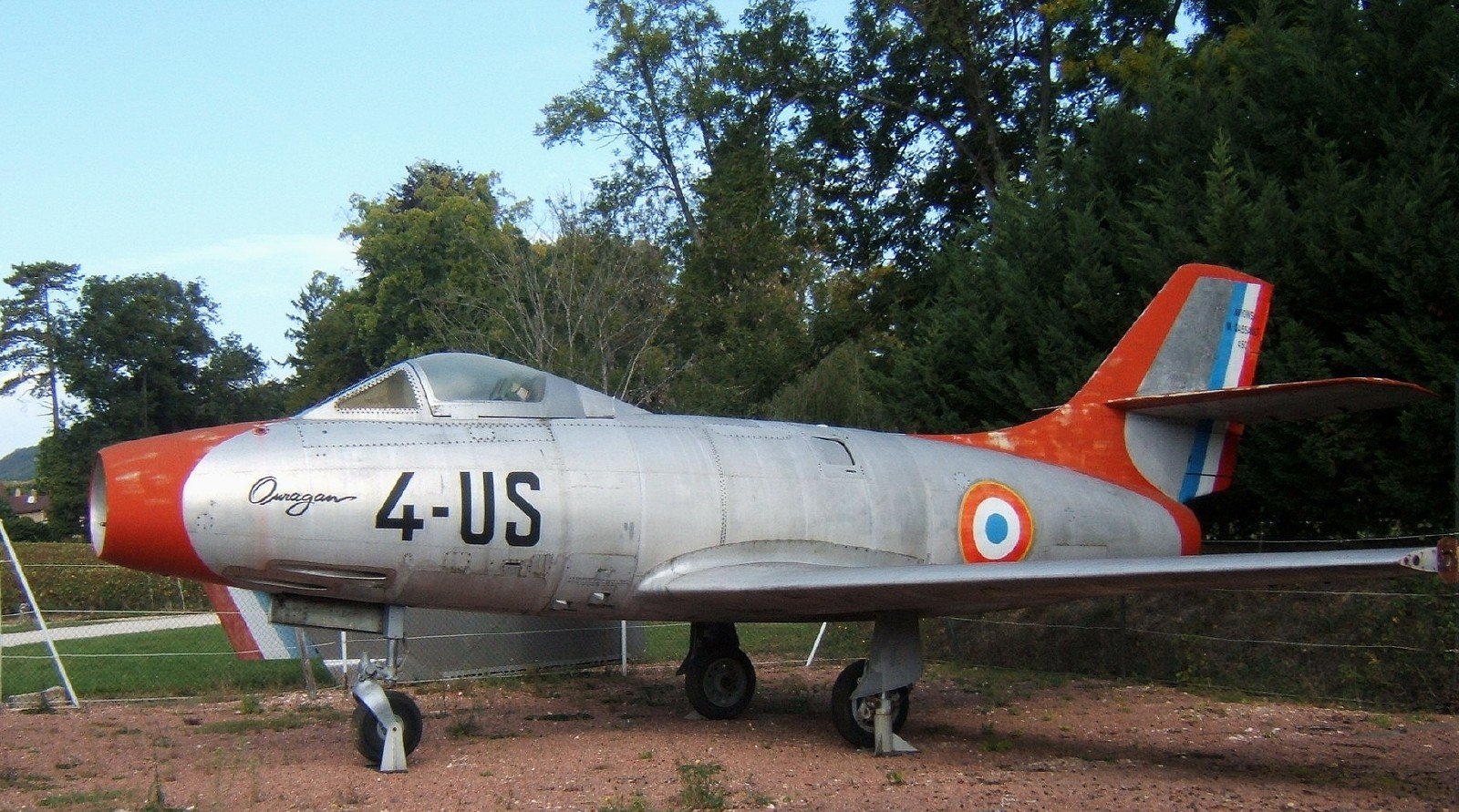
Design and Development
Designed by Marcel Dassault as a private venture, the MD 450 Ouragan was developed to provide France with a robust, simple, and effective jet fighter-bomber. The aircraft featured a straight-wing configuration and a single-engine layout, placing it in a similar design class to the American F-84 Thunderjet. The prototype, designated MD 450-01, made its maiden flight on February 28, 1949, at Melun-Villaroche, piloted by test pilot Kostia Rozanoff. The first production-standard aircraft subsequently flew on December 20, 1951, at Mérignac.
Production and Manufacturing
Production of the Ouragan spanned from 1948 to 1954, with over 567 airframes built. To accelerate the manufacturing process, Société des Avions Marcel Dassault shared production across several French facilities, including SNCASE in Toulouse, SNCASO in Saint-Nazaire, and SNCAC in Bourges, though final assembly and testing remained centered at Dassault's Mérignac facilities. The company, which evolved from Marcel Bloch's earlier aviation activities in 1916 and the subsequent Société des Avions Marcel Bloch, eventually became the modern Dassault Aviation.
Technical Specifications and Variants
The Ouragan was powered by a single-spool centrifugal-flow turbojet from the Rolls-Royce Nene family. The MD 450A variant utilized the Nene 102 engine, while the MD 450B employed a license-built Hispano-Suiza Nene 104B, which produced approximately 5,000 lbf (22.2 kN) of thrust. The MD 450B also featured revised two-section nose landing gear doors to protect against gun blast. The aircraft was armed with four 20 mm Hispano-Suiza HS.404 cannons, each with 125 rounds. For external ordnance, it could carry up to 2,270 kg of payload on four underwing hardpoints, including 105 mm Brandt T-10 rockets, Matra rocket pods with 68 mm SNEB rockets, or general-purpose bombs and napalm.
Operational History
The French Air Force introduced the Ouragan into squadron service in 1952 to replace the de Havilland Vampire, with the 12e Escadre de Chasse at Cambrai becoming the first equipped unit in November 1952. Between 1955 and 1956, the aircraft was used by the Patrouille de France aerobatic team. Beyond France, the aircraft saw significant export success. India operated 104 aircraft, designating them the "Toofani" (meaning Typhoon or Hurricane). Israel operated 75 aircraft, employing them as attack aircraft during the 1956 Suez Crisis and the 1967 Six-Day War. El Salvador operated 18 aircraft, remaining the last frontline operator until the type's retirement in 1985.
Performance and Legacy
With a maximum speed of approximately 940 km/h (Mach 0.83) at sea level and a service ceiling of 43,000 feet, the Ouragan provided a reliable platform for ground-attack and tactical fighter duties. Its legacy is defined by its role as the catalyst for the French jet age, paving the way for the subsequent Mystère and Mirage families. Today, fewer than six static museum examples survive in Europe and the Middle East.