
Origins and Design Innovation
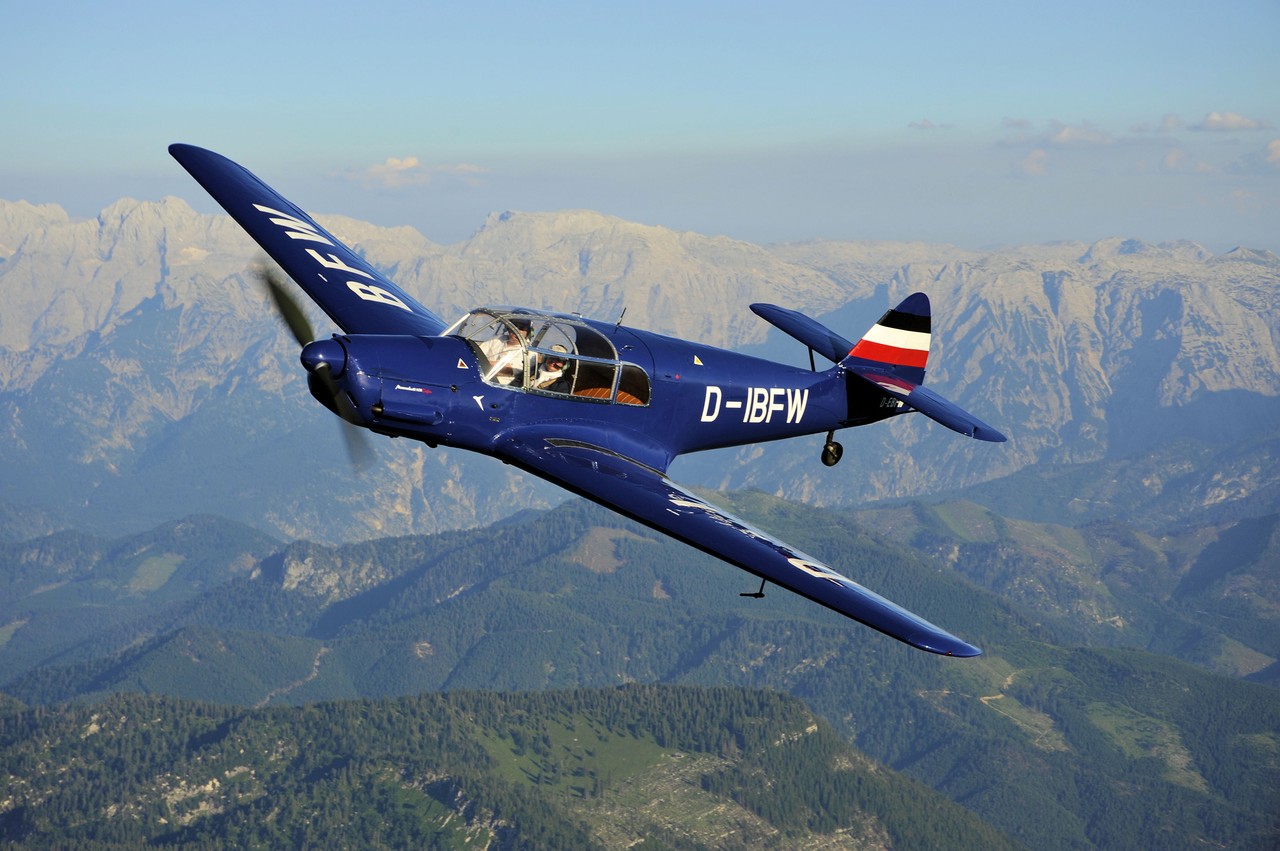
Willy Messerschmitt conceived the Bf 108 specifically for the 4th Challenge de Tourisme Internationale of 1934, an international touring aircraft competition held in Poland. Originally designated M 37 internally, the aircraft represented a quantum leap in light aircraft construction techniques. Its all-metal stressed-skin construction was revolutionary for aircraft in its class, establishing manufacturing standards that would influence light aircraft design for decades.
The prototype's maiden flight during spring 1934 revealed exceptional handling characteristics, combining impressive speed with docile low-speed behavior that made it ideal for both competitive flying and practical transportation. By the competition deadline, Bayerische Flugzeugwerke had completed six aircraft, demonstrating remarkable efficiency in bringing the design from concept to production.
Production History
Production began with the Bf 108A variant in 1934, initially powered by various engines including the Hirth HM 8U, a 220-horsepower Argus As 17B, and a 160-horsepower Siemens-Halske Sh 14 radial. The definitive Bf 108B entered production in late 1935, standardizing on the 240-horsepower Argus As 10C or the more powerful 270-horsepower As 10E inverted V-8 engine.
Manufacturing occurred at three primary facilities. Early aircraft emerged from the Augsburg factory until Bayerische Flugzeugwerke became Messerschmitt AG in July 1938. A modern facility at Regensburg, constructed between 1936 and 1938, produced more than 500 aircraft by 1942. When wartime priorities demanded factory space for combat aircraft, production transferred to Les Mureaux, France, in 1942, where 170 additional machines were completed before liberation.
Wartime Service
The Luftwaffe pressed the civilian Taifun into military service as a communications, liaison, ambulance, and utility transport throughout World War II. Its rugged construction and reliable performance made it invaluable for moving personnel and supplies behind the lines. The aircraft's ability to operate from short, unprepared airstrips while carrying four occupants proved essential for maintaining communications across the expanding German military operations.
By 1939, large numbers of Bf 108s operated across multiple continents, serving in countries including Brazil, Bulgaria, China, Croatia, Czechoslovakia, Hungary, Italy, Japan, Norway, Poland, Romania, Spain, Switzerland, and the Soviet Union. This global distribution demonstrated both the aircraft's export success and its versatility across diverse operating conditions.
Engine and Performance
The Argus As 10 series engines that powered most production aircraft featured air-cooled inverted V-8 configuration with 12.67-liter displacement. This powerplant delivered exceptional reliability while providing sufficient power for the aircraft's 2,987-pound maximum weight. The engine's inverted design lowered the aircraft's center of gravity, improving handling characteristics and ground stability.
Pilots praised the Bf 108's forgiving flight characteristics and impressive performance envelope. With a maximum speed of 190 mph, service ceiling of 20,300 feet, and range of 620 miles, it offered airline-like capability in a compact package. The aircraft's 27-foot 2-inch length and 34-foot 10-inch wingspan provided an optimal balance between performance and hangar requirements.
Post-War French Production
French manufacturer Société Nationale de Constructions Aéronautiques du Nord recognized the Taifun's potential after liberation in 1944, launching production as the Nord 1000 Pingouin series. Initial aircraft utilized salvaged German airframes and remaining Argus engine stocks, producing 285 additional machines that brought total production to over 1,135 aircraft.
As German engine supplies dwindled, SNCAN developed the Nord 1001 with a 233-horsepower Renault 6Q-10 engine and the Nord 1002 featuring the six-cylinder Renault 6Q-11. These French variants served primarily with military units but also found civilian operators who valued their proven reliability and reasonable operating costs. Production continued into the 1960s, with later variants incorporating tricycle landing gear and other modern refinements.
Legacy and Survivors
The Bf 108's influence extended far beyond its production numbers, establishing construction techniques and performance standards that guided subsequent light aircraft development. Many post-war films featured French-built derivatives as stand-ins for the original German aircraft, cementing its place in popular aviation culture.
Several original Bf 108 aircraft and numerous French-built examples remain airworthy today, treasured by collectors for their historical significance and exceptional flying qualities. The aircraft's transition from competition racer to military utility aircraft to post-war civilian transport demonstrates the timeless appeal of Willy Messerschmitt's innovative design, which proved that advanced construction techniques could create light aircraft with capabilities previously reserved for much larger machines.