
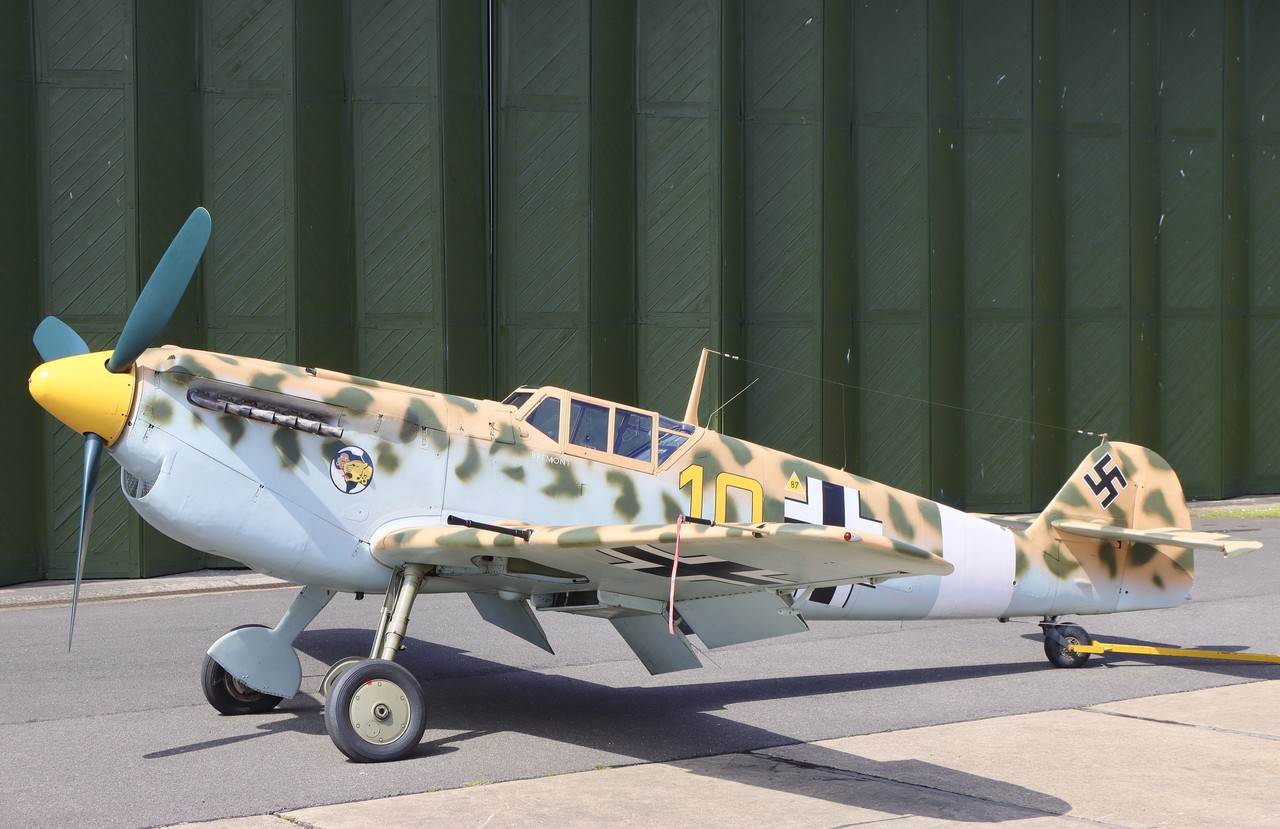
Wartime Dominance
The Bf 109 formed the backbone of the Luftwaffe's fighter force throughout World War II, serving in every major theater from the Spanish Civil War through the final battles over Germany. During the Battle of Britain in 1940, approximately 1,000 Bf 109s faced the Royal Air Force, providing escort for German bombers and engaging in fierce dogfights with Hurricanes and Spitfires. The aircraft's combat record was extraordinary - Bf 109 pilots claimed more aerial victories than any other fighter aircraft in history, with legends like Erich Hartmann achieving 352 kills and Gerhard Barkhorn scoring 301 victories, both surviving the war.
The final major operation involving the Bf 109 was Operation Bodenplatte on January 1, 1945, when over 800 German fighters, predominantly Bf 109s, launched surprise attacks against Allied airfields. While destroying 144 enemy aircraft on the ground, the Luftwaffe lost approximately 200 fighters in the operation, crippling Germany's remaining air strength.
Evolution Through Variants
Production began with the B-series in 1937, with 341 aircraft built, followed by 58 C-variants and 647 D-models. The breakthrough came with the E-series, particularly the E-3 variant with approximately 1,380 examples constructed. The F-series introduced the powerful DB 601E engine, with 1,841 F-4 fighters manufactured. However, the G-series represented the pinnacle of Bf 109 production, with the G-6 alone accounting for more than 12,000 aircraft. The final production variants included 2,600 G-10s and between 5,500 and 6,500 G-14 fighters.
Messerschmitt AG Legacy
Willy Messerschmitt established his company in 1923 through a merger between his workshop and the Deutsche Verkehrsfliegerschule. Originally focused on glider design, the company rapidly expanded under Nazi rearmament programs, becoming one of Germany's premier aircraft manufacturers. Beyond the Bf 109, Messerschmitt produced the revolutionary Me 262 jet fighter and numerous other innovative designs. The company operated independently until 1996, when it merged into Daimler-Benz Aerospace AG, eventually becoming part of EADS and now existing under the Airbus corporate umbrella.
Engineering Excellence
The Bf 109's design team, led by Willy Messerschmitt, created the aircraft in response to a 1934 Reich Air Ministry requirement for a lightweight monoplane fighter. The design emphasized speed, agility, and compactness, featuring all-metal stressed-skin construction and retractable landing gear. One crucial innovation was the implementation of direct fuel injection in later variants, preventing carburetor flooding during negative-G maneuvers - a significant advantage over Allied fighters using conventional carburetors.
The powerplant evolved from the early Jumo 210D engines to the legendary Daimler-Benz DB 600 series. The DB 601A and DB 601N powered the E and F variants, while the DB 605A became standard in G-series aircraft. The DB 605A delivered 1,475 horsepower, though reliability issues plagued high-altitude operations. Late-war innovations included methanol-water injection systems (MW50) that boosted emergency power to 2,000 horsepower. Over 100,000 DB 600-series engines were manufactured, powering the majority of Luftwaffe fighters.
Performance and Pilot Experience
The Bf 109G-4, representing the most numerous variant, measured 8.95 meters in length with a maximum speed of 660 kilometers per hour at 7,000 meters altitude. Combat range extended to approximately 850 kilometers with drop tanks, while service ceiling reached 12,000 meters with a climb rate of 17 meters per second. Standard armament consisted of two 13mm MG 131 machine guns with 400 rounds each and one 20mm MG 151/20 cannon carrying 150-200 rounds.
Pilots praised the Bf 109's exceptional climbing performance and high-altitude capabilities, though the narrow-track landing gear made ground handling challenging. The aircraft's small size provided excellent maneuverability but limited fuel capacity and cockpit space compared to contemporaries.
Production Achievement
Between 1936 and 1945, approximately 33,984 to 34,852 Bf 109s rolled off production lines across Germany and occupied territories. Primary manufacturing occurred at Messerschmitt's Regensburg facility, with additional production by Fieseler, Erla Maschinenwerke, Focke-Wulf, Arado, AGO, and WNF. Licensed production extended to Spain, Czechoslovakia through Avia, Hungary at Győr, and other Axis nations. Post-war variants like the Czechoslovakian Avia S-199 continued production until 1948.
Museum Legacy
Fewer than 50 airworthy Bf 109s exist today, primarily G-series variants restored using components from post-war Hispano HA-1112 Buchón aircraft. Notable museum examples include Bf 109G-4 WerkNr.19257 at the Military Aviation Museum in Virginia Beach, a Bf 109G-10/U4 at California's Planes of Fame Air Museum, and significant displays at the American Heritage Museum and Germany's Messerschmitt Museum of Flight. As the second-most produced fighter aircraft in history, trailing only the Soviet Il-2, the Bf 109 remains a testament to German engineering excellence and a symbol of World War II aerial combat.