
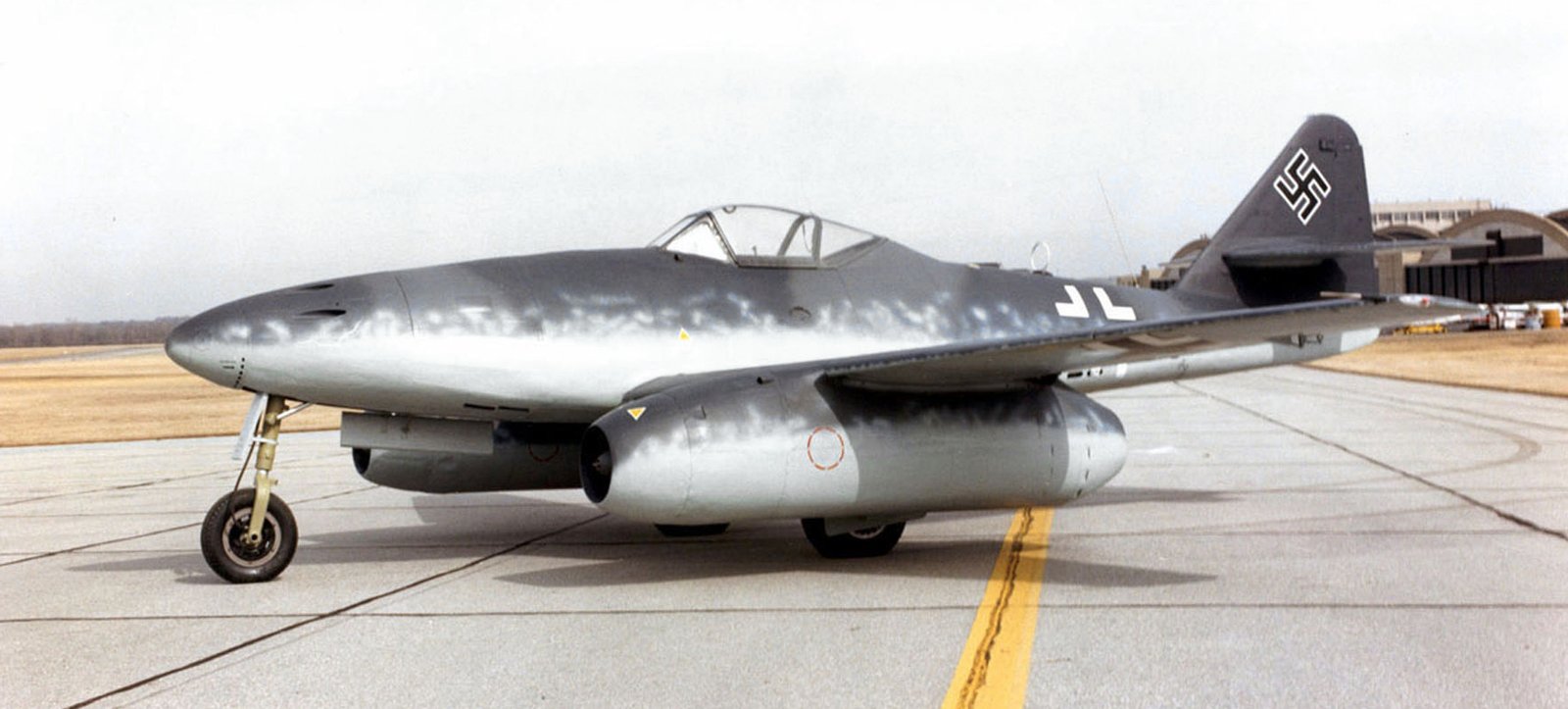
The Messerschmitt Me 262 was developed by Messerschmitt AG in Germany, beginning as Projekt 1065 in 1939. Under the design leadership of Willy Messerschmitt, the aircraft underwent a phased development process. A piston-engined prototype first flew on April 18, 1941, powered by a Junkers Jumo 210 engine, while the first jet-powered flight occurred on July 18, 1942, utilizing two Junkers Jumo 004 turbojets.
Production of the Me 262 began in April 1944 and continued until April 19, 1945. To protect the program from Allied bombing, manufacturing was dispersed across various Bavarian facilities in Augsburg, Regensburg, and Obertraubling, as well as underground sites in southern Germany, Austria, and Czechoslovakia. Total production figures vary due to fragmented records, but estimates generally range between 1,430 and 1,443 aircraft. Despite these numbers, only about 400 reached front-line units, and operational capacity was often limited; General Adolf Galland noted that no more than 25 jets were typically operational at any single time.
Technically, the Me 262 was far superior in speed to contemporary Allied fighters, reaching maximum speeds between 540 and 559 mph. It was powered by two Junkers Jumo 004 axial-flow turbojets, each producing approximately 1,980 lbf of thrust. The aircraft was designed for multi-role utility: the A-1a "Schwalbe" served as a high-speed interceptor armed with four 30 mm MK 108 cannons, while the A-2a "Sturmvogel" functioned as a fighter-bomber capable of carrying up to 2,000 lb of bombs. Other specialized variants included reconnaissance and radar-equipped night fighters.
Operational service took place during World War II, primarily from mid-1944 to May 1945. Notable units included Jagdgeschwader 7 (JG 7), the first operational jet wing formed in January 1945, and Jagdverband 44 (JV 44), an elite unit led by Adolf Galland. German pilots claimed 542 Allied aircraft destroyed, though these figures are contested. The Me 262's legacy persisted post-war as the United States, United Kingdom, Soviet Union, and France evaluated captured aircraft. Czechoslovakia further produced the Avia S-92 and CS-92 variants, which served until 1951. Today, original airframes are rare, with "White 35" displayed at the U.S. Naval Aviation Museum, while modern replicas continue to be produced under Project 262.