
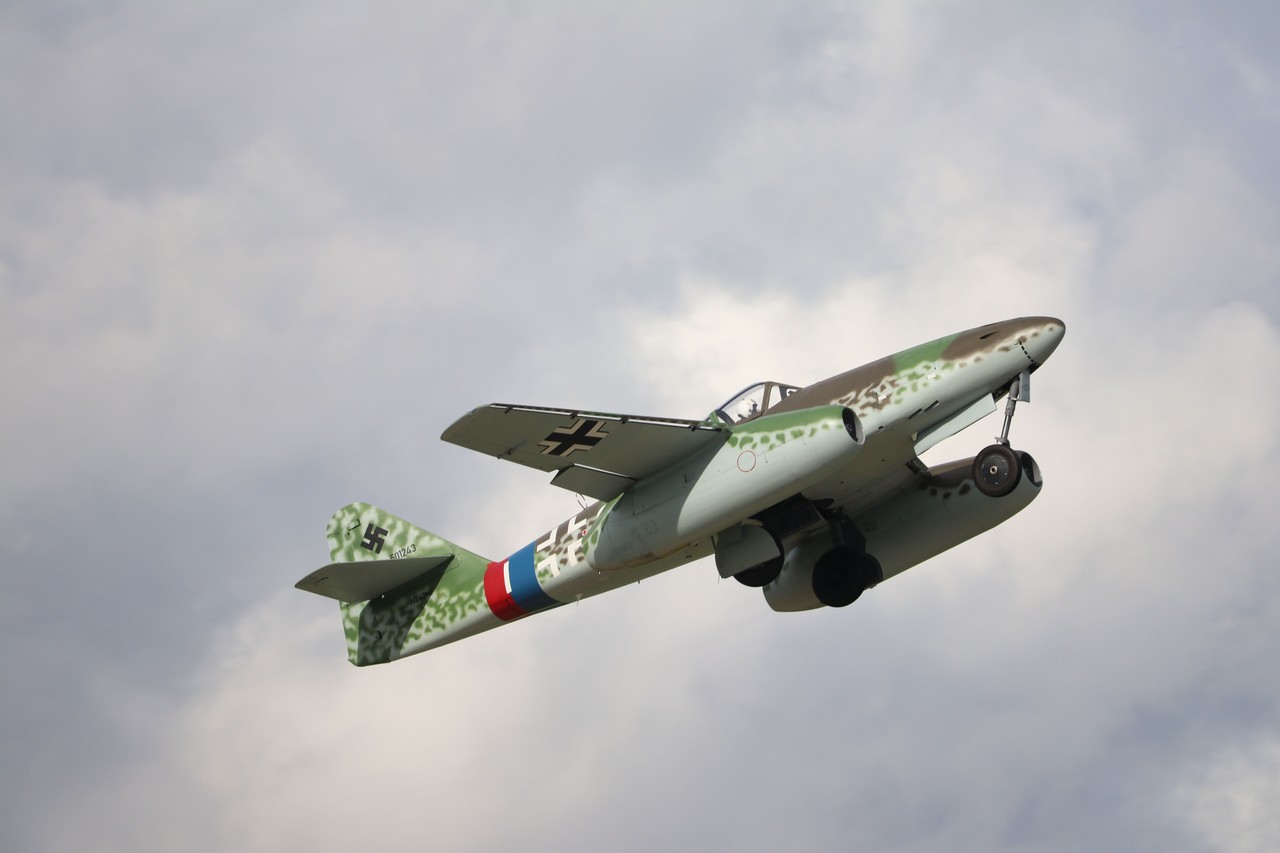
Project 262: Bringing History Back to Life
The Me 262 replica program emerged from a desire to preserve one of aviation's most significant aircraft in flying condition. Construction began on July 1, 1993, in Texas, using an original two-seater training aircraft (Me 262 B-1a/U1, Werknummer 121448) from the U.S. Navy as the master template. The ambitious project required extensive research, utilizing fragments of original wartime drawings and careful analysis of surviving airframes to ensure historical accuracy.
Five replica variants were ultimately constructed through the mid-1990s, with main assembly occurring in 1996. The program's crowning achievement came on August 15, 2005, when the first replica took to the skies over Seattle, marking the return of the Me 262 design to operational status after more than half a century.
Engineering Improvements Over the Original
While maintaining the external appearance and flight characteristics of the original Schwalbe, the replicas incorporated crucial safety and reliability improvements. The most significant upgrade involved replacing the problematic Junkers Jumo 004B turbojets with modern General Electric CJ610 engines. Each replica produces 2 × 13.8 kN (1,406 kp) of thrust compared to the original's 2 × 8.9 kN (910 kp), providing not only greater power but exponentially improved reliability.
The original Jumo engines were so unreliable that they frequently required replacement after single flights, a limitation that made the wartime Me 262 as much a maintenance nightmare as a revolutionary fighter. The modern engines solved this fundamental problem, allowing the replicas to operate safely for demonstration flights, research purposes, and historical preservation activities.
Additional safety enhancements included upgraded braking systems and strengthened landing gear, addressing known weaknesses in the original design without compromising its historical authenticity.
The Revolutionary Original Design
Willy Messerschmitt's team began developing what would become the Me 262 in April 1939, before World War II began. The design competed with Ernst Heinkel's experimental He-280 and was selected for production because it was specifically engineered around the Junkers Jumo 003 axial-flow engine technology.
The original aircraft first flew with piston power on April 18, 1941, but achieved its historic first jet-powered flight on July 18, 1942. This milestone marked the dawn of the jet age in combat aviation, introducing performance capabilities that rendered piston-engine fighters obsolete overnight.
Wartime Service and Combat Record
Despite beginning serial production in 1944, the Me 262's impact on World War II remained limited by manufacturing constraints and strategic mismanagement. Production peaked with 28 aircraft delivered in June 1944, 59 in July, but dropped to only 20 in August due to Allied bombing campaigns targeting manufacturing facilities.
Approximately 1,400 Me 262s were built during the war, but fewer than 100 remained combat-ready at any given time. The aircraft entered operational service in August 1944, with German pilots initially claiming 19 Allied aircraft destroyed for the loss of only six Me 262s.
Major General Adolf Galland, who personally flew the Me 262 on April 22, 1943, later commanded Jagdverband 44, an elite unit of Luftwaffe aces flying the revolutionary fighter. Despite the aircraft's superior performance, Allied air dominance and effective fighter sweep tactics prevented the Me 262 from significantly affecting the war's outcome.
Manufacturing Under Pressure
Wartime production was dispersed across numerous facilities to avoid Allied bombing, including clearings in German forests and underground factories. The most significant underground facility was the B8 Bergkristall-Esche II complex beneath St. Georgen/Gusen in Austria, where slave laborers produced fully equipped fuselages at 450 units monthly from early 1945.
Allied bombing campaigns targeted major production sites throughout 1945, destroying approximately 60 Me 262s at Obertraubling and 30 at Leipheim, while bombing the Neuburg jet plant on March 19, 1945.
Legacy and Modern Preservation
Of the more than 1,500 Me 262s produced during and immediately after the war, only eight to ten original aircraft survive today, making the replica program crucial for preserving this revolutionary design in flying condition.
The replica aircraft carry serial numbers continuing from where wartime production ended (Werknummer 501241, 501243, 501244). Werknummer 501241 was delivered to a private owner in the southwestern United States, while 501244 went to the Messerschmitt Foundation at Manching, Germany. The Military Aviation Museum operates serial number W.Nr.501243, which first flew in 2011.
These flying replicas serve as tangible links to aviation history, demonstrating the revolutionary technology that bridged the gap between propeller-driven fighters and modern jet aircraft, while solving the reliability issues that plagued the original design.