
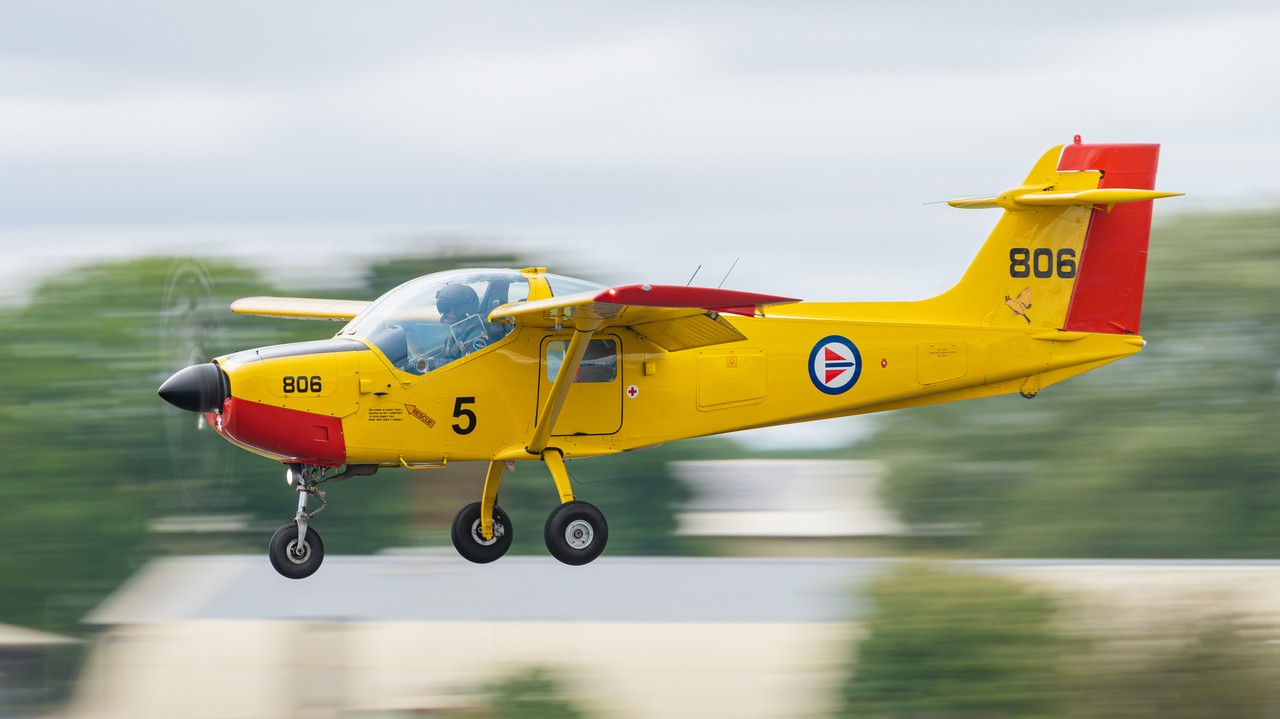
Service History
The MFI-17 Supporter achieved extraordinary global penetration as a military trainer, with 477 aircraft of the Safari/Supporter family remaining in active service as of 2022. This remarkable longevity established the type as one of the most commonly used training aircraft worldwide. The aircraft's success stemmed from its dual capability as both a primary trainer and light counter-insurgency platform, filling a crucial niche for air forces requiring versatile, economical training solutions.
Pakistan became the type's most significant operator, initially contracting for 15 ready-to-fly aircraft in June 1974, followed by 107 knock-down kits assembled locally over eight years. The Pakistan Air Force designated the aircraft "Mushshak," meaning "Proficient" in Urdu, reflecting its role in training generations of Pakistani pilots. Denmark's Royal Danish Air Force and Army Air Service ordered 32 MFI T-17s on January 10, 1975, as direct replacements for aging de Havilland Chipmunks and Piper L-18C Super Cubs, with the first aircraft (T-401) delivered September 4, 1975.
Operational Development
The Supporter's military credentials were established through its enhanced design compared to the civilian MFI-15 Safari. Six underwing hardpoints distinguished the MFI-17 from its predecessor, enabling weapons training and light ground-attack missions that civilian variants could not perform. This capability made the aircraft valuable for counter-insurgency operations while maintaining its primary training mission.
Zambia's Air Force acquired 20 MFI-17s beginning in 1977, while Norway's Royal Norwegian Air Force operated 16 aircraft for basic military training. Sierra Leone's Armed Forces utilized two aircraft for training and liaison duties, demonstrating the type's adaptability to various operational requirements and economic constraints.
The Manufacturer
Malmö Flygindustri, operating as part of Svenska Aeroplan Aktiebolaget (SAAB), developed the MFI-17 as an evolution of their successful light aircraft program. SAAB had established itself as Sweden's premier aerospace manufacturer, producing everything from fighters to commercial aircraft. The company's expertise in military aviation informed the Supporter's robust design, incorporating features like strengthened wings and T-tail configuration specifically for military training environments.
Production ran from 1972 to 1979 at SAAB's facilities, with the company manufacturing 250 fully assembled aircraft while supplying 212 knock-down kits to Pakistan. This hybrid production model proved economically successful, allowing SAAB to maintain quality control while enabling international partners to develop local aerospace capabilities.
Engine and Technical Innovation
The MFI-17 Supporter utilized an Avco Lycoming IO-360-A1B6 air-cooled flat-four engine, representing an upgrade from the IO-320 powerplant used in early MFI-15 prototypes. This 180-horsepower engine provided reliable performance in demanding training environments while maintaining relatively simple maintenance requirements crucial for military operators.
The aircraft's T-tail configuration became a signature design feature, positioning the horizontal stabilizer above propeller wash and reducing damage risk during rough-field operations. Internal fuel tanks within the strengthened wings increased operational range while the six hardpoints could accommodate various training weapons and external stores up to light combat loads.
Production Legacy and Continued Success
Pakistan's acquisition of manufacturing rights in 1981 marked a pivotal moment in the aircraft's history. Pakistan Aeronautical Complex produced its first locally manufactured Mushshak in September 1983, designated 83-5117. Between 1983 and 1997, PAC built 180 additional Mushshak aircraft, demonstrating the design's continued relevance and Pakistan's commitment to the platform.
The ultimate evolution came with PAC's MFI-395 Super Mushshak in 1995, featuring a more powerful 260-horsepower engine, modern electrical instruments, dual flight controls, and Bendix RSA fuel injection. This advancement proved the original MFI-17 design's fundamental soundness, capable of accommodating significant technological upgrades while maintaining its core training mission effectiveness.
Today, the Supporter family represents one of aviation's most successful trainer aircraft programs, combining Swedish engineering excellence with proven operational reliability. The aircraft's ability to serve both basic training and operational roles continues attracting air forces worldwide, ensuring the type's relevance well into the 21st century.