
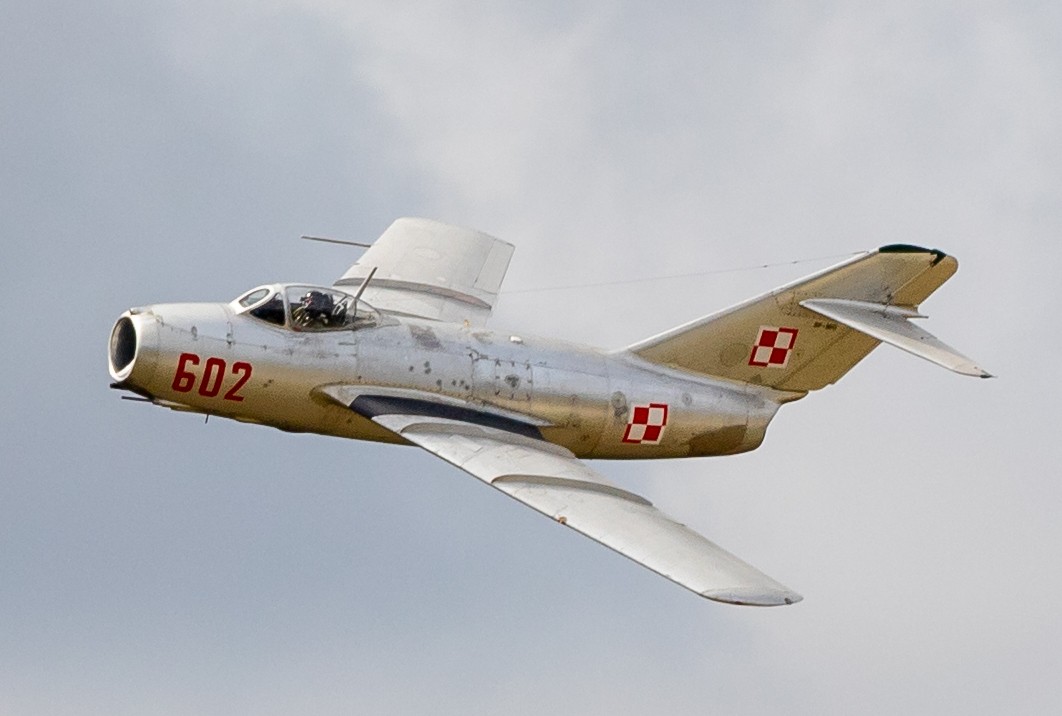
Combat Dominance in Korea
The MiG-15 fundamentally altered the balance of air power during the Korean War from 1950 to 1953. Operating primarily from bases in Manchuria, Soviet pilots of the 64th Fighter Aviation Corps achieved air superiority over northwest Korea in the region dubbed "MiG Alley." Soviet records claim their MiG-15s destroyed 1,106 United Nations aircraft, including 647 F-86 Sabres and 65 B-29 bombers. The fighter's first major success came in November 1950 when MiG-15s claimed 29 enemy aircraft, with 23 matching confirmed UN losses.
Soviet ace Yevgeny Pepelyaev emerged as the conflict's leading pilot with 23 confirmed victories flying the MiG-15. The aircraft's superior climb rate and high-altitude performance allowed it to effectively intercept B-29 formations, forcing the United States to abandon daylight bombing missions over North Korea. Chinese and North Korean pilots began operating MiG-15s from 1952, though with less success than their Soviet counterparts.
The Mikoyan-Gurevich Legacy
Artyom Mikoyan and Mikhail Gurevich established their design bureau in 1939, but the MiG-15 transformed them from secondary players into jet fighter leaders. Working at OKB-155, their team began with the I-310 prototype, which first flew on December 30, 1947. The production MiG-15 followed exactly one year later on December 31, 1948, with serial number 101003 designated as the MiG-15 SV.
The design bureau underwent several reorganizations and mergers throughout its history, eventually becoming part of the United Aircraft Corporation in 2006. Today, the legacy continues under UAC and Rostec subsidiaries, which produce modern fighters including the MiG-35, maintaining the MiG lineage that began with this groundbreaking aircraft.
Revolutionary Design and Engineering
The MiG-15's 35-degree swept wings represented cutting-edge aerodynamic design in 1948, providing crucial stability at transonic speeds when most Western fighters still employed straight wings. Design objectives called for a high-altitude interceptor capable of 621 mph with a 745-mile range, specifically engineered to counter American bombers like the B-29.
Powering this performance was the Klimov VK-1 turbojet, a reverse-engineered version of the British Rolls-Royce Nene engine. After the Soviet Union acquired Nene engines from Britain in 1946, the Klimov Design Bureau created their own version producing 26,5 kN of thrust. This powerplant proved remarkably reliable and simple to maintain, crucial factors for operation by minimally trained conscript crews.
Global Production and Variants
Full-scale production commenced in 1949 across multiple Soviet factories, with four facilities repurposed by discontinuing other aircraft types to meet MiG-15 demand. Total production reached approximately 18,000 aircraft, making it history's most-produced jet fighter. The Soviet Union manufactured 12,000 to 13,000 examples, while licensed production added another 6,000 aircraft.
Poland built the type as the Lim-2, Czechoslovakia produced it as the S-102 and S-103, and China manufactured their version designated Ji-2. The improved MiG-15bis incorporated refinements and served as the standard production variant. A two-seat trainer version, the UTI, provided conversion training for pilots transitioning from propeller aircraft to jets.
Operational Excellence and Pilot Experience
Pilots praised the MiG-15's exceptional turning ability and climb performance, which proved superior to early American jets including the F-80 Shooting Star and F-84 Thunderjet. The aircraft's design philosophy emphasized agility over pure speed, creating a fighter optimally suited for dogfighting rather than high-speed interception missions.
The MiG-15 could reach altitudes where it significantly outperformed contemporary Western aircraft, forcing American bomber crews to adopt new tactics and eventually abandon certain mission profiles entirely. Its fuel capacity of 1,420 liters provided adequate range for interceptor missions while maintaining the performance advantages that made it so effective.
Enduring Impact and Museum Preservation
At least 41 nations operated the MiG-15 during its service life, with North Korea continuing to use trainer variants into 2026. Combat losses included 335 Soviet aircraft from all causes, 224 Chinese examples, and approximately 100 North Korean machines, totaling around 659 MiG-15s lost during the Korean conflict.
Today, several MiG-15s remain in flying condition, including a 1951 MiG-15bis operated by the Planes of Fame Air Museum bearing serial number 910-51. The National Air and Space Museum displays a Chinese Ji-2 with serial 4320, while the MAPS Air Museum exhibits a MiG-15 UTI trainer. These preserved examples represent a fighter that fundamentally changed jet aviation, introducing swept-wing design to mass production and establishing performance benchmarks that influenced fighter development for decades.