
Global Production Success
The MiG-17 achieved remarkable production success, with total manufacturing exceeding 10,000 aircraft worldwide. Soviet factories produced between 8,000 and 10,600 units from late 1951 through the late 1950s, reaching peak output of 300 aircraft per month. Licensed production expanded the type's reach significantly, with Poland manufacturing over 1,500 as the PZL-Mielec Lim-6, China producing more than 1,500 as the Shenyang J-5, Czechoslovakia building the S-104 variant, and East Germany contributing additional units.
Combat Service Across Decades
Entering Soviet service in October 1952, the MiG-17 became the backbone of communist air forces for three decades. During the Vietnam War from 1965 to 1973, North Vietnamese Air Force MiG-17s proved formidable opponents despite facing more advanced American fighters. On May 20, 1967, USAF Colonel Robin Olds and First Lieutenant Stephen B. Croker scored notable victories against two Vietnamese MiG-17s using AIM-7 Sparrow and AIM-9 Sidewinder missiles from their F-4 Phantom.
The fighter served in numerous Middle Eastern conflicts and operated with more than 20 air forces including the USSR, Warsaw Pact nations, Egypt, Cuba, Syria, Afghanistan, and North Korea. Poland's 11th Fighter Aviation Regiment began flying the type in July 1958, while North Korea continued operating MiG-17s well into the 21st century.
Design Bureau Heritage
The Mikoyan-Gurevich Design Bureau, founded in 1939 by Artem Mikoyan and Mikhail Gurevich, established itself as the Soviet Union's premier fighter aircraft organization. The bureau evolved through various state-directed reorganizations, becoming the Mikoyan OKB and later the Mikoyan Aircraft Scientific-Industrial Complex. Today it operates as part of United Aircraft Corporation under Rostec, continuing to produce modern fighters like the MiG-35.
Revolutionary Design Features
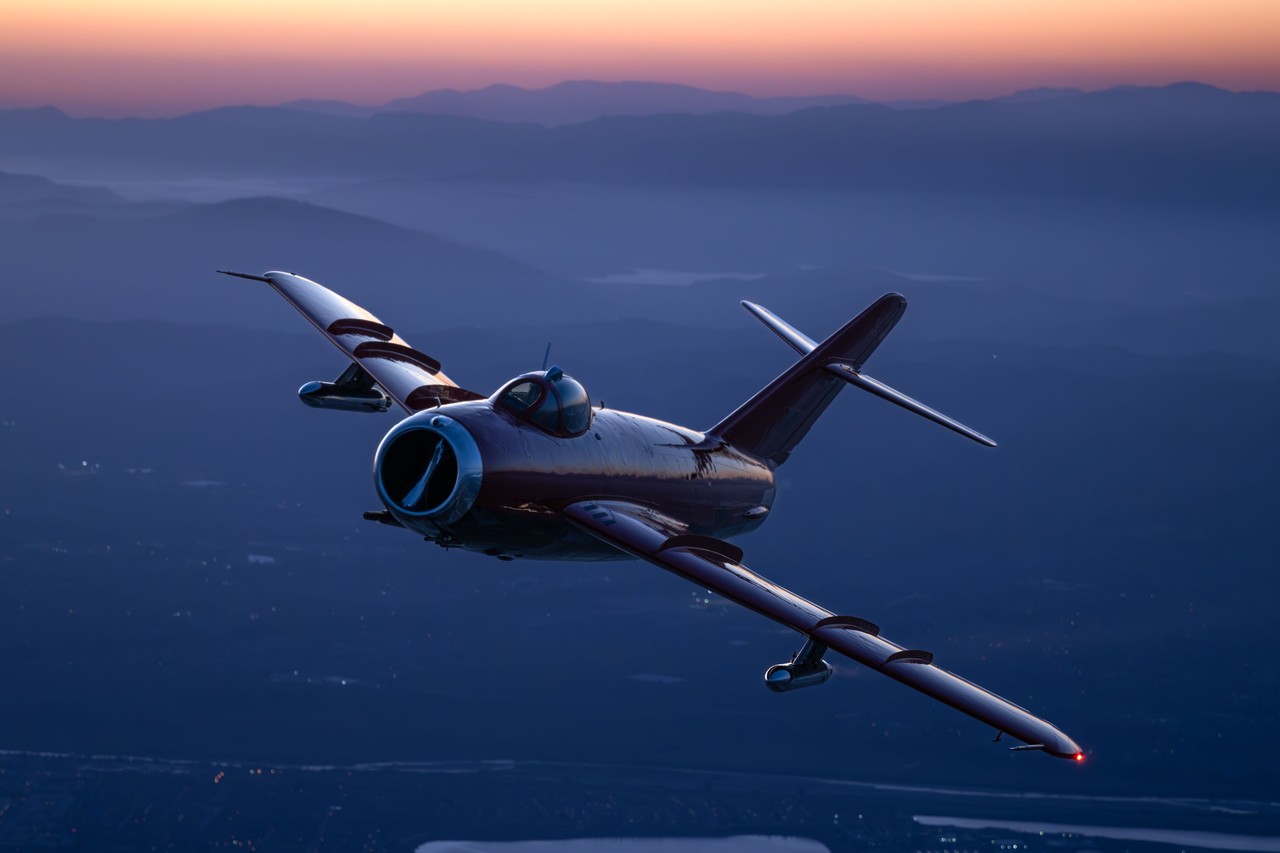
Artem Mikoyan and Mikhail Gurevich developed the MiG-17 as an evolution of their successful MiG-15, incorporating crucial improvements for transonic flight. The design featured compound wing sweep angles of 45 degrees inboard and 42 degrees outboard, with three wing fences per wing and a ventral fin for enhanced stability. These modifications allowed the aircraft to exceed the MiG-15's Mach 0.92 limitation and achieve controlled flight beyond the sound barrier.
The prototype, designated SI-1 or I-330, first flew on January 14, 1950, demonstrating the effectiveness of these aerodynamic refinements. The aircraft became the first Soviet fighter equipped with an afterburner when the MiG-17F variant entered production with the VK-1F engine.
Powerplant Performance
The Klimov VK-1F turbojet engine, a Soviet development based on the Rolls-Royce Nene, powered later MiG-17 variants with impressive performance. Producing 7,500 pounds of thrust with afterburner and 6,000 pounds dry, the engine enabled the fighter to achieve maximum speeds of 712 mph and climb rates of 12,800 feet per minute. Service ceiling reached 57,000 feet, while combat radius extended to 1,280 miles with external fuel tanks.
Variant Development
The MiG-17 family expanded through four main variants, each designated with NATO reporting names beginning with "Fresco." The basic MiG-17 (Fresco-A) lacked afterburner, while the MiG-17F (Fresco-C) introduced the VK-1F afterburning engine. The MiG-17PF (Fresco-D) added radar capability for night fighting, and the MiG-17PFU (Fresco-E) incorporated air-to-air missiles for enhanced interception capability.
Armament typically consisted of one 37mm N-37 cannon and two 23mm NR-23 cannons, with underwing pylons capable of carrying 1,100 pounds of bombs, rockets, or fuel tanks. This versatility enabled the aircraft to serve effectively in both air-to-air and ground-attack roles.
Preservation and Legacy
Approximately 10 MiG-17s remain airworthy today, primarily converted from military service. Notable examples include N717MG, a Polish Lim-5 built on April 30, 1958, which made its last Polish military flight on November 17, 1990. Major museums preserve the type's legacy, including the San Diego Air & Space Museum's ex-East German example in North Vietnamese colors, Hill Aerospace Museum's MiG-17F (serial 1C0406), and Planes of Fame Air Museum's Polish-built Lim-5 from 1959.
The MiG-17 stands as an iconic Cold War symbol, representing Soviet aviation export success and the bridge between subsonic and supersonic fighter generations. Its widespread service and production numbers established it as the most successful transonic Soviet fighter, paving the way for later MiG-19 and MiG-21 developments.