
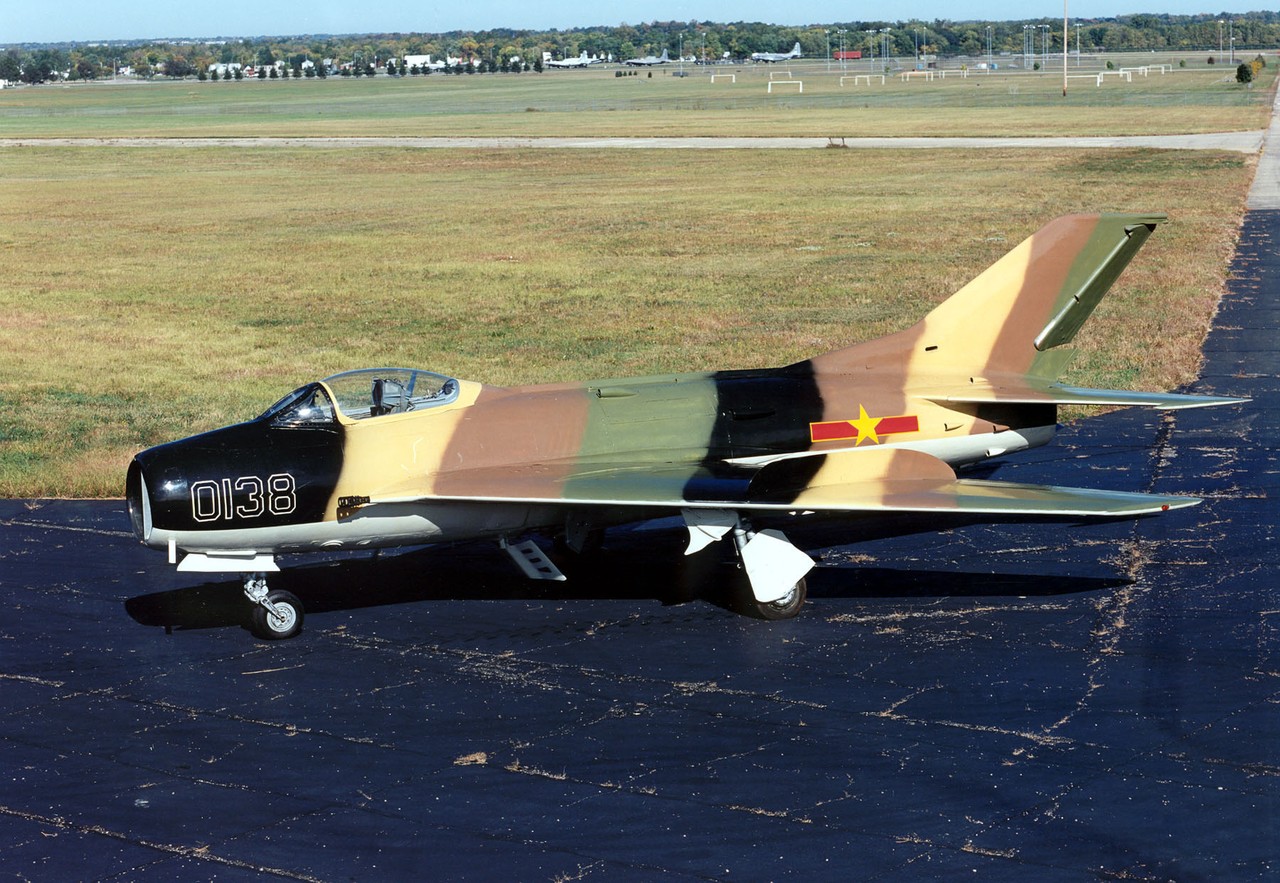
Breaking the Sound Barrier
The MiG-19 emerged from the competitive atmosphere of the early Cold War, when Soviet designers faced urgent pressure to match Western supersonic fighters like the North American F-100 Super Sabre. Led by Artem Mikoyan and Mikhail Gurevich at OKB MiG, the design team evolved their concept from the experimental I-360 prototype of 1952. The resulting SM-9/1 prototype achieved its maiden flight on January 5, 1954, leading to production approval just six weeks later on February 17, 1954.
Operational Service and Combat History
The MiG-19 entered Soviet Air Force (VVS) service in March 1955, followed by air defense forces (PVO) later that year. The aircraft made its public debut in spectacular fashion when 48 MiG-19s participated in a mass flyover at the Tushino airshow on July 3, 1955, demonstrating Soviet supersonic capabilities to the world.
While the MiG-19 saw limited action in major conflicts, its export variants played significant roles in regional wars. Chinese-built J-6 variants fought extensively during the Vietnam War throughout the 1960s and 1970s. Pakistani F-6 fighters, derived from the Chinese J-6, engaged in combat during the 1971 Indo-Pakistani War. Iraqi MiG-19s, delivered between 1959 and 1960, saw minimal action before being transferred to Egypt around 1964.
Design Innovation and Technical Excellence
The MiG-19's twin Tumansky RD-9B engines each produced 7,450 pounds of thrust with afterburner, enabling the aircraft to achieve Mach 1.3 in level flight—a first for Soviet production fighters. The engines, originally developed from the troublesome AM-5 design, proved reliable for supersonic dashes but demanded intensive maintenance. This powerplant configuration allowed the aircraft to climb at an impressive rate of 180 meters per second and reach a service ceiling of 57,415 feet.
The aircraft's conventional swept-wing design incorporated lessons learned from earlier MiG fighters while introducing innovations necessary for sustained supersonic flight. The fuselage stretched 41 feet 2 inches, optimized for the twin-engine configuration and supersonic aerodynamics.
Production Variants and Global Reach
Soviet and Czechoslovak factories produced 2,172 MiG-19s between 1954 and 1968. The primary variants included the baseline MiG-19 "Farmer-A" with three 23mm NR-23 cannons, the improved MiG-19S day fighter (317 built), the radar-equipped MiG-19P all-weather interceptor (443 built), and the missile-armed MiG-19PM (369 built) introduced in 1957.
Chinese production as the J-6 exceeded 3,000 aircraft, continuing into the 1980s and pushing total production beyond 10,000 units across all variants. Czechoslovakia manufactured approximately 100 aircraft as the S-105 between 1958 and 1961 at the Avia Vodochody facility.
The Manufacturer's Legacy
Mikoyan-Gurevich, founded as a design bureau in 1939, established itself as the Soviet Union's premier fighter manufacturer with iconic aircraft including the MiG-15, MiG-17, and later the MiG-21. Following Artem Mikoyan's death in 1970, the company reorganized as the Mikoyan design bureau. After the Soviet collapse in 1991, it evolved into the Mikoyan Joint Stock Company and currently operates as Mikoyan within Russia's United Aircraft Corporation.
International Operators
The MiG-19 served with air forces across more than 20 nations, including major operators such as the Soviet Union, China, Poland, Egypt, Iraq, North Vietnam, Pakistan, Afghanistan, Albania, Bulgaria, Cuba, East Germany, Hungary, Indonesia, North Korea, Romania, Syria, and Zambia. This widespread adoption demonstrated the aircraft's effectiveness and the Soviet Union's growing influence in military aviation exports.
Legacy and Current Status
Despite being overshadowed by the more famous MiG-17 and MiG-21, the MiG-19 proved crucial in establishing Soviet supersonic fighter technology. Production ceased in the Soviet Union by the early 1960s as the more advanced MiG-21 entered service, but Chinese variants continued flying well into the 1980s.
Today, few MiG-19s remain operational, with most survivors being Chinese J-6 or F-6 variants still serving in limited numbers with air forces in Pakistan, Tanzania, and Zambia. Museum examples can be found across Eastern Europe, Russia, and China, though many facilities housing these aircraft have since closed, including the notable MiG-19PM displayed at Hungary's Taszár base museum until 2005.
The aircraft's influence extended beyond its service life, directly contributing to the development of the Nanchang Q-5 attack aircraft, which first flew on June 5, 1965, using MiG-19 technology as its foundation.