
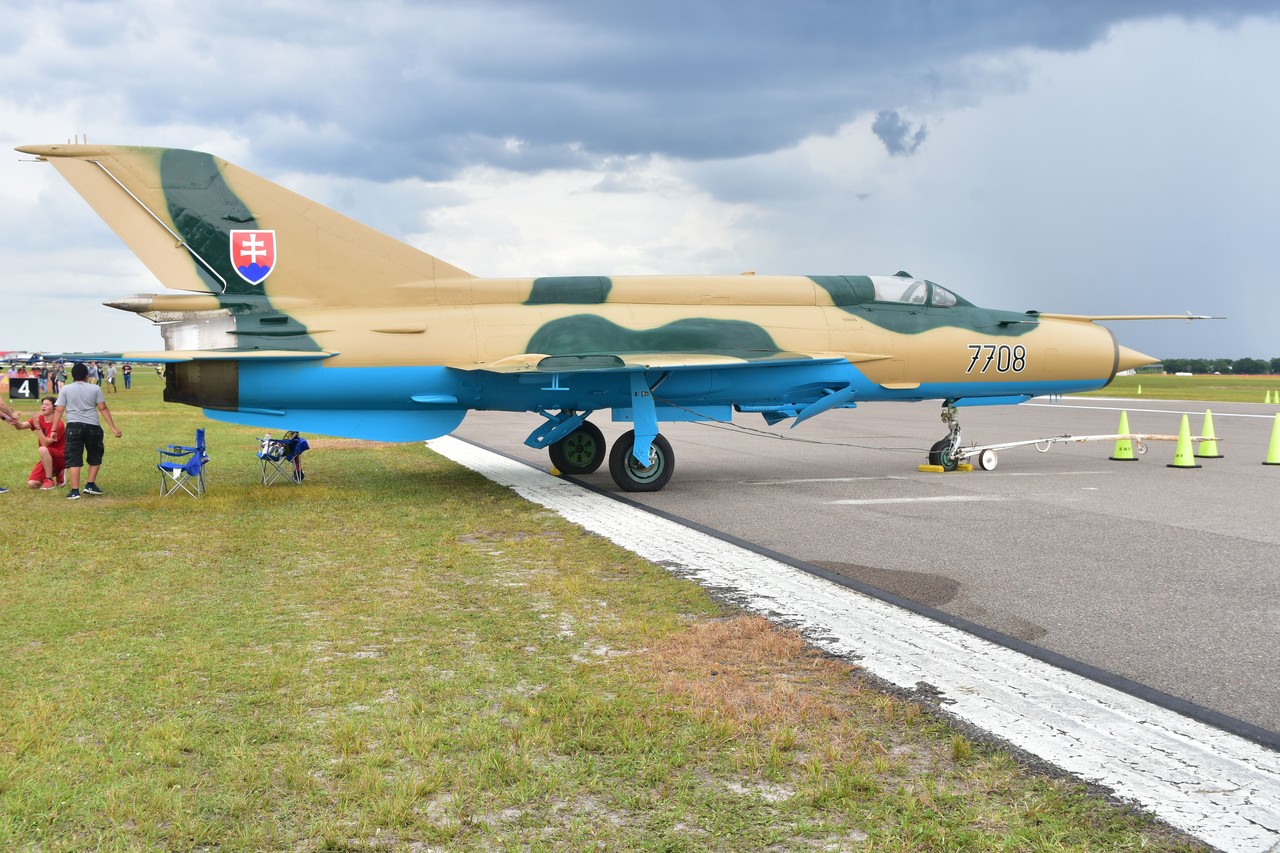
Operational Dominance
The MiG-21 achieved unprecedented global reach, with more than 60 countries operating the type during its service life. By the 1970s, the aircraft equipped the primary fighter squadrons of nations across Eastern Europe, Asia, Africa, and the Middle East. Over 3,000 examples remain in active service today, testament to the design's enduring utility and robust construction.
Combat Heritage
The MiG-21 proved its mettle in numerous Cold War conflicts, beginning with the Vietnam War from 1966 to 1973. North Vietnamese pilots flying MiG-21s claimed more than 120 American aircraft, with Captain Nguyen Van Coc achieving nine confirmed victories to become the conflict's leading MiG-21 ace. During the 1973 Yom Kippur War, Egyptian and Syrian MiG-21s engaged Israeli forces in intense air battles over the Sinai Peninsula and Golan Heights.
The type saw extensive action during the Indo-Pakistani Wars of 1965 and 1971, where Indian Air Force pilot Sultan Singh distinguished himself as a MiG-21 ace. Soviet forces later employed the aircraft during the Afghanistan conflict from 1979 to 1989, adapting the interceptor for ground attack missions in mountainous terrain.
The Mikoyan Legacy
Artem Mikoyan and Mikhail Gurevich established their design bureau in 1939, creating a series of successful fighters including the MiG-15, MiG-17, and MiG-19 before developing the MiG-21. Under Mikoyan's leadership, the design team prioritized simplicity, speed, and mass production capability over sophisticated avionics or extended range. Following the Soviet Union's dissolution in 1991, the company evolved into Mikoyan JSC, later becoming part of the United Aircraft Corporation in 2006. Today, Mikoyan continues operations as a subsidiary, developing advanced fighters like the MiG-35.
Engineering Excellence
The MiG-21's Tumansky R-11 turbojet engine, manufactured at the Kaluga Engine Plant, provided the thrust necessary for Mach 2.05 performance while maintaining mechanical simplicity for field maintenance. Later variants received the more powerful R-25-300 engine, generating up to 14,000 pounds of afterburning thrust. The aircraft's area-ruled fuselage and tailed delta wing configuration represented cutting-edge aerodynamics for the 1950s, making it the Soviet Union's first operational Mach 2 fighter.
Single-pilot operation kept cockpit systems deliberately straightforward, though this simplicity sometimes limited the aircraft's effectiveness in complex combat scenarios. The standard armament consisted of a 30mm GSh-23L cannon and provision for up to 4,400 pounds of external ordnance, including AA-2 Atoll air-to-air missiles and unguided rockets.
Pilot Experience
Pilots praised the MiG-21's exceptional climb rate and high-altitude performance, characteristics that made it deadly in hit-and-run interceptor missions. The aircraft's small size and nimble handling allowed experienced pilots to exploit its strengths in close combat, though limited fuel capacity restricted mission duration. Combat veterans noted the type's tendency toward demanding takeoff and landing characteristics, requiring precise pilot technique particularly in adverse weather conditions.
With a service ceiling of 57,400 feet and maximum range of 910 miles with external tanks, the MiG-21 excelled as a point-defense interceptor but struggled in extended patrol missions. Its 1,350 mph top speed at altitude provided a significant advantage over many contemporary Western fighters during the 1960s and early 1970s.
Production Achievement
Total production reached 11,496 aircraft between 1959 and 1985, making the MiG-21 the most numerous supersonic fighter in aviation history. Soviet factories at Moscow, Gorky, and Tbilisi produced 10,645 examples, while international licensing agreements resulted in 657 aircraft manufactured by Hindustan Aeronautics in India and 194 built in Czechoslovakia. China's Chengdu Aircraft Corporation produced over 2,400 copies as the J-7 and F-7, with final deliveries continuing until 2013.
Fourteen major variants emerged during the production run, from the early MiG-21F through the substantially improved MiG-21bis introduced in 1972. Specialized versions included the MiG-21R reconnaissance variant and the two-seat MiG-21U trainer, which introduced countless pilots to supersonic flight.
Enduring Legacy
Museum examples preserve the MiG-21's legacy worldwide, including specimens at the Smithsonian National Air and Space Museum, Combat Air Museum in Kansas, and Planes of Fame Air Museum in California. The aircraft earned the NATO reporting name "Fishbed" and the affectionate Soviet nickname "Balalaika" for its triangular planform resembling the traditional Russian stringed instrument.
The MiG-21's influence on fighter design philosophy extended far beyond its service life, demonstrating that relatively simple, affordable aircraft could achieve remarkable performance when properly engineered. Its 26-year production run and continued operational service six decades after first flight represent an unmatched achievement in military aviation history.