
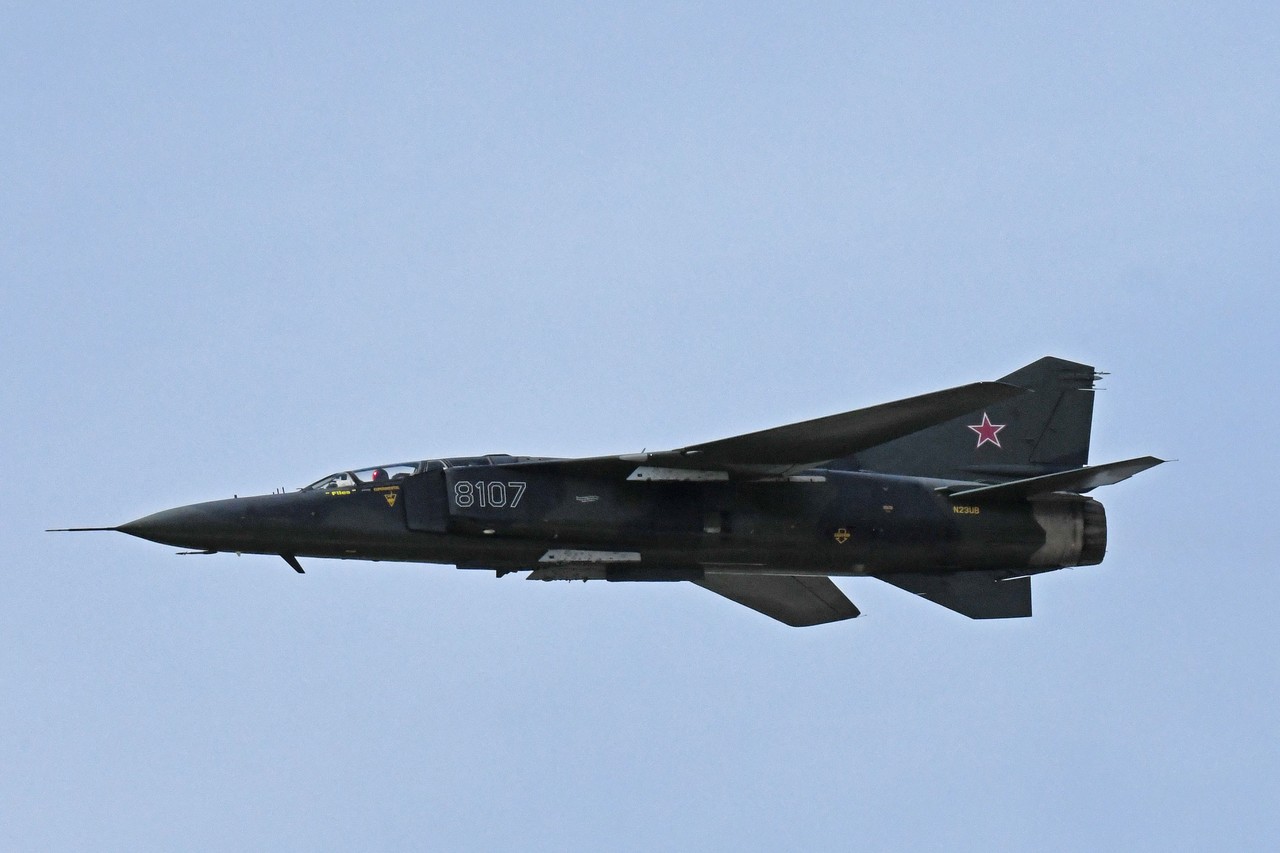
Development and Innovation
The MiG-23's development began in the early 1960s as Mikoyan's answer to the operational limitations of their highly successful but short-ranged MiG-21. By 1965, Soviet specifications called for a fighter with dramatically improved range and short-field performance capabilities. The design bureau initially pursued two competing prototypes: the conventional swept-wing 23-01 "Faithless" and the revolutionary variable-sweep 23-11. Test pilot A.V. Fedotov took the swing-wing 23-11 prototype aloft for its maiden flight on April 10, 1967, marking the beginning of a new era in Soviet fighter design.
The aircraft made its public debut at the Domodedovo air parade on July 9, 1967, revealing to Western observers the Soviet Union's entry into variable-geometry wing technology. Flight testing continued through 1968 with 98 recorded flights, demonstrating the design's fundamental soundness. The first production MiG-23S completed its initial flight on May 21, 1969, leading to operational introduction in 1970.
Revolutionary Technology
The MiG-23 represented several technological firsts for Soviet aviation. It became the first Soviet fighter equipped with look-down/shoot-down radar capability through its RP-23 Sapfir system, designated "High Lark" by NATO intelligence. This advancement allowed the aircraft to detect and engage targets flying below it against ground clutter, a significant tactical advantage. The fighter also pioneered Soviet beyond-visual-range missile capability, marking a fundamental shift in air combat doctrine.
The variable-sweep wing mechanism allowed pilots to optimize the aircraft's configuration for different flight regimes. Wings could be swept forward for maximum lift during takeoff and landing, positioned at intermediate angles for subsonic cruise efficiency, or swept fully back for supersonic dash performance up to Mach 2.6.
Production Variants and Service Entry
Serial production commenced in 1968 at the Irkutsk manufacturing facility, with the initial MiG-23S "Flogger-A" serving as an operational trials variant. Only 50 to 60 examples were built, equipped with the basic RP-22 "Jay Bird" radar system. The improved MiG-23SM "Flogger-B" followed as a pre-production evaluation model, with approximately 80 aircraft completed.
The definitive MiG-23M "Flogger-B," first flown in June 1972, became the primary mass-production variant. Mikoyan produced 769 examples of this model, which served as the backbone of Soviet interceptor regiments. For export customers, the company developed the downgraded MiG-23MS "Flogger-E," produced from 1973 to 1978 with restricted missile capabilities limited to AA-2 "Atoll" and AA-8 "Aphid" short-range weapons.
The enhanced MiG-23ML "Flogger-G," manufactured between 1976 and 1981, incorporated significant weight reductions and aerodynamic improvements. This variant represented the pinnacle of the basic MiG-23 design, offering improved performance and handling characteristics.
Powerplant Evolution
Tumansky turbojet engines powered all MiG-23 variants, with progressive improvements throughout the production run. Early MiG-23S aircraft utilized the R-27-300 engine, while later variants received increasingly powerful iterations. The export MiG-23MS featured the R-27F2M-300, generating 22,046 pounds of thrust. The advanced MiG-23ML switched to the Soyuz/Khachaturov R-35-300 powerplant, providing enhanced performance and reliability.
Operational Challenges and Combat History
Despite its technological sophistication, the MiG-23 faced significant operational difficulties in foreign service. Syria received its first examples in April 1974, but poor manufacturing quality, mechanical unreliability, and inadequate technical documentation plagued the deployment. By year's end, Syrian forces had written off 13 aircraft due to various problems, highlighting the challenges of operating complex Soviet equipment outside the Warsaw Pact infrastructure.
The aircraft saw extensive combat across multiple theaters, serving in conflicts throughout the Middle East, Asia, and Africa. Its service record proved mixed, with sophisticated systems often proving difficult to maintain in austere operating environments.
The Mikoyan Legacy
The Mikoyan-Gurevich design bureau, operating as OKB-155, brought decades of fighter development experience to the MiG-23 program. The organization's heritage traced back to World War II piston fighters including the MiG-1 and MiG-3, followed by the revolutionary MiG-15 "Fagot" that shocked NATO forces during the Korean War and prompted development of the North American F-86 Sabre as a direct counter.
Production Achievement and Decline
Between 1967 and 1984, Mikoyan produced approximately 5,047 MiG-23 fighters, making it the most numerous variable-sweep wing aircraft ever built. This production achievement demonstrated Soviet industrial capability and the design's fundamental utility despite operational challenges.
Serial production concluded in 1984 as more advanced designs entered development. The Russian Air Force began systematic decommissioning in 1993 as fourth-generation MiG-29 fighters became available in sufficient numbers. However, many export operators continued flying their MiG-23s well into the 21st century, testament to the aircraft's basic durability despite its complexity.