
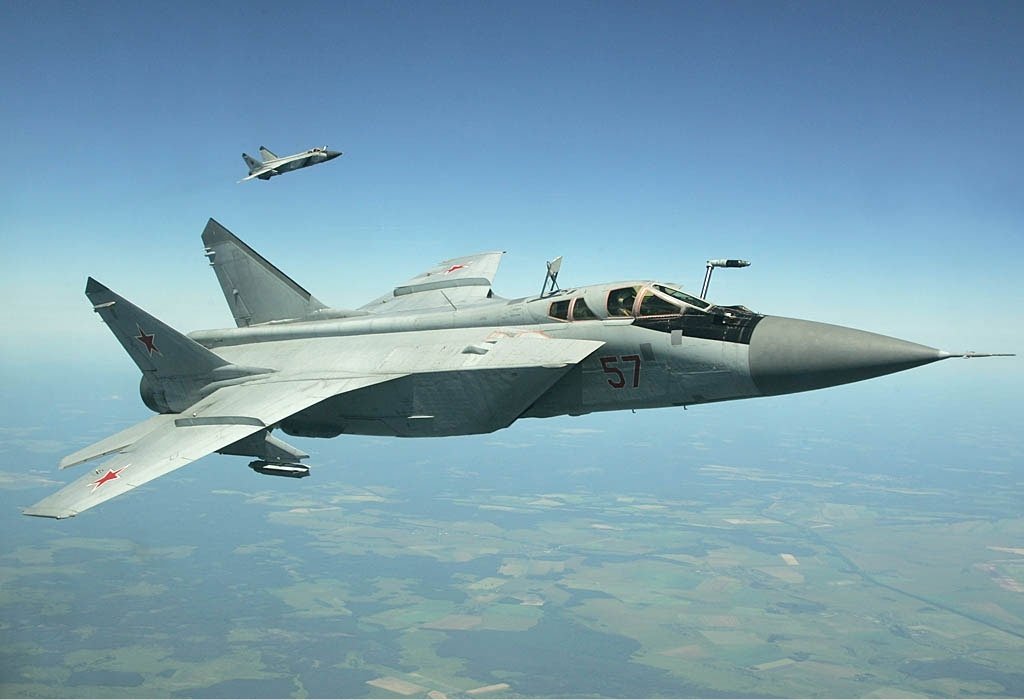
Revolutionary Interceptor Technology
The MiG-31's most groundbreaking feature was its Zaslon phased array radar system, making it the first fighter aircraft to employ this advanced technology. On February 15, 1978, a MiG-31 prototype successfully demonstrated its revolutionary capability by simultaneously tracking ten separate targets, a feat that established new standards for air defense interceptors. This technological leap allowed Soviet air defense forces to engage multiple high-altitude threats across vast territorial expanses.
Development and Design
Development of the MiG-31 began in 1967 under the Mikoyan Design Bureau, with the Soviet government formally ordering prototype construction on May 24, 1968. The design team, led by the Mikoyan organization, initially designated the project E-155MP as a successor to the MiG-25 interceptor. After years of refinement, the aircraft configuration featuring a fixed trapezoidal wing was approved in 1971.
The first prototype, designated E-155MP with side number 831, was completed at the Mikoyan Machine-building Plant in Moscow in 1975. Test pilot Aleksandr Fedotov conducted the maiden flight of the second prototype (number 832) on April 22, 1976. Production aircraft began flying in 1977, with aircraft number 012 taking flight on June 30 and number 011 following on July 13.
Production and Manufacturing
Series production commenced in 1979 at the Sokol Aircraft Plant in Nizhny Novgorod, continuing until 1994 when the final aircraft was delivered in April. Over this 15-year production run, approximately 450 MiG-31s were manufactured, with the baseline MiG-31 variant accounting for 349 of these aircraft. The final 69 aircraft were built as MiG-31B variants between 1990 and 1994, with 50 retained by Kazakhstan following the Soviet Union's dissolution.
Engine and Technical Specifications
The MiG-31's propulsion system consisted of two Soloviev D-30F-6 turbojet engines, selected after initial consideration of RD36-41M turbojets. These engines were developed by the Perm-based MKB Design Bureau under Chief Designer Pavel Solovyev. Later variants incorporated D-30F6M engines with increased thrust to accommodate the raised maximum takeoff weight of 52,000 kilograms for advanced models.
The aircraft's two-seat tandem cockpit housed a pilot and systems operator, essential for managing the complex radar and weapons systems. Primary armament consisted of R-33 long-range air-to-air missiles and GSh-6-23 cannons, each featuring six 23-millimeter barrels.
Operational Service
The MiG-31 entered operational service with Soviet Air Defense Forces in 1981, following comprehensive testing phases from May 1977 through September 1980. Initial operational capability was achieved by 1983, with the aircraft serving as the backbone of Soviet and later Russian air defense.
By 2017, the Russian Aerospace Forces maintained approximately 120 to 132 modernized MiG-31 variants in active service, with an additional 150 aircraft held in reserve. Kazakhstan operates 25 aircraft as of 2017, representing the only other nation to field the type operationally.
Variants and Modernization
Several variants emerged throughout the aircraft's service life. The MiG-31B entered service in 1990, followed by the extensively upgraded MiG-31BM in 2008 and MiG-31BSM in 2014. These modernized versions featured air refueling probes and improved canopies with heat-resistant glass enabling sustained cruise speeds of 3,000 kilometers per hour.
The most recent variant, the MiG-31K, achieved operational status in 2018 as a carrier for the Kh-47M2 Kinzhal hypersonic missile. Ten aircraft were modified to this configuration as of May 2018, adding a strategic strike capability to the interceptor's traditional air defense role.
Legacy and Current Operations
By 2018-2019, a total of 113 aircraft had been modernized to MiG-31BM/BSM standards under contracts signed with Sokol Aircraft Plant in 2011 and 2014. These upgrades ensure the Foxhound's continued relevance in modern air defense scenarios, maintaining its position as one of only two aircraft worldwide capable of independently firing long-range air-to-air missiles.
Despite export attempts to India, Israel, and Syria during the 1990s, no international sales materialized. China acquired a production license for 700 aircraft in 1992 but never utilized it. The MiG-31 remains exclusively operated by Russia and Kazakhstan, with approximately 45 aircraft lost to accidents and other causes by 2015.