
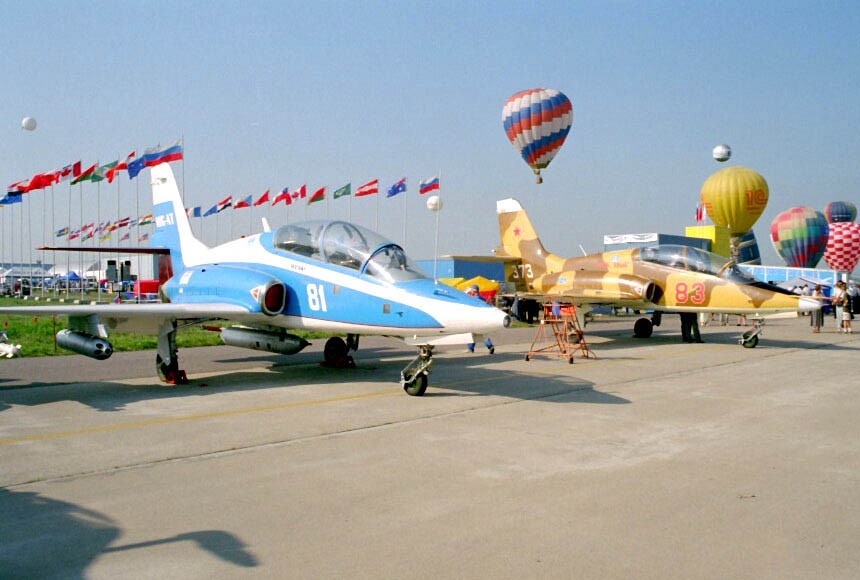
Development and Design Philosophy
The MiG-AT emerged from Russia's urgent need to replace aging Soviet-era trainers in the post-Cold War period. The Mikoyan Design Bureau embarked on an ambitious project to create not just another trainer, but a sophisticated aircraft that could simulate the handling characteristics of modern fighters like the MiG-29. The design incorporated fly-by-wire flight controls for inherent instability, composite materials, and a tandem cockpit equipped with heads-up displays, hands-on-throttle-and-stick controls, and multifunctional displays.
What made the MiG-AT truly remarkable was its international collaboration aspect. It represented the first Russia-France joint military aircraft project to achieve flight status, born from a 1992 partnership that highlighted the dramatic shift in post-Cold War relations. French companies provided the Snecma-Turbomeca Larzac 04-R20 engines and avionics packages specifically designed for Western export markets.
Manufacturing and Prototypes
The Moscow Aircraft Production Association (MAPO) undertook construction of the prototypes at their Moscow facilities. MAPO had merged with the Mikoyan Design Bureau in 1995 to form MAPO-MiG, creating a more integrated design and manufacturing entity. Despite severe financial constraints in 1990s Russia, MAPO managed to roll out the first prototype in May 1995 using self-funded resources, demonstrating remarkable determination in a challenging economic environment.
Only two prototypes were ever completed between 1995 and 1997. The aircraft utilized proven French turbofan technology originally developed in the 1970s for the Dassault/Dornier Alpha Jet. Each Larzac engine produced 14.12 kN of thrust and had accumulated extensive service experience across hundreds of Alpha Jet trainers worldwide. A November 1996 contract secured ten additional engines for planned pre-production aircraft that would never materialize.
Flight Testing and Performance
Test pilot Roman Taskayev lifted the first MiG-AT prototype into the sky on 21 March 1996 at Zhukovsky airfield. The inaugural flight lasted 45 minutes, reaching 1,200 meters altitude and 400 km/h, with a MiG-29UB and L-39 providing chase plane support. The aircraft demonstrated its design goals effectively, achieving a maximum speed of 1,000 km/h, operational range of 1,200 kilometers, and service ceiling of 14,000 meters.
By 2002, the two prototypes had accumulated an impressive 750 flights, proving the aircraft's basic airworthiness and design validity. Alternative powerplant options were explored during development, including the Russian Soyuz RD-1700 producing 16.7 kN thrust and the NPO Saturn AL-55I, as program planners sought to reduce dependence on French engines for domestic and certain export variants.
Planned Variants and Military Applications
The MiG-AT family was conceived as a flexible platform serving multiple roles. The baseline MiG-AT provided advanced training in a twin-seat configuration. The proposed MiG-AC variant featured a shortened fuselage accommodating a single pilot for dedicated light attack missions. Most ambitious was the MiG-ATC hybrid trainer-attacker, equipped with helmet-mounted displays and capable of deploying air-to-air missiles, air-to-surface missiles, and conventional bombs.
Marketing efforts targeted the Russian Air Force as the primary customer, seeking to replace thousands of aging Aero L-29 Delfins and L-39 Albatros trainers throughout former Soviet territories. International prospects included India, Greece, Algeria, UAE, Malaysia, and Commonwealth of Independent States air forces. Despite demonstration flights and the aircraft's certification by Russian military authorities in February 2004, no production orders materialized.
Competition and Cancellation
The MiG-AT's fate was sealed by direct competition with the Yakovlev Yak-130, which offered greater combat capability and more comprehensive training simulation. When the Russian Air Force competition concluded in 2002, the Yak-130's expanded operational envelope and superior attack capabilities proved decisive. The MiG-AT program was officially cancelled, ending nearly a decade of development work.
MAPO-MiG itself underwent further corporate changes, eventually becoming part of Russian Aircraft Corporation MiG (RAC MiG), which traces its lineage to the 1939 Mikoyan-Gurevich OKB founded by Artem Mikoyan and Mikhail Gurevich. Today, this heritage continues under the United Aircraft Corporation subsidiary, focusing primarily on MiG-29 and MiG-35 fighter development and production.
Legacy and Historical Significance
The MiG-AT made its final public appearance at the Paris Air Show in 2001, showcasing Russian aviation technology to international audiences. While no examples remain in flying condition today, the aircraft's significance extends beyond its limited prototype status. It represented a pivotal moment in Russian aviation history, demonstrating the industry's ability to pursue international partnerships and incorporate Western technology during a period of dramatic political and economic transition.
The program's failure highlighted the harsh realities facing Russian aerospace companies in the 1990s: limited domestic funding, intense international competition, and the challenge of maintaining technological relevance while preserving industrial capabilities. Rumors of program revival surfaced in 2018 but remain unconfirmed, leaving the MiG-AT as a fascinating "what-if" in military aviation history.