
Service History
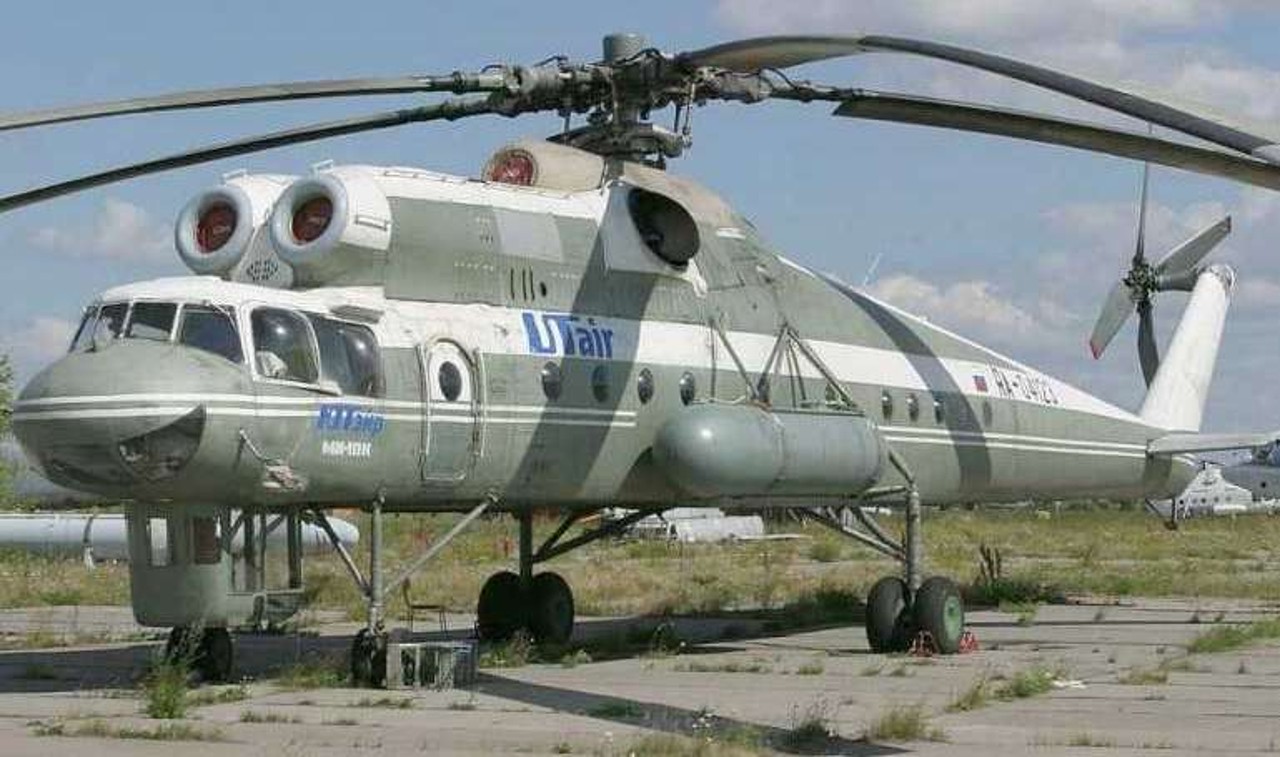
The Mi-10 established itself as the backbone of Soviet heavy construction operations, with the majority of its 55 aircraft serving under Aeroflot for infrastructure development in remote regions. The helicopter's unique design allowed it to transport oversized cargo that conventional aircraft could not handle, making it invaluable for oil rig installations, construction equipment delivery, and industrial module placement across the vast Soviet territory.
Only one Mi-10 ventured beyond Soviet borders during its operational years, exported to Petroleum Helicopters Inc. in the United States through a Dutch intermediary for oil and gas operations in Bolivia. This sole export demonstrated the aircraft's capabilities but also highlighted the limited international market for such specialized equipment during the Cold War era.
Military Operations
The Soviet Air Force operated the Mi-10 in limited numbers, primarily utilizing 20 specialized Mi-10PP variants equipped with "Steppe" electronic countermeasures jamming modules for battlefield operations. These aircraft served as airborne ECM platforms, representing one of the early applications of helicopter-based electronic warfare systems.
During the Soviet-Afghan War from 1979 to 1989, standard Mi-10 helicopters provided crucial cargo-lifting capabilities in the mountainous terrain where traditional transport aircraft could not operate effectively. The helicopter's ability to deliver supplies to remote outposts and extract heavy equipment proved invaluable in the challenging Afghan environment.
The Manufacturer
Mil Moscow Helicopter Plant emerged from the Soviet Union's post-war aviation expansion, founded by Mikhail Leontyevich Mil in 1947 as part of the nation's rotary-wing development initiative. The design bureau pioneered large Soviet helicopters, with the Mi-6 serving as the direct technological predecessor that enabled rapid Mi-10 prototyping and development.
Following the Soviet collapse, the company reorganized as part of Russian Helicopters, a subsidiary of Rostec through Oboronprom. Today, Mil continues operations within Russian Helicopters, while Rostvertol in Rostov-on-Don maintains responsibility for serial helicopter production. The company celebrated the 50th anniversary of the Mi-10's first serial production flight in September 2014.
Engine and Technical Innovation
Two Soloviev D-25V turboshaft engines powered the Mi-10, manufactured by the Soloviev Design Bureau, now incorporated into NPO Saturn. These proven powerplants had previously demonstrated their reliability in the Mi-6, enabling speeds exceeding 300 kilometers per hour and supporting the helicopter's impressive lifting capabilities.
The Mi-10's design incorporated a closed-circuit television system for cargo monitoring, an innovative feature that allowed pilots to observe slung loads during flight operations. This technological advancement significantly improved operational safety and precision during heavy-lift missions.
Record-Breaking Performance
Test pilot Raphael Kaprelyan achieved remarkable altitude records with the Mi-10 in 1965, lifting 15 tonnes to 2,840 meters and carrying 5 tonnes to 7,151 meters altitude. These achievements demonstrated the helicopter's exceptional performance envelope and established benchmarks for heavy-lift helicopter capabilities.
The prototype program experienced both triumph and tragedy. The first prototype crashed in May 1961, killing four of the five crew members aboard. A second prototype successfully flew and was displayed at the Tushino Air Show in July 1961, showcasing Soviet helicopter advancement to the world.
Production Variants
Production centered around two main variants: the original Mi-10 with tall landing gear optimized for pallet cargo operations, and the Mi-10K with shortened landing gear designed for slung-load operations. The Mi-10K, first flown on September 6, 1966, featured a glazed gondola beneath the fuselage housing a copilot for improved slung-load visibility.
Total production reached approximately 55 helicopters across all variants. The main series Mi-10 accounted for 40 aircraft built between 1964 and 1969, while 17 Mi-10K variants entered production beginning in 1974. Two of the Mi-10K aircraft were actually conversions from earlier Mi-10 helicopters. Production briefly resumed in 1977, though specific numbers for this period remain undocumented.
Legacy and Current Status
By the end of the 20th century, most Mi-10 helicopters had retired from active service, with only a handful continuing operations into the early 2000s. The aircraft's specialized role and limited production numbers meant that as Soviet infrastructure projects concluded and maintenance became increasingly difficult, operators gradually withdrew the helicopters from service.
The Mi-10's historical significance lies in its pioneering role as the world's first operational flying crane helicopter, derived from the record-setting Mi-6 and enabling unique oversized cargo transport capabilities that served both Soviet military and civilian needs throughout the Cold War era.