
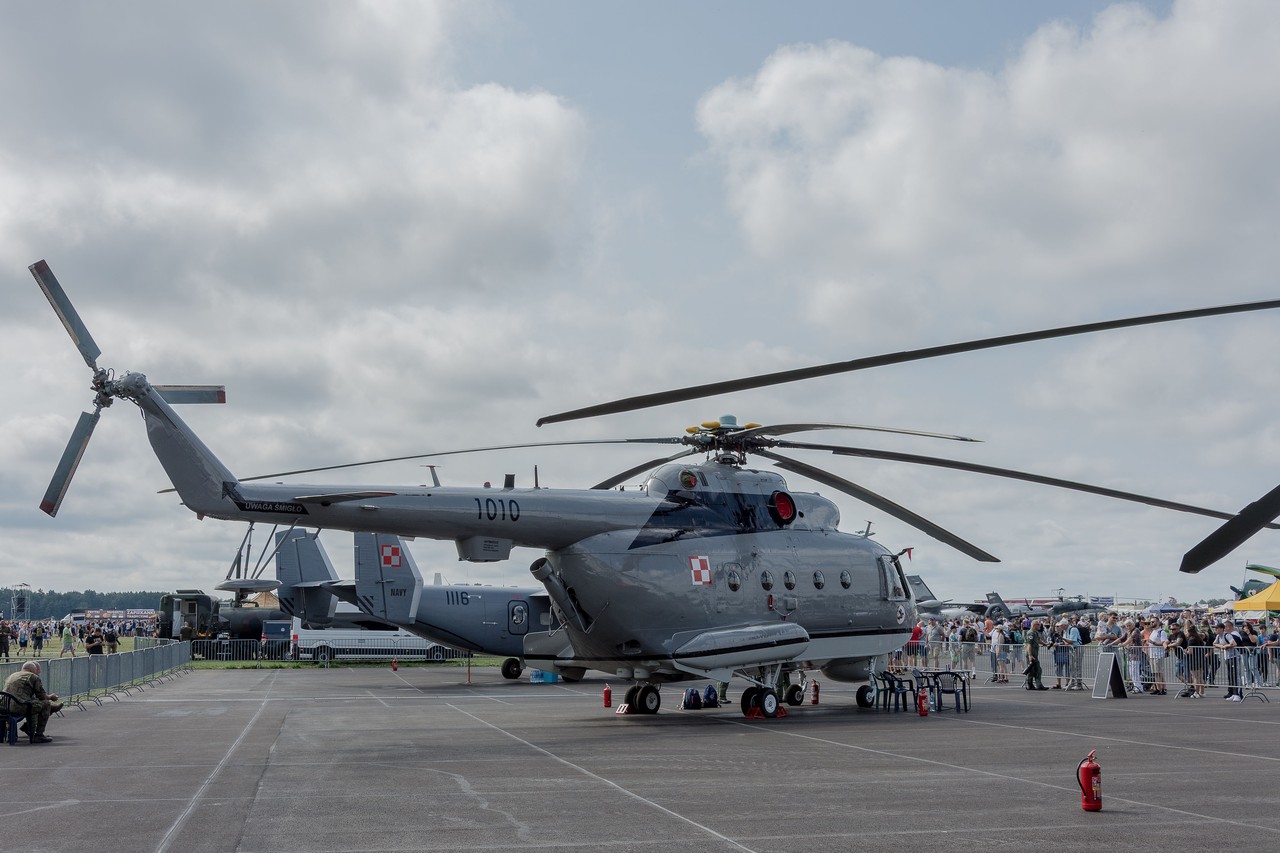
Naval Aviation Pioneer
The Mi-14 emerged from a critical Soviet naval requirement identified in the mid-1960s. On April 11, 1965, the Soviet Communist Party Central Committee and Council of Ministers formally authorized development of a specialized anti-submarine helicopter to replace the aging Mi-4 in maritime roles. The new helicopter needed to maintain a 2-hour patrol capability at 222 kilometers from base, a demanding specification that pushed Soviet helicopter technology forward.
Development proved challenging, with an eight-year gap between the prototype's first flight in 1967 and production beginning in 1973. Technical difficulties centered on avionics integration and engine reliability in harsh maritime environments. The prototype V-14 initially flew with less powerful Klimov TV2-117 engines before the definitive TV3-117MT powerplants were perfected for production aircraft.
Service History
The Mi-14 entered Soviet Naval Aviation service on May 11, 1976, becoming the backbone of shore-based anti-submarine operations. Unlike purely land-based helicopters, the Mi-14's amphibious design allowed emergency water landings and takeoffs, a crucial capability for extended maritime patrols. The aircraft's sponsons and retractable landing gear provided stability on water while maintaining land-based operational flexibility.
Soviet Naval Aviation deployed the Mi-14 extensively throughout the 1970s and 1980s as tensions with NATO submarine forces intensified. The helicopter's dunking sonar could detect submerged targets while its watertight belly compartment carried torpedoes, depth charges, and naval mines. This combination made the Mi-14 a formidable anti-submarine platform capable of both detection and engagement.
International Operations
By 1991, approximately 230 Mi-14s had been delivered to Soviet allies across four continents. Bulgaria, Cuba, East Germany, Libya, Poland, Romania, Syria, and Yugoslavia all operated various Mi-14 variants. Poland became the most significant export operator, receiving both anti-submarine and search-and-rescue variants for Polish Navy service.
East German reunification in 1990 led to the retirement of Luftwaffe der DDR Mi-14s, but other operators continued service well into the 21st century. The Republic of the Congo uniquely operated Mi-14s for their navy, demonstrating the helicopter's adaptability to diverse maritime environments from Arctic waters to tropical coastlines.
The Mil Design Bureau
Mil Moscow Helicopter Plant, established under Mikhail Mil's leadership, developed the Mi-14 as part of their comprehensive helicopter family. Building on the successful Mi-8 transport helicopter's proven systems and structure, Mil engineers created a specialized maritime variant without starting from scratch. This approach reduced development costs and leveraged existing maintenance expertise.
Kazan Helicopters handled all Mi-14 production from 1973 to 1986, manufacturing between 230 and 273 units across all variants. The Kazan facility's expertise in helicopter assembly made it the natural choice for this specialized aircraft, and the plant continues helicopter production today as part of Russian Helicopters.
Technical Innovation
The Mi-14's amphibious capabilities set it apart from contemporary anti-submarine helicopters. Its boat-like hull with integrated sponsons allowed controlled water landings in sea states up to moderate conditions. The retractable tricycle landing gear folded completely into the fuselage, eliminating drag and potential damage during water operations.
Powered by twin Klimov TV3-117MT turboshaft engines with special anti-corrosion coatings, the Mi-14 generated sufficient power for extended maritime patrols while carrying heavy sensor and weapon loads. The engines drove a five-bladed main rotor and offset three-bladed tail rotor, providing excellent control authority in challenging maritime conditions.
Variant Development
Three primary Mi-14 variants served distinct naval roles. The Mi-14PL "Haze-A" entered service in 1976 as the basic anti-submarine warfare platform, equipped with dunking sonar and surface search radar. The Mi-14BT "Haze-B" mine countermeasures variant followed in 1986, carrying specialized equipment for detecting and neutralizing naval mines.
The Mi-14PS "Haze-C" search-and-rescue variant entered service in 1992, featuring twin nose-mounted searchlights and a retractable hoist capable of lifting three personnel. Poland was the only export customer for this humanitarian variant, reflecting the Mi-14's evolution beyond pure military applications.
Legacy and Current Status
Production ended in 1986 as Soviet naval priorities shifted and improved U.S.-Russian relations reduced submarine warfare tensions. The Mi-14 remained in active Soviet service until approximately 1996, when most examples were withdrawn from frontline duty.
Today, an estimated 44 Mi-14s remain in active service worldwide. Ukraine's 10th Naval Aviation Brigade operates several examples, while Georgia, Libya, Poland, and Yemen maintain smaller fleets. The helicopter's robust construction and specialized capabilities ensure continued relevance for nations requiring maritime patrol and search-and-rescue capabilities.
The Mi-14 represents a unique chapter in Cold War aviation history, demonstrating Soviet innovation in adapting existing designs for specialized roles. Its amphibious capabilities and comprehensive sensor suite made it one of the most capable shore-based anti-submarine helicopters of its era, influencing subsequent maritime helicopter development worldwide.