
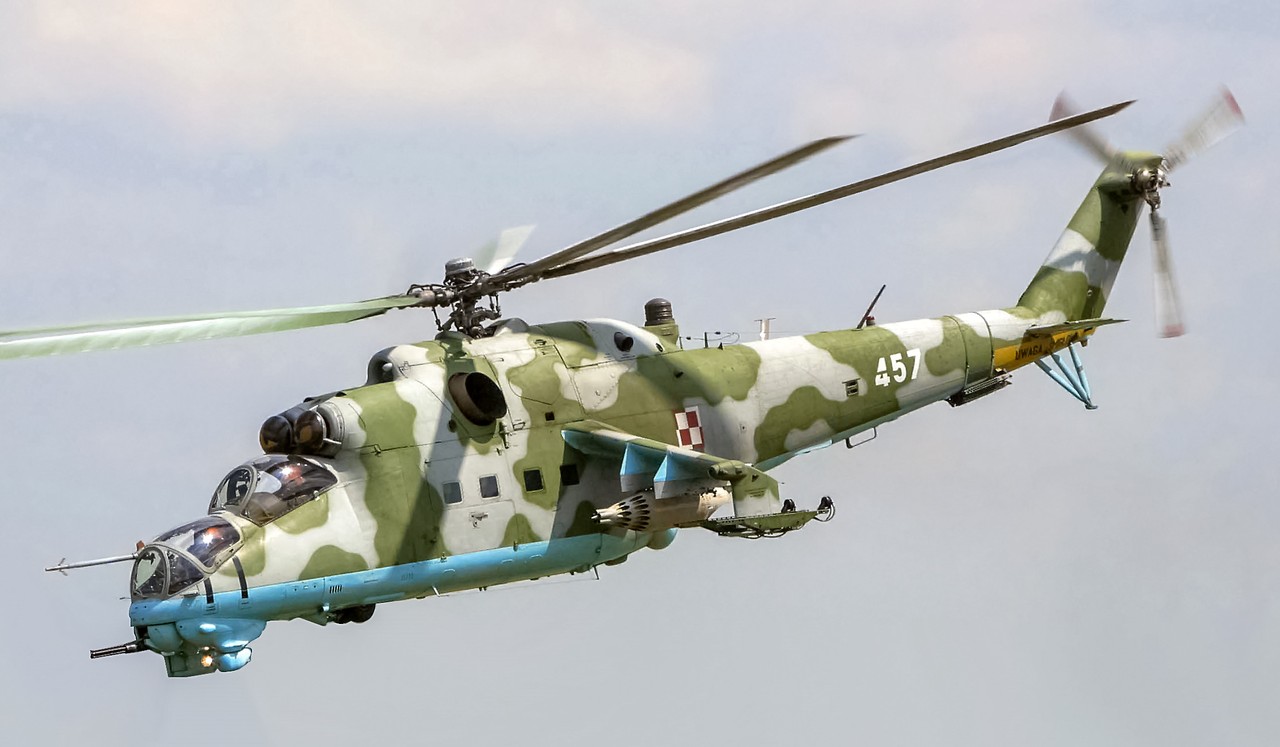
Revolutionary Combat Design
The Mi-24's development began on May 6, 1968, when the Soviet military issued requirements for a heavily armed, armored helicopter capable of both ground attack and troop transport missions. Mikhail Mil led the design team at the Mil design bureau, creating an aircraft that would fundamentally change helicopter warfare. The prototype progressed from drawing board to first flight in just 18 months, initially powered by TV2-117 engines before switching to the more powerful TV3-117 turboshafts.
The aircraft's innovative design combined a five-bladed main rotor and three-bladed tail rotor system derived from the successful Mi-8 transport helicopter. However, the Mi-24 featured unprecedented armor protection and stub wings capable of mounting various weapons systems, earning it the nickname "flying tank" among Soviet pilots.
Production and Variants
Serial production commenced in 1970, with the first ten units built jointly by Mil's Moscow facility and AAPO Progress in Arsenyev between 1969 and 1970. The Mi-24A entered full production in 1972, followed by the significantly improved Mi-24D in 1973. The D-variant, produced at both Arsenyev and Rostov plants, featured a distinctive tandem cockpit configuration and nose-mounted 12.7mm gun turret. Approximately 350 Mi-24D helicopters were manufactured between 1973 and 1977.
The most numerous variant proved to be the Mi-24V, which entered production in 1976 with more than 1,500 units built. This version incorporated the advanced 9M114 Shturm anti-tank missile system, greatly enhancing its battlefield effectiveness. Production concluded with the Mi-24VP in 1989, featuring a 23mm GSh-23 cannon turret, though only 25 units were completed before manufacturing ended.
Combat Debut and Global Service
The Mi-24 first saw combat during Ethiopia's Ogaden War against Somalia in 1977-1978, marking its international debut. However, the aircraft gained its fearsome reputation during the Soviet-Afghan War from 1979 to 1989, where it served extensively in close air support and anti-insurgency operations. The helicopter's ability to deliver troops directly into combat zones while providing heavy fire support proved invaluable in the mountainous Afghan terrain.
Over 30 nations eventually operated the Mi-24, with exports reaching approximately 600 units. Major operators included Warsaw Pact allies such as Poland and East Germany, as well as Soviet client states like Angola, Libya, and Syria. The helicopter saw action in numerous conflicts including the Iran-Iraq War, Chechen Wars, and Syrian Civil War, consistently demonstrating its durability and firepower.
The Mil Design Bureau Legacy
Mil Moscow Helicopter Plant, founded by pioneering designer Mikhail Mil in the 1940s, established itself as the Soviet Union's premier rotorcraft manufacturer. The company's systematic approach to helicopter development, building upon proven designs like the Mi-8, enabled rapid development of specialized variants. Following the Soviet Union's dissolution, the company underwent reorganization, eventually becoming part of Russian Helicopters JSC in 2007 under the state-owned Rostec holding.
The design bureau's philosophy of creating robust, multi-role aircraft reflected Soviet military doctrine emphasizing versatility and survivability. This approach proved successful across Mil's product line, from the ubiquitous Mi-8 transport to the massive Mi-26 heavy-lift helicopter.
Technical Innovation and Performance
Powered by two Isotov TV3-117 turboshaft engines producing 2,200 shaft horsepower each, the Mi-24 achieved a maximum speed of 208 mph and cruise speed of 135 mph. Its service ceiling reached 14,750 feet with a combat range of approximately 280 miles. The aircraft's retractable tricycle landing gear and stub wings provided stability during weapons delivery while maintaining helicopter maneuverability.
The Mi-24's armament flexibility became a defining characteristic. Early variants carried 9M17 AT-2 Swatter anti-tank missiles, later upgraded to the more capable 9M114 AT-6 Spiral system. Standard loadouts included 57mm rocket pods, various bombs, and nose-mounted machine guns ranging from 12.7mm to 23mm cannons depending on the variant.
Enduring Global Presence
Today, Russia operates approximately 360 Mi-24 helicopters across its armed forces, while many export customers continue flying their aircraft decades after delivery. Notable museum examples include an East German Mi-24D at Arizona's Pima Air & Space Museum, representing the type's Cold War significance.
The Mi-24's cultural impact extends beyond military circles, featuring prominently in films like Rambo III and Red Dawn as a symbol of Soviet military power. Its distinctive silhouette and combat reputation influenced Western helicopter development and NATO tactical planning throughout the Cold War era. With total production exceeding 3,650 units, the Mi-24 remains one of history's most successful attack helicopters, proving that innovative design and robust engineering can create aircraft that serve effectively across multiple decades and diverse operational environments.