
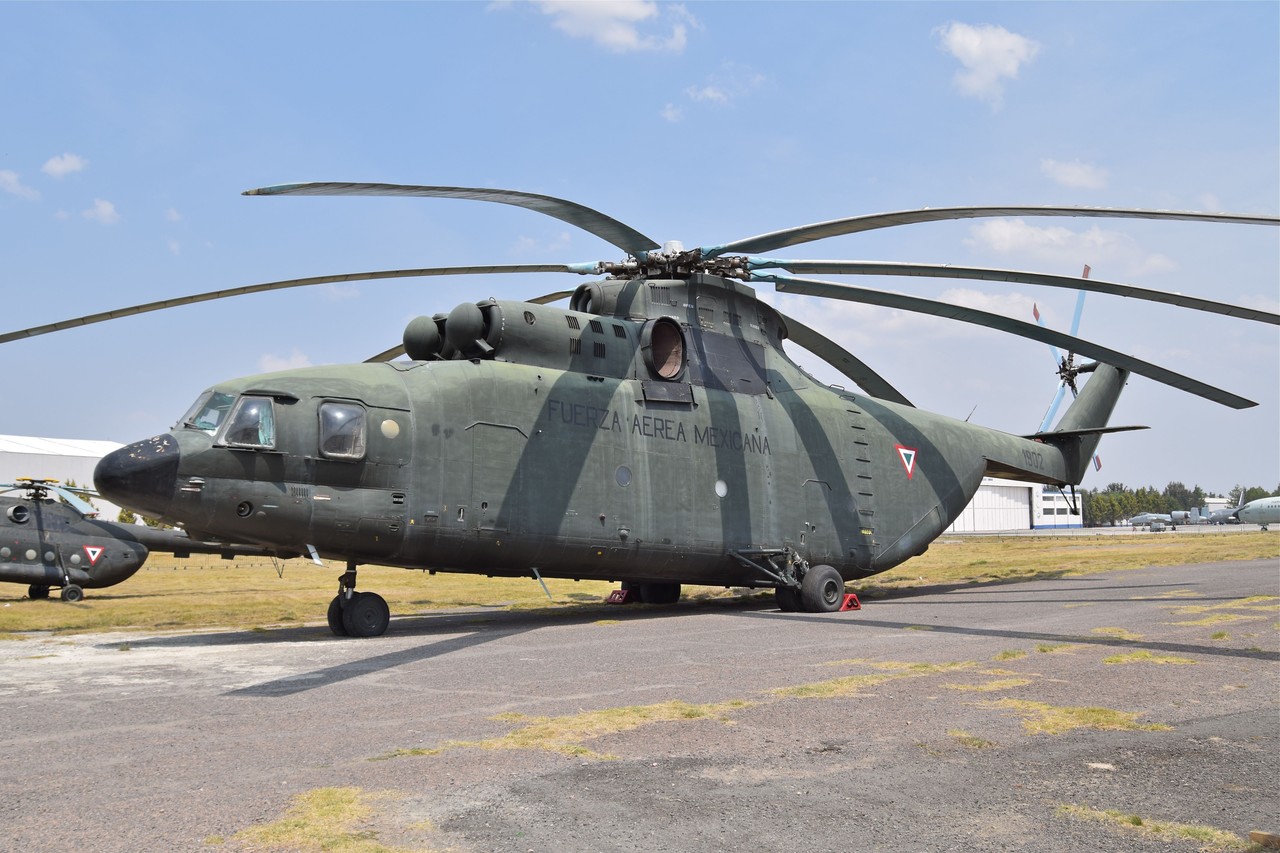
Service History
The Mi-26 entered Soviet military service in 1983 and quickly proved its worth across diverse operational environments. During the 1980s Soviet-Afghan War, these massive helicopters transported troops, equipment, and supplies to remote mountain bases inaccessible to fixed-wing aircraft. The type's exceptional lifting capacity made it invaluable during the Chernobyl nuclear disaster cleanup, where Mi-26s carried concrete and other heavy materials for containment efforts while operating in radioactive conditions.
By 2001, nearly 300 Mi-26 helicopters had been built, growing to over 380 units by 2025. Export deliveries began in June 1986 to India, and the helicopter has since been sold to approximately 20 countries. Military operators include Russia (35 delivered), Belarus (15), Ukraine (20), Peru (3), and North Korea (2), among others.
Design Innovation
The Mil bureau's engineers initially considered twin main rotor configurations similar to the Boeing CH-47 Chinook but abandoned this approach due to mechanical complications. Instead, they developed a conventional single-rotor design with an eight-bladed main rotor system powered by twin wing-mounted engines. The critical engineering breakthrough was creating a transmission system light enough yet strong enough to transfer power from both engines to the main and tail rotors simultaneously.
The design objective was ambitious: create a helicopter with cargo capacity matching the four-engine Antonov An-22 turboprop transport but without runway requirements. This would enable heavy cargo delivery to remote locations where conventional aircraft cannot operate.
The Manufacturer
Rostvertol, operating from the Rostov-on-Don plant (Plant 168), manufactured the Mi-26 under design authority of the Soviet Mil helicopter bureau. The same facility had previously produced other Mil helicopter models and continues Mi-26 production today, though output has slowed due to geopolitical circumstances following Russia's 2022 invasion of Ukraine.
The Mil bureau, founded by Mikhail Mil, became the Soviet Union's premier helicopter design organization, creating iconic aircraft including the Mi-8, Mi-24, and Mi-26. The bureau's expertise in heavy-lift helicopter design culminated in the Mi-26, which remains unmatched in production helicopter lifting capacity.
Engine and Technical Details
Two ZMKB Progress D-136 turboshaft engines, each producing 11,400 horsepower, power the Mi-26. These engines drive the massive eight-bladed main rotor through a complex transmission system that represents one of the helicopter's key engineering achievements. The aircraft requires a crew of four: two pilots, a flight engineer, and a navigator for complex missions.
The helicopter's 105-foot main rotor diameter creates 8,656.9 square feet of rotor disc area, enabling the enormous lifting capacity. Empty weight is 62,170 pounds, with a maximum takeoff weight of 123,459 pounds. The fuel capacity of 12,000 liters provides substantial range for such a large aircraft.
Performance Characteristics
The Mi-26 achieves a maximum speed of 183 mph and cruises at 158 mph, impressive figures for such a large helicopter. Service ceiling reaches 15,100 feet, while range varies significantly with payload: 310 miles with a 17,000-pound cargo load, extending to 416 miles with an 18,000-kilogram payload. The helicopter's ability to maintain reasonable performance while carrying massive loads sets it apart from other aircraft.
In 1982, an Mi-26 established a world record by lifting 125,000 pounds to an altitude of 6,500 feet, demonstrating capabilities that remain unmatched by any production helicopter. This record highlighted the aircraft's potential for specialized heavy-lift missions impossible for other rotorcraft.
Variants and Modern Developments
Multiple variants serve specific roles: the Mi-26T for civil freight transport, Mi-26TM flying crane with an under-nose operator gondola, Mi-26TP firefighting version carrying 4,000 gallons of retardant, Mi-26MS medical evacuation configuration, and Mi-26P 63-seat passenger variant.
The latest Mi-26T2V military variant, which first flew in 2018, features substantially upgraded avionics, improved flight control and navigation systems for all-weather operation, night-vision goggle compatibility, modernized communications and self-defense systems, plus enhanced crew protection. This version saw combat use during Russia's invasion of Ukraine.
Legacy
Priced between $10-12 million, the Mi-26 remains in production and service worldwide, representing a singular achievement in helicopter engineering. No other production helicopter approaches its lifting capacity, making it irreplaceable for specialized missions requiring movement of extremely heavy loads to locations inaccessible by conventional aircraft. The type continues serving military and civilian operators globally, from disaster relief operations to industrial heavy-lift missions.