
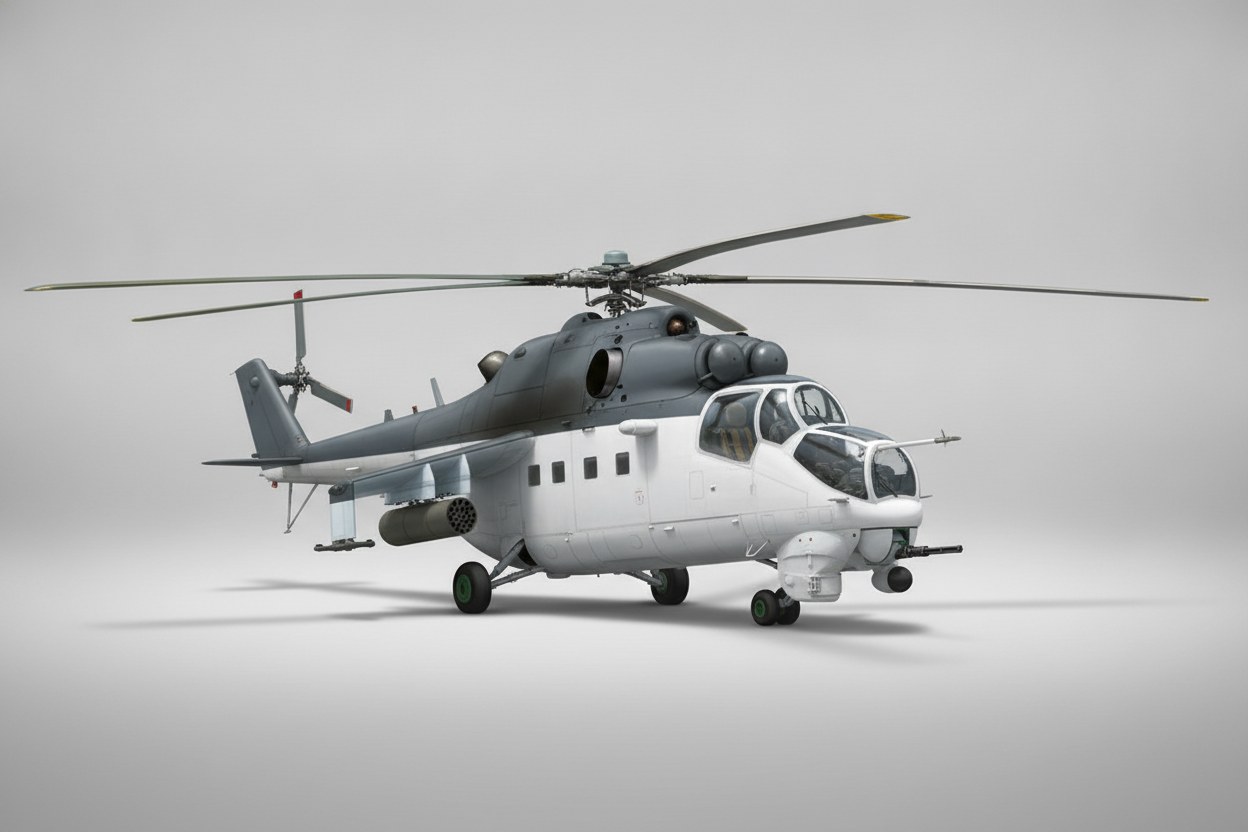
Combat Dominance and Global Service
Since entering Soviet Air Force service in 1972, the Mi-24/Mi-35 family has established itself as one of the most successful attack helicopter designs ever created, with over 2,648 units produced across all variants. The aircraft has served with more than 40 countries and approximately 50 operators worldwide, seeing extensive combat action in conflicts ranging from the Soviet-Afghan War (1979-1989) to numerous regional conflicts across Africa, Asia, and the Middle East. The Russian Air Force alone operated 250 Mi-24s as of 2007, though plans called for their replacement with 300 Mi-28 and Ka-50 helicopters by 2015.
Evolution Through Modern Variants
The Mi-35 designation specifically applies to export versions of the basic Mi-24 design, with continuous development producing increasingly sophisticated variants. The Mi-35M emerged as a comprehensive modernization, while the Mi-35P "Phoenix" variant, unveiled at the Army-2018 exhibition, completed trials in 2020 and entered Russian service that same year. This latest iteration features a movable 23mm GSh-23L gun system replacing the previous 30mm cannon, upgraded avionics packages, and the capability to carry up to 16 Ataka or Vikhr anti-tank missiles on its stub-wing pylons.
The Mil Design Bureau Legacy
Mikhail Mil established his helicopter laboratory within the Central Aerohydrodynamic Institute in 1947, transforming it into the Mil Moscow Helicopter Plant. The organization produced its first prototype, the Mi-1, in 1948, making its public debut at the 1951 Tushino Air Display. Mil's design philosophy centered on creating practical, robust helicopters that could fulfill multiple mission requirements. The Mi-24/Mi-35 emerged from this approach, utilizing the proven Mi-8 "Hip" as its foundation while incorporating dedicated attack capabilities.
In 2006, the Mil organization merged with the Kamov Design Bureau and Rostvertol to form Russian Helicopters, now operating under the State Corporation Rostec umbrella. Despite this consolidation, the Mil brand continues today, with current production occurring at multiple facilities including the Rostvertol Plant, Kazan Helicopters, and Ulan-Ude Aviation Plant.
Engineering Innovation and Performance
The Mi-35's design represents a sophisticated balance between transport utility and combat effectiveness. Its twin Isotov TV3-117 turboshaft engines, manufactured by what is now the Klimov/Omsk Engine Plant, provide exceptional power-to-weight ratios that enabled the type to establish multiple helicopter speed records. On September 21, 1978, a modified Mi-24 A-10 achieved an absolute helicopter speed record of 368.4 km/h (229 mph), a mark that stood until 1986. Earlier, on August 13, 1975, the type set a speed record of 332.65 km/h over a 1,000-kilometer course.
Operational Characteristics
Pilots appreciate the Mi-35's exceptional versatility, though its dual-role nature requires careful mission planning. The aircraft operates with a crew of two to three, including a pilot and weapons officer, with an optional technician for complex missions. Its maximum speed reaches 335 km/h (208 mph), with an operational range of 450 kilometers (280 miles) and a service ceiling of 14,750 feet. The helicopter can accommodate eight combat troops or four stretchers for medical evacuation, while maintaining its full weapons capability.
The aircraft's maximum takeoff weight of 26,500 pounds allows for substantial ordnance loads across multiple mission profiles. Beyond its primary armament, the Mi-35 can fulfill fighter, bomber, transport, and reconnaissance roles, adapting to diverse operational requirements through modular equipment packages.
Current Production and Future
While large-scale production of the original Mi-24 concluded decades ago, specialized variants like the Mi-35M and Mi-35P continue in limited production for both domestic Russian use and export customers. The total production figure across all Mi-24/Mi-35 variants may exceed 3,500 units according to some estimates, making it one of the most numerous attack helicopters ever manufactured.
The Mi-35's enduring success stems from its unique combination of firepower, transport capacity, and operational flexibility. Female pilots Galina Rastorgoueva and Ludmila Polyanskaia established additional records in the type, demonstrating its accessibility across diverse pilot populations. Today, the helicopter remains active in military inventories worldwide, with the latest variants incorporating modern avionics and weapons systems that ensure continued relevance in contemporary combat environments.