
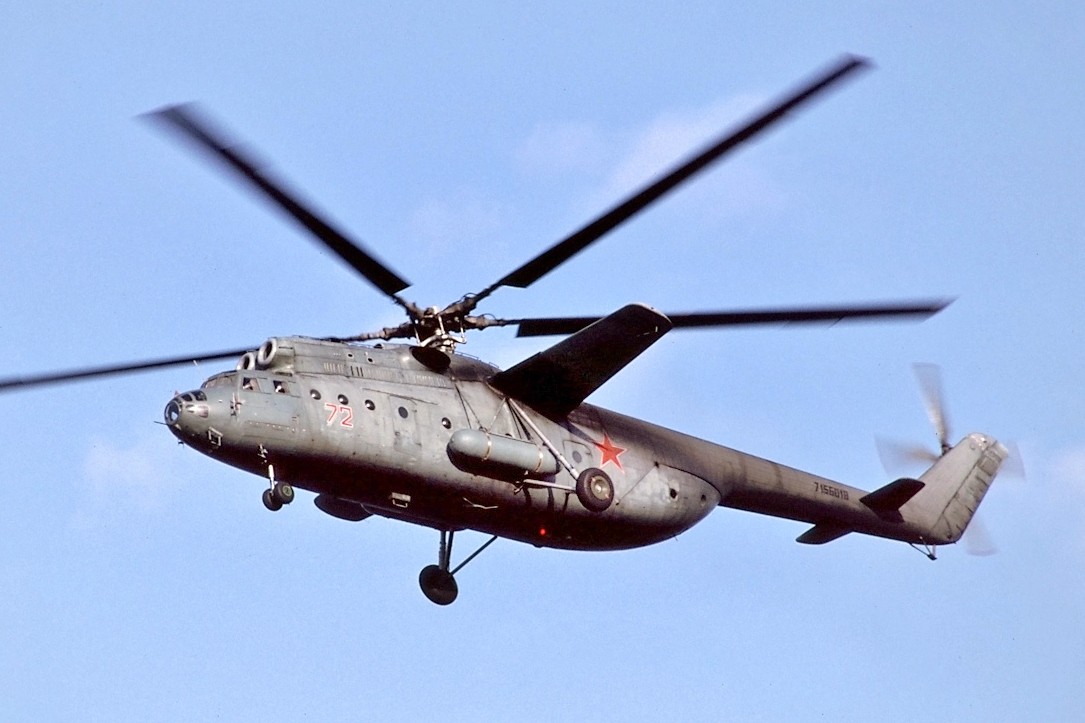
Development and Design
The Mi-6 originated from a 1953 joint requirement by the Soviet Air Force and Aeroflot for a heavy-lift helicopter capable of supporting military operations and civilian development in remote regions of the USSR. Mikhail Mil led the design team at OKB-329, completing preliminary design by the end of 1953. The USSR Council of Ministers authorized the program on June 11, 1954, with mock-up approval following on June 1, 1955.
The first prototype was assembled by October 1956, culminating in the maiden flight on June 5, 1957, piloted by Rafael Ivanovich Kaprelian. The aircraft's company designation was V-6, with the military designation izdeliye 50.
Technical Innovation
The Mi-6 represented several groundbreaking achievements in rotorcraft design. As the world's first production turboshaft-powered helicopter, it utilized two Soloviev D-25V engines, each producing 5,500 shaft horsepower. These engines, manufactured by the Soloviev Design Bureau in Rybinsk, powered the aircraft through an R-7 reduction gearbox system.
The helicopter's innovative design included hydraulic shock absorbers on the main rotor head and a twin-turbine configuration that became standard for Soviet heavy helicopters. The aircraft's size was unprecedented - its 35-meter main rotor diameter and 9.8-meter height made it a giant among helicopters of its era.
Record-Breaking Performance
The Mi-6 quickly established itself as a record-setter, achieving 16 world records for speed and load capacity. In 1961, it became the first helicopter to exceed 300 kilometers per hour (186 mph), earning the Sikorsky Trophy. These achievements demonstrated the viability of turboshaft power for heavy-lift operations and established Soviet leadership in large helicopter design.
Production History
Production began in 1959 with an initial batch of approximately 50 aircraft built in Moscow at Zavod No. 329. The majority of production, totaling around 874-878 units, was subsequently transferred to State Factory 168 in Rostov-on-Don. Total production reached between 925 and 928 aircraft by 1980, when manufacturing ceased.
Military Service
The Mi-6 served primarily as a military transport for the Soviet Air Force (VVS), designated 'Hook-A' by NATO. The helicopter proved invaluable for troop and cargo transport, reconnaissance support, and heavy-lift operations throughout the Cold War period. Its service extended into the 1980s Afghanistan conflict, where it provided crucial logistical support.
Several variants emerged during production, including the Mi-6A with uprated engines, the Mi-6AY anti-submarine variant, the Mi-6R radio relay version, the Mi-6TZ fuel tanker, and the Mi-6VPK VIP transport configuration.
International Operations
The Soviet Union exported the Mi-6 to numerous allied nations, including Algeria, Bulgaria, China, Egypt, Ethiopia, Indonesia, Iraq, Pakistan, Peru, Poland, Syria, Vietnam, and Zimbabwe. These exports demonstrated Soviet technological capability and strengthened military relationships during the Cold War era.
Civilian Applications
Aeroflot operated the Mi-6 for construction projects and oil and gas exploration support in remote areas of the eastern USSR. A civilian demonstrator, CCCP-06174, made its international debut at the Paris Air Show in May 1965, showcasing Soviet rotorcraft technology to Western audiences. This aircraft later transferred to Soviet Air Force service on May 12, 1970, as CCCP-58647.
The proposed Mi-6P passenger variant of 1963 never entered mass production, though the standard Mi-6 could accommodate up to 90 passengers in high-density configuration.
The Manufacturer
The Mil Moscow Helicopter Plant, established by Mikhail Leontyevich Mil's OKB-329 design bureau in 1951, pioneered Soviet turbine helicopter development. Post-Soviet restructuring saw the company become part of Mil Moscow Helicopter Plant JSC in 1991, eventually merging into Russian Helicopters under the Rostec state corporation in 2014. Production capabilities shifted to Rostvertol in Rostov-on-Don, continuing the legacy established by the original Moscow facility.
Legacy and Retirement
The Mi-6's operational career in Russia concluded in 2002, primarily due to the limited lifespan of its wooden tail rotors. The helicopter was succeeded by the even larger Mi-26, which entered production in 1980. Despite retirement from Russian service, some Mi-6 aircraft may continue operating in other nations.
The Mi-6's significance extends beyond its operational service - it established the foundation for Soviet heavy-lift helicopter capability and demonstrated the potential of turboshaft power for large rotorcraft. Museum examples preserve this pioneering aircraft's legacy, including displays at Russian aviation museums near Moscow. The helicopter earned the nickname "flying heavy truck" for its reliable heavy-lift capabilities and remains a testament to 1950s Soviet aerospace engineering achievement.