
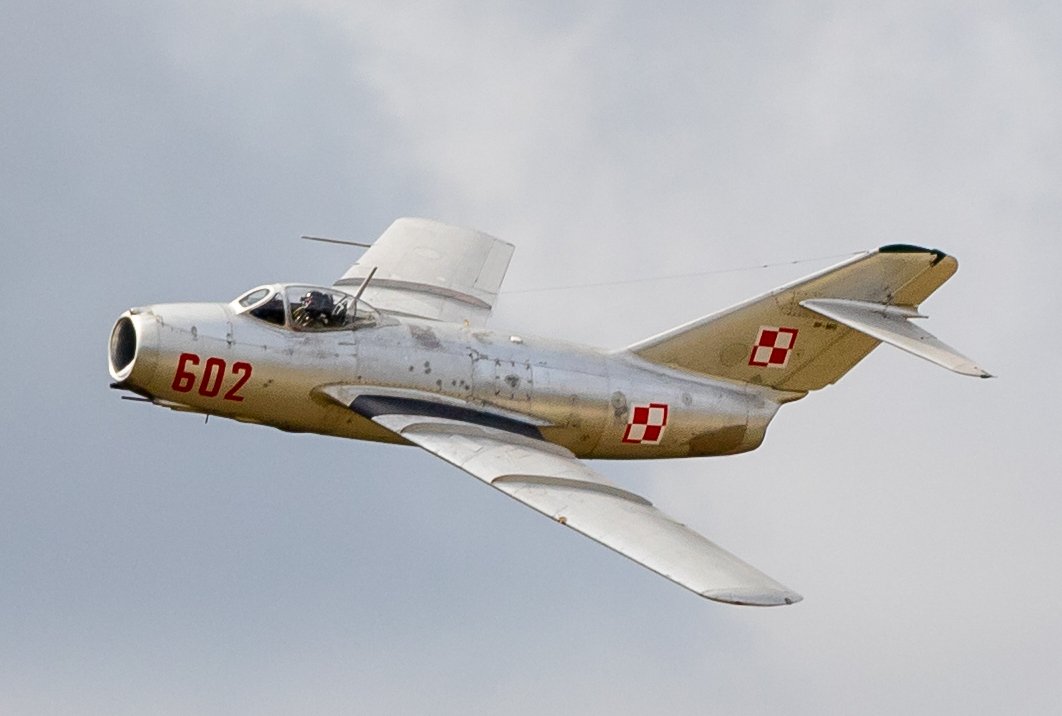
The Mikoyan-Gurevich MiG-15 was a pivotal development in early jet aviation, emerging as one of the most produced jet fighters ever built. Designed by Artem Ivanovich Mikoyan and Mikhail Iosifovich Gurevich at OKB-155, the aircraft's prototype, designated I-310 (factory designation S-1), first flew on December 30, 1947, with test pilot Vladimir N. Yuganov at the controls. The design was notable for its 35-degree swept-back wings and tailplane, which provided superior high-subsonic performance compared to contemporary straight-wing aircraft. Other advanced features for the era included a pressurized cockpit and an ejection seat.
Production began in late 1948, with the main Soviet production run extending through the mid-1950s. While the Komsomolsk-on-Amur Aircraft Plant is explicitly documented as a production site, the aircraft was built across a network of Soviet state plants. Global production was extensive, with estimates suggesting at least 13,000 aircraft were built worldwide, including 8,000 to 8,400 in the USSR. License production was widespread in allied nations: Aero Vodochody in Czechoslovakia produced the S-102 and S-103 from 1951, PZL-Mielec in Poland produced the Lim-1 and Lim-2 starting in 1953, and China produced the J-2 copy in the mid-1950s.
Technically, the MiG-15 relied on centrifugal-flow turbojets derived from the British Rolls-Royce Nene. The initial production models used the RD-45 engine, providing approximately 22.25 kN of thrust. The improved MiG-15bis variant utilized the VK-1 engine, which increased thrust to about 26.5 kN. This powerplant allowed the MiG-15bis to reach maximum speeds of 1,075–1,090 km/h at altitude and a service ceiling of up to 16,000 meters. Its heavy armament, consisting of one 37 mm Nudelman-N-37 cannon and two 23 mm cannons, made it a formidable interceptor.
The aircraft gained worldwide fame during the Korean War (1950–1953), where it was operated by the North Korean Air Force, the Chinese People’s Volunteer Air Force, and Soviet volunteer units, such as the 64th Fighter Aviation Corps. Soviet aces like Nikolai Sutyagin and Yevgeny Pepelyaev recorded 21 and 19 victories, respectively. Beyond Korea, the MiG-15 served in various conflicts, including the 1956 Suez Crisis with Egypt. Today, the legacy of the MiG-15 persists through numerous museum examples at the Central Air Force Museum in Monino and the Polish Aviation Museum in Kraków, while a small number of airworthy two-seat UTI trainers continue to fly as warbirds.