
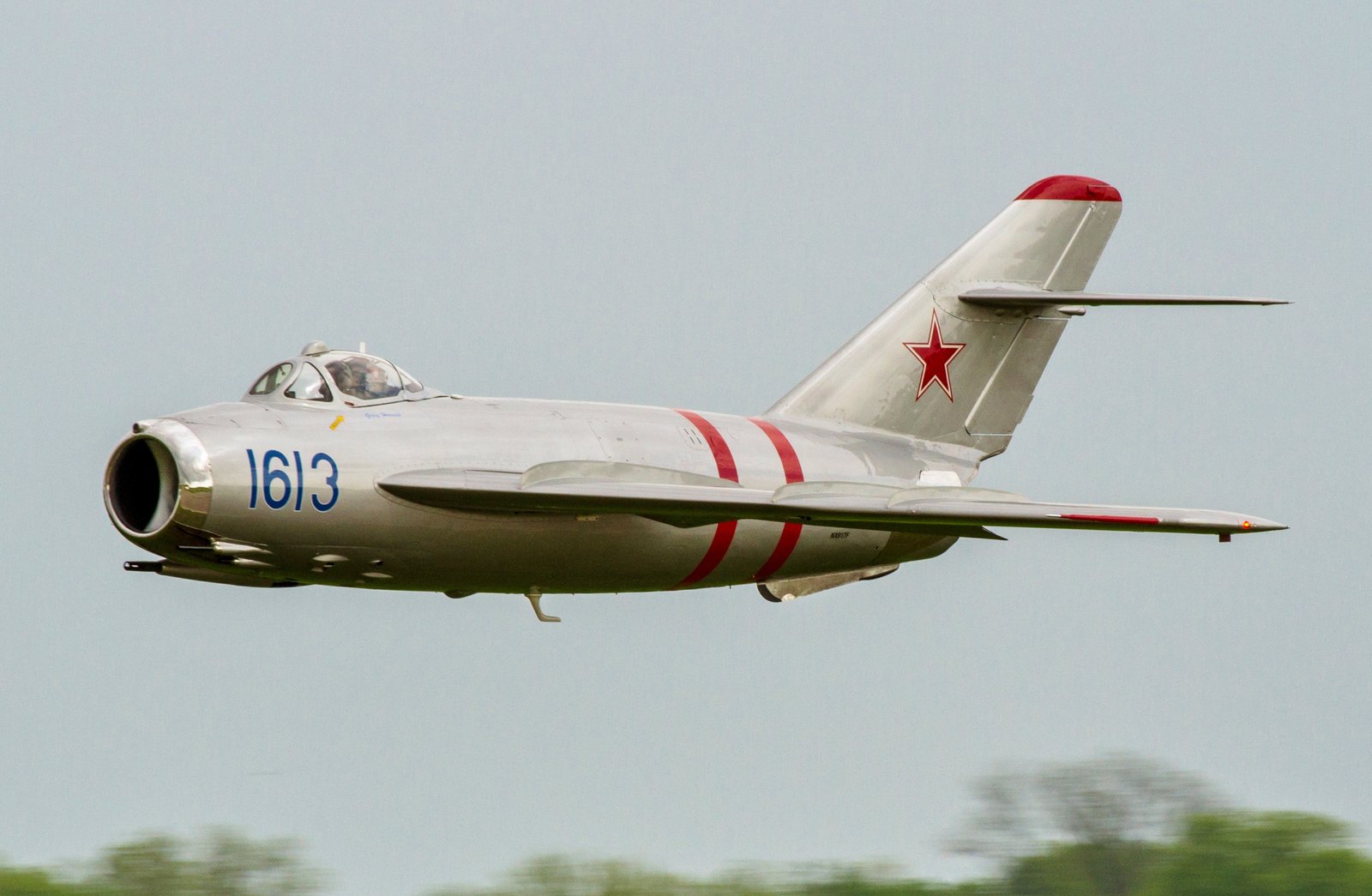
Design and Development
The Mikoyan-Gurevich MiG-17 was developed by the Soviet OKB-155 design bureau under the leadership of Artem Mikoyan and Mikhail Gurevich. Rather than a completely new aircraft, the MiG-17 was an evolutionary refinement of the MiG-15, featuring a redesigned wing with increased sweep and chord-wise fences to improve high-speed handling and transonic behavior. The prototype, designated I-330 SI, made its maiden flight on January 14, 1950.
Production and Manufacturing
Series production began in the USSR in 1951 and continued until approximately 1959. The aircraft was mass-produced across several Soviet plants, including the Komsomolsk-on-Amur Aviation Plant (KnAAZ) and the Sokol plant in Nizhny Novgorod. Due to its effectiveness, the type was widely license-built abroad. In Poland, PZL-Mielec produced the Lim-5 and the ground-attack Lim-6 variants from the mid-1950s to the mid-1960s. Simultaneously, the Shenyang Aircraft Factory in the People's Republic of China manufactured the J-5 and export F-5 versions from the late 1950s through the 1960s. Total global production is estimated to be between 10,000 and 11,000 aircraft.
Technical Specifications
The MiG-17 was powered by the Klimov VK-1, a single-spool axial-flow turbojet. Early models used the non-afterburning VK-1, while the primary production MiG-17F utilized the VK-1F afterburning engine, which provided approximately 33–34 kN of thrust. The MiG-17F reached maximum speeds of Mach 0.93–0.95 (roughly 1,145 km/h) at 10,000 meters and possessed a service ceiling of 16,000–17,000 meters. Standard armament included one 37 mm Nudelman N-37 cannon and two 23 mm NR-23 cannons.
Operational History
As a primary interceptor for the Soviet Air Forces and Warsaw Pact nations, the MiG-17 saw extensive combat in various regional conflicts. During the Vietnam War, the Vietnam People’s Air Force (VPAF) utilized the MiG-17 and Chinese J-5s for low-altitude dogfighting against US aircraft such as the F-4 and F-105. It also played a significant role in the Arab-Israeli conflicts, operated by Egypt, Syria, and Iraq during the 1956 Suez Crisis, the 1967 Six-Day War, and the 1973 Yom Kippur War. Specialized variants like the MiG-17PF and PFU introduced radar and early beam-riding air-to-air missiles for all-weather interception.
Legacy
Today, the MiG-17 is remembered as one of the most exported jet fighters of the Cold War. While it was a purely military aircraft with no commercial service, several examples survive as privately owned warbirds in Europe and the United States. Museum examples are preserved globally, including at the Central Air Force Museum at Monino in Russia.