
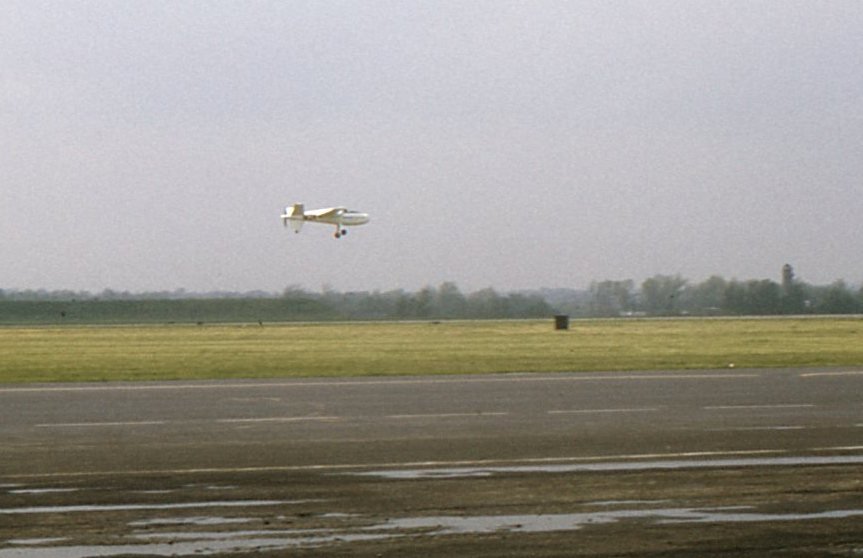
Design Philosophy and Innovation
The Mini-IMP emerged from Moulton Taylor's vision to create an economical aircraft for private builders during the energy-conscious late 1970s. Taylor, already famous for his roadable Aerocar series including the certificated Aerocar I that first flew in 1949, sought to update the pusher configuration pioneered by the 1912 Edson Fessenden Gallaudet Bullet. The Mini-IMP represented a scaled-down version of Taylor's larger IMP design, reducing the original four-seat concept to a practical single-seat homebuilder's aircraft.
Taylor's design incorporated several innovative features for its era. The aircraft utilized riveted aluminum sheet construction in a cantilever high-wing arrangement spanning 24 feet 6 inches. The NASA GA(PC)-1 airfoil provided efficient low-speed performance, while the center-mounted engine drove a pusher propeller through a long driveshaft system. This configuration allowed for an unobstructed forward view and reduced propeller noise in the cockpit.
The Micro-IMP Experiment
In 1978, Taylor and collaborator Jerry Holcomb embarked on an even more ambitious project: the Micro-IMP prototype. This experimental aircraft pushed the boundaries of affordable construction by utilizing fiberglass-reinforced paper as the primary structural material. The pre-printed TPG stock could be cut and laminated by builders, potentially reducing kit costs significantly below traditional materials.
The Micro-IMP incorporated fully retractable tricycle landing gear, full-span reflexing flaperons, and a two-position propeller system. Weighing just 260 pounds empty with a maximum takeoff weight of 525 pounds, the aircraft demonstrated remarkable efficiency. Construction began in 1978 and concluded in 1981, followed by a single demonstration flight at the Oshkosh airshow in 1982.
Technical Specifications and Performance
The Mini-IMP typically employed modified Volkswagen automotive engines, specifically the 1835cc four-cylinder air-cooled unit producing 60 to 100 horsepower. This powerplant drove a two-bladed composite propeller and provided adequate performance for the aircraft's 805-pound gross weight. Fuel capacity of 12 US gallons offered reasonable range for local flying.
The Micro-IMP prototype suffered from significant underpowering issues. The chosen 620cc Citroën 2CV engine, despite being produced in millions across Europe, delivered only 16-18 horsepower instead of the intended 32-38 horsepower. This power deficit severely limited the aircraft's performance and contributed to the project's eventual abandonment.
Production Challenges and Legacy
No serial production occurred for either variant. The Mini-IMP remained available as plans for homebuilders as late as 2015, but manufacturing never progressed beyond individual construction projects. The Micro-IMP faced insurmountable challenges from its inadequate powerplant and Taylor's declining health in the early 1980s.
Taylor's previous success with the Aerocar Coot amphibian in the homebuilt market had established Aerocar International as a respected name among experimental aircraft builders. However, the complexity and costs associated with the IMP series led Taylor to shift focus away from these designs.
Current Status
The Micro-IMP prototype remained in storage following its 1982 demonstration, never receiving further development. Mini-IMP Aircraft Company currently holds the rights and tooling for the Micro-IMP, though no active development continues. Jerry Holcomb later refined the Mini-IMP concept into the Perigee and Ultra-IMP variants, selling plans but never progressing to kit production.
Recent discoveries of Molt Taylor's original Micro-IMP drawings have renewed interest among aviation historians and homebuilders. The aircraft represents an important chapter in experimental aviation during the energy crisis era, demonstrating both the potential and limitations of innovative construction methods and alternative powerplants in general aviation.
Historical Significance
The Mini-IMP and Micro-IMP projects exemplified the experimental spirit of 1970s homebuilt aviation. While neither achieved commercial success, they contributed valuable lessons about composite construction, pusher configurations, and the challenges of adapting automotive engines for aircraft use. Taylor's work on these designs paralleled broader industry efforts to develop more efficient and economical aircraft during a period of rising fuel costs and increased environmental awareness.