
Service History
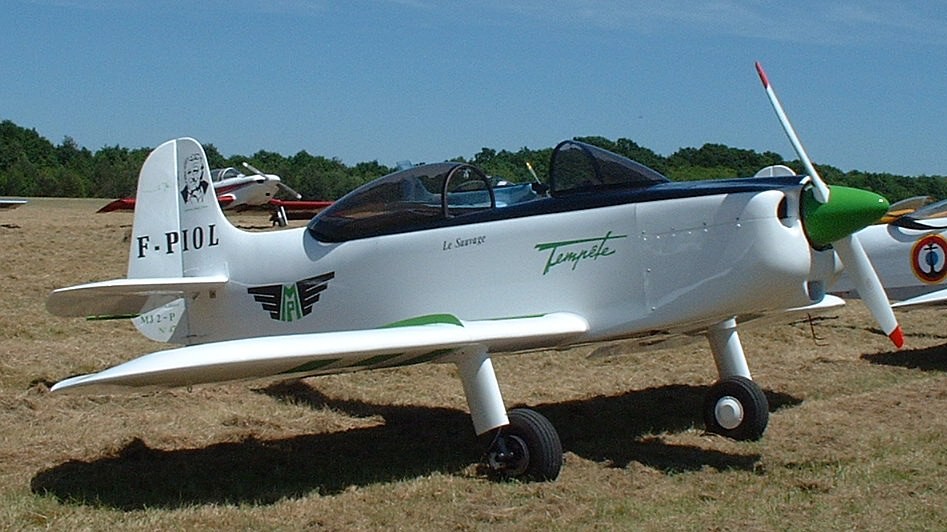
The MJ-2 Tempête found its niche among European sport pilots seeking aerobatic capability and cross-country performance. By 1978, at least 42 examples had been constructed by homebuilders, with French aviation registers listing 37 aircraft by 2010. The design's versatility attracted pilots across multiple countries, with examples operating in France, the United Kingdom, United States, and Luxembourg. Notable operators included French pilot Joel Bénété, who flew aircraft #042 from Compiègne in 1977 before advancing to military service as a Mirage IV pilot, and Alain Pujadas, who demonstrated the aircraft's touring capabilities by flying #020 to Romania in 1973.
The Manufacturer
Marcel Jurca operated as an independent aircraft designer rather than a traditional manufacturing company. Born in Romania and later establishing himself in France, Jurca began developing homebuilt designs in the mid-1950s, drawing inspiration from the thriving French amateur aviation movement and incorporating elements from Jodel designs. His business model centered on selling construction plans directly to builders, eliminating the need for factory production facilities. Following Jurca's death on October 19, 2001, his plans remained available through his website as late as 2009, though the design bureau ceased active operations.
Engine & Technical Details
The Tempête's design accommodated at least 13 different engine configurations, ranging from the 75-horsepower Continental A-65-8 in the MJ-2A variant to 180-horsepower installations in higher-performance versions. The MJ-2D variant typically mounted the Continental C90-14F producing 90 horsepower, while some builders selected the Lycoming O-235-F2B generating 125 horsepower for enhanced performance. The wooden airframe featured a cantilever wing design with fabric covering, eliminating the need for external bracing wires while maintaining structural strength for aerobatic operations.
The aircraft's bubble canopy provided excellent visibility for both touring and aerobatic flight, while the fixed tailwheel configuration simplified construction and maintenance for amateur builders. Some variants incorporated a passenger seat for occupants weighing less than 121 pounds, expanding the aircraft's utility beyond pure sport flying.
Pilot Perspective
Pilots praised the MJ-2 Tempête for its responsive handling characteristics and solid aerobatic performance. The MJ-2A variant achieved a maximum speed of 120 mph with a cruise speed of 102 mph, while maintaining a service ceiling of 11,500 feet. The aircraft's rate of climb reached 555 feet per minute at sea level, providing adequate performance for its Continental A-65-8 powerplant. Empty weight of 639 pounds allowed a useful load of 311 pounds at the maximum gross weight of 950 pounds.
The combination of light weight and adequate power gave pilots an agile platform suitable for both aerobatic training and recreational flying. The wooden construction provided a traditional feel that many European pilots preferred over metal alternatives, while the various engine options allowed builders to tailor performance to their specific requirements and budgets.
Production & Legacy
Construction of the MJ-2 Tempête peaked during the 1960s and 1970s as the homebuilt movement gained momentum in Europe. Individual aircraft required extensive construction time, with builders working from detailed plans to fabricate wooden components and assemble fabric-covered surfaces. Serial numbers tracked through #042 by 1977, though total production likely exceeded this figure as not all aircraft received sequential numbering.
The design spawned several variants including the strengthened MJ-22 accommodating 150-horsepower engines, and the experimental MJ-3 Dart built by Denis Jacobs in Dayton, Ohio in 1977. The MJ-4 Shadow incorporated an enlarged swept tail design, though only two examples were completed.
By 2010, approximately 33 aircraft remained on the French register following several withdrawals from service, while two continued operating in the United Kingdom under Permits to Fly. Multiple examples flew in the United States as of 2000, demonstrating the design's international appeal. The Tempête established Marcel Jurca's reputation in homebuilt aviation, leading to his later designs including the Sirocco and other sport aircraft that continued his philosophy of plans-built construction for amateur aviators.