
Training Revolution in European Skies
By 2010, the Magni M-16 had established itself as the dominant training autogyro across Europe, with 114 aircraft on European registers excluding Russia. The type's success stemmed from its forgiving handling characteristics and robust construction, making it ideal for introducing pilots to rotorcraft flight. Flying schools throughout Europe adopted the M-16 as their primary training platform, drawn to its dual-control configuration and proven reliability record.
The aircraft gained international recognition in 2019 when British pilot James Ketchell completed a world circumnavigation in his M-16, covering the globe in 122 stages over 175 days. This achievement demonstrated the type's long-range capabilities and mechanical durability under challenging conditions.
The Magni Legacy
Magni Gyro srl traces its origins to 1976 when Vittorio Magni founded VPM (later renamed Magni Gyro in 1996) in Besnate, Italy. Magni's involvement with autogyros began in 1967 when he imported and built one of Italy's first Bensen gyroplane designs. The company evolved from these early experiments, developing successful models like the single-seat MT5 and two-seat MT7 before introducing the M-16.
By 2020, Magni had produced approximately 1,500 gyroplanes across all models, establishing the company as a leading manufacturer in the ultralight autogyro market. The firm continues operations today, producing variants including the M-22 Voyager, M-18 Spartan, M-14 Scout, and M-24 Orion alongside the M-16.
Engineering Excellence
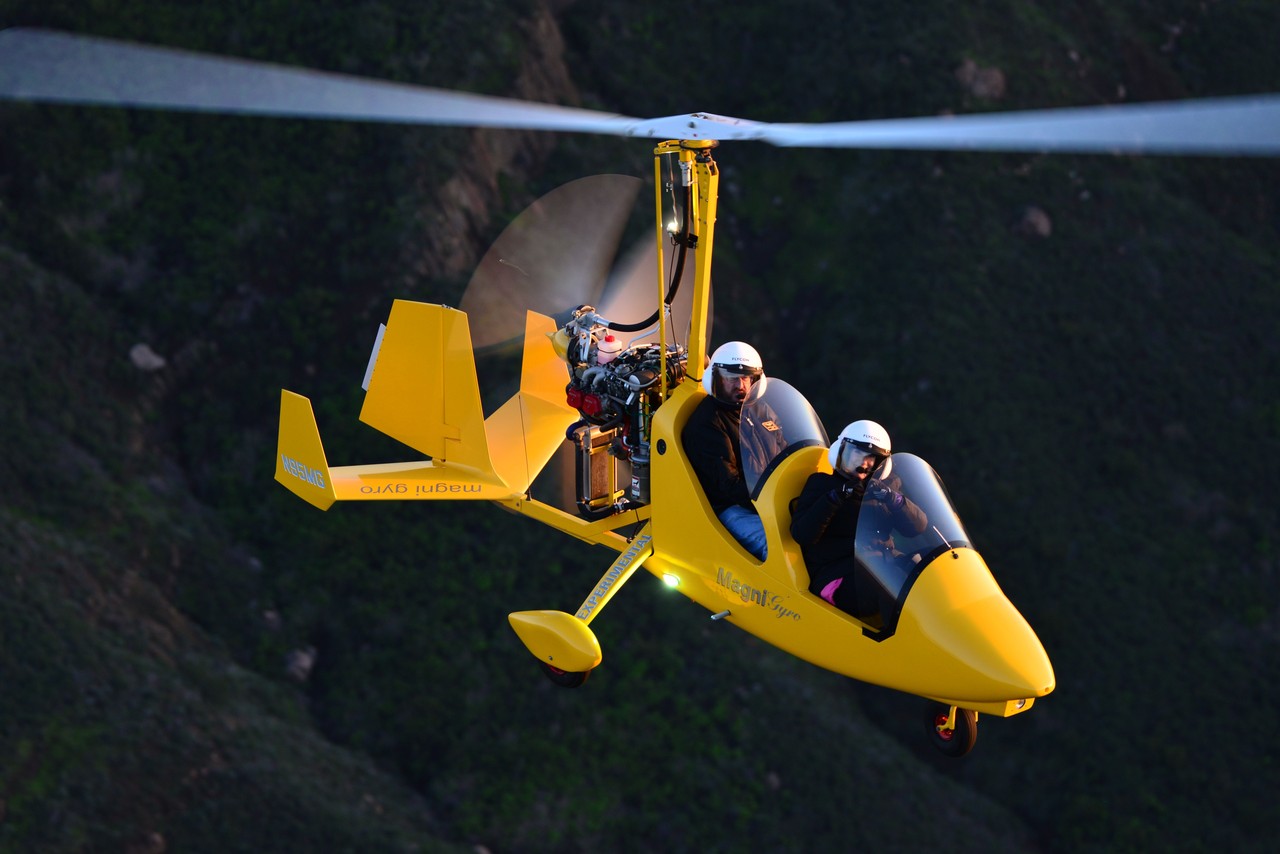
The M-16's success stems from its well-engineered design combining proven components with innovative solutions. The aircraft employs a pod-and-boom fuselage configuration with a swept-back tailplane featuring triple fins, with the rudder mounted on the central fin. This arrangement provides excellent directional stability during flight operations.
Powering the M-16 is the reliable Rotax 914UL, a turbocharged four-cylinder engine producing 85 kW (114 horsepower). Manufactured by BRP-Rotax GmbH & Co KG in Austria, this powerplant drives a three-bladed ground-adjustable pitch propeller measuring 1.70 meters in diameter. The engine installation features a high-mounted uncowled pusher configuration, simplifying maintenance while providing excellent performance characteristics.
The rotor system consists of a composite two-bladed main rotor with an 8.23-meter diameter, providing 53.20 square meters of rotor disc area. This configuration delivers a maximum climb rate of 5.0 meters per second at sea level and a service ceiling of 3,500 meters.
Flight Characteristics
Pilots praise the M-16 for its predictable handling and forgiving flight characteristics. The aircraft cruises at 145 km/h while achieving a maximum speed of 185 km/h. With fuel capacity ranging from 60 to 80 liters depending on configuration, the M-16 provides an endurance of three to four hours and a range of 480 kilometers without reserves.
The tandem seating arrangement places both occupants in open cockpits with dual flight controls, allowing effective instruction while maintaining good visibility for both pilot and student. The tricycle landing gear configuration with faired main wheels ensures stable ground handling during taxi operations.
Production Variants
Magni introduced several M-16 variants to meet different operational requirements. The original M-16 of 2000 could be equipped with either the Rotax 914UL or 912 ULS engines. The improved M-16-2006 variant featured enhanced lubrication and cooling systems, refined center of gravity characteristics, and upgraded avionics.
The M-22 Voyager, introduced in June 2005, adapted the basic M-16 design for touring operations with baggage pods and increased fuel capacity to 80 liters. Magni also developed the enclosed M-19 Shark variant, though only three prototypes were constructed.
Global Operations
Beyond Europe, the M-16 found operators in South Africa and the United States, with at least six aircraft registered in these markets by 2010. The type received UK CAA BCAR Section T certification, enabling operations under British aviation regulations. Notable registrations include N52DP in the United States and EW-483SL operated by the Belarus STC special training center.
The aircraft serves diverse roles beyond training, including agricultural spraying, surveying, traffic observation, fire prevention patrols, and photographic mapping missions. This versatility contributed to the type's commercial success and broad acceptance among operators.
Continuing Production
Production of the M-16 continued through 2020, with over 150 units delivered by 2010 according to manufacturer figures. The ongoing production indicates sustained demand for this proven training platform, supported by Magni's established dealer network and parts support organization. The aircraft remains active on registers worldwide, testament to its durability and continued relevance in the training role.