
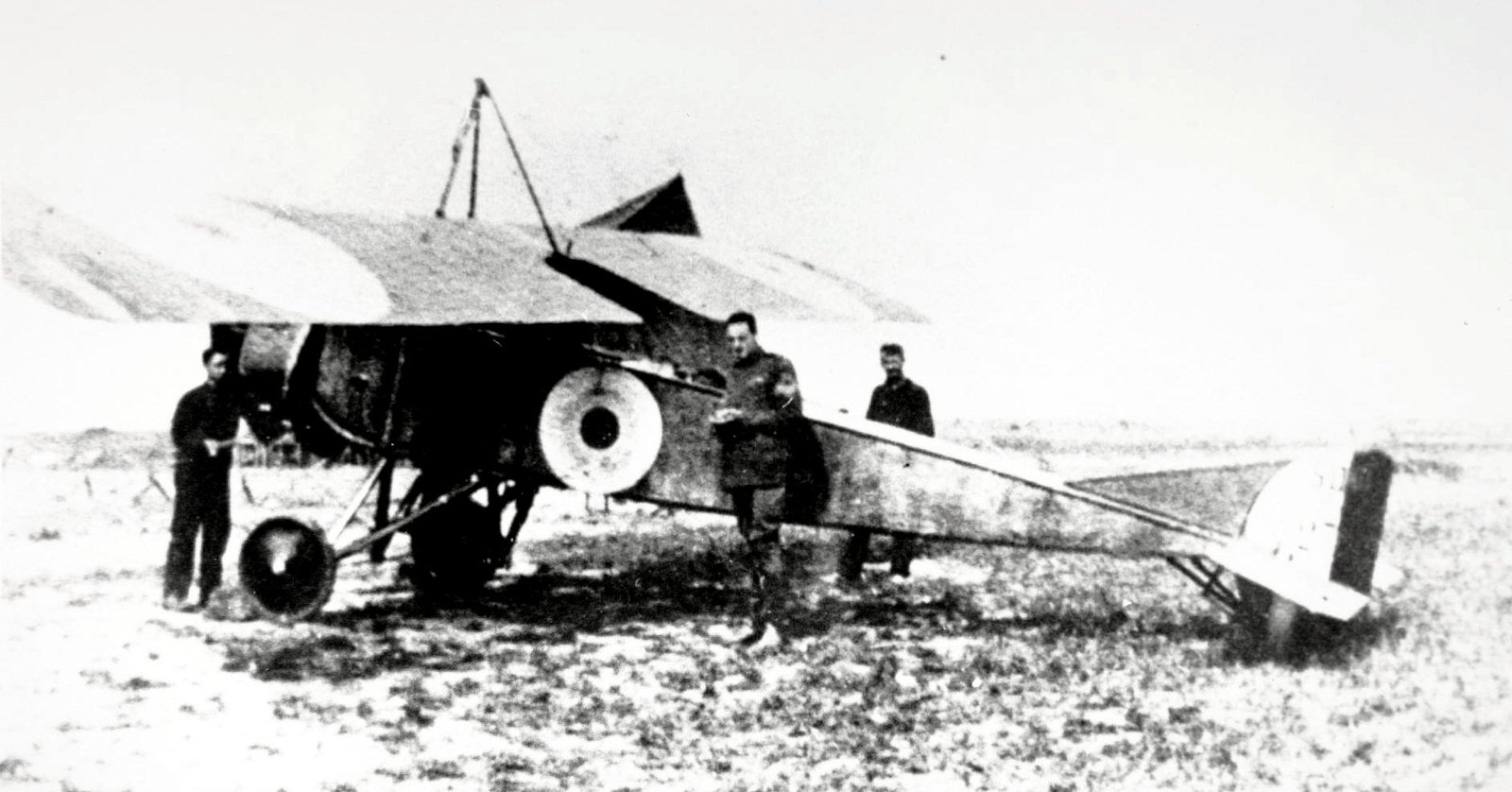
The Morane-Saulnier Type L was a seminal French aircraft that bridged the gap between early observation platforms and dedicated combat aircraft. Introduced in 1913, the Type L was a parasol-wing monoplane characterized by a wire-braced structure. In its original form, the aircraft utilized wing warping for lateral control, though a subsequent development known as the Type LA introduced ailerons for improved maneuverability. In French military service, these aircraft were designated as the MS.3.
Designed by Raymond Saulnier in partnership with Léon and Robert Morane, the Type L is historically significant for its role in the development of aerial combat. While initially used for reconnaissance, it became one of the first successful fighter aircraft when it was equipped with a single machine gun capable of firing through the arc of the propeller. This was achieved using metal deflector plates to protect the bullets from striking the propeller blades. This innovation was famously utilized by Roland Garros, who became the first French ace and triggered a technological arms race that led to the development of synchronized machine-gun gear.
Production took place in the Paris region at the facilities of Société des Aéroplanes Morane-Saulnier. While exact production dates are not fully documented, the aircraft entered service between 1913 and 1914, with primary production continuing through approximately 1915. Roughly 600 aircraft from the Type L/LA family were constructed for the French Aviation Militaire, the British Royal Flying Corps (RFC), the Royal Naval Air Service (RNAS), and the Imperial Russian Air Service.
Technically, the aircraft was powered by a single 80 hp Gnome rotary engine. It featured a wingspan of 11.2 meters, a length of 6.88 meters, and a height of 3.93 meters, with a listed weight of 655 kg. Performance figures indicate a maximum speed of 115 km/h at an altitude of 2,000 meters, a service ceiling of 4,000 meters, and an endurance of 2 hours and 30 minutes. For armament, it carried one Hotchkiss machine gun and had the capacity to carry a small number of bombs for ground-attack missions.
Following its front-line service in 1914 and 1915, the Type L was relegated to secondary roles and training, including use by the U.S. Army starting in 1917. No original wartime airframes are known to survive today; however, the aircraft's legacy is preserved through high-quality reproductions. Notable examples include a replica at the Combat Air Museum in Topeka, Kansas, and a reproduction built by the company's industrial successor, Daher, which was displayed at EAA AirVenture 2017.