
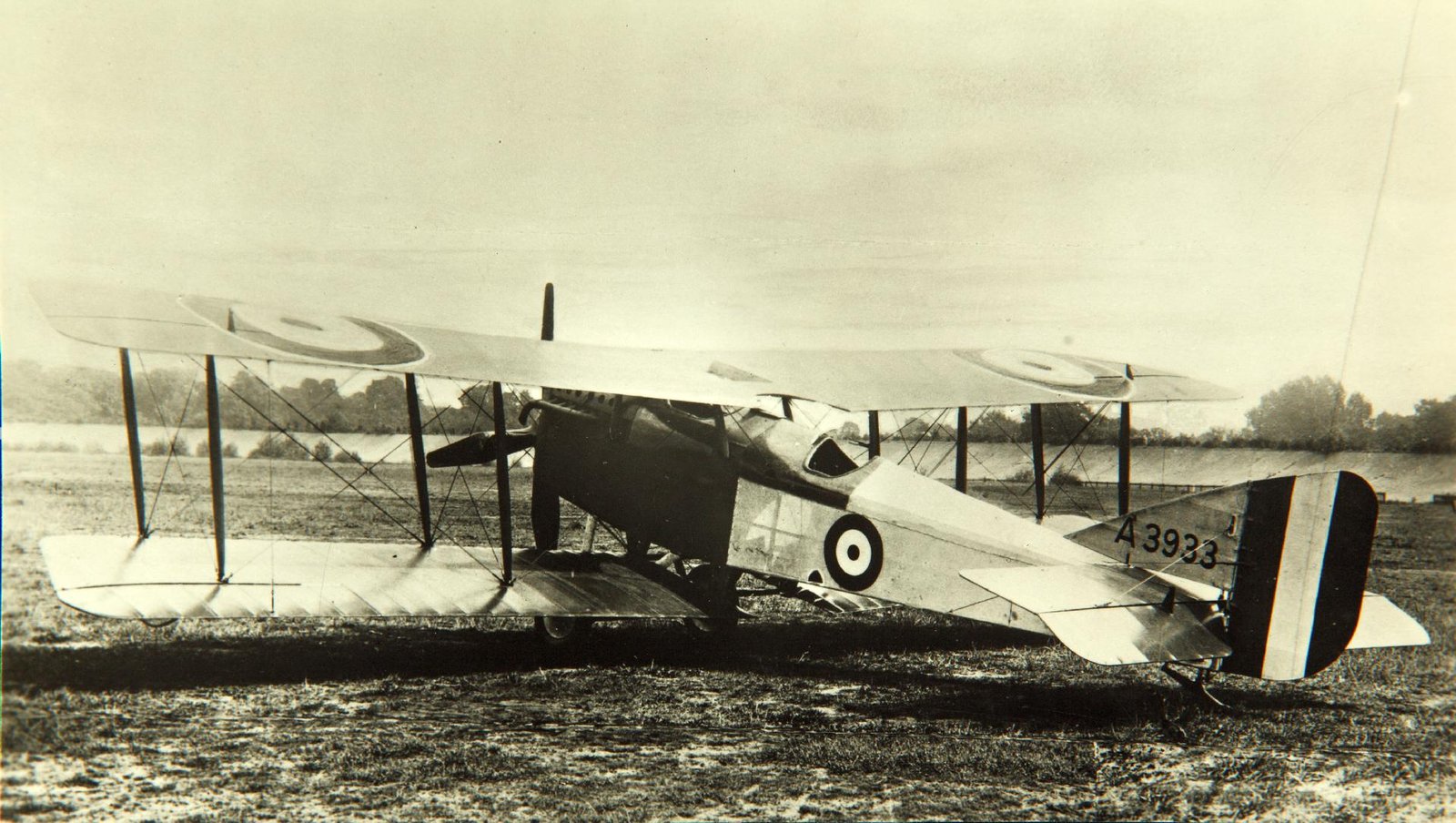
The Martinsyde F.1 represents a sparsely documented chapter in the development of British fighter aircraft during the First World War. Produced by Martinsyde Ltd, a British firm active in aircraft and motorcycle manufacturing since before 1914, the F.1 was an early experimental effort in the company's fighter lineage. While the firm is well-known for producing the S.1 Scout and the G.100/G.102 "Elephant" bomber and reconnaissance aircraft, the F.1 remained a prototype or a paper project, as no reliable historical sources indicate that it ever entered series production.
Technical data for the F.1 is extremely limited, as most surviving records for the Martinsyde F-series focus on the later F.3 and F.4 Buzzard. The F.3, which first flew on October 3, 1917, was a single-seat, water-cooled tractor biplane powered by a Rolls-Royce Falcon V-12 engine. The F.4 Buzzard further evolved this design, utilizing a 300 hp Hispano-Suiza 8 engine to become one of the fastest British aircraft developed during the war. While George Handasyde is credited as the designer of the F.3, it is inferred that he or his team led the development of the preceding F.1, though this specific attribution is not explicitly documented in available technical records.
Due to its experimental nature, the F.1 never entered military service. In contrast, the later F.3 saw limited use with RAF Home Defence squadrons, including No. 39 and No. 141 Squadrons in 1918. The F.4 Buzzard achieved wider distribution, with the RAF receiving 310 units, and later seeing service in Finland, Spain, and the Soviet Union. Following the bankruptcy of Martinsyde Ltd shortly after the war, the company's remaining assets and airframes were managed by the Aircraft Disposal Company (ADC). Because the F.1 never reached production, no examples survived; the only remaining F-series aircraft is an F.4 Buzzard preserved at the Aviation Museum of Central Finland.