
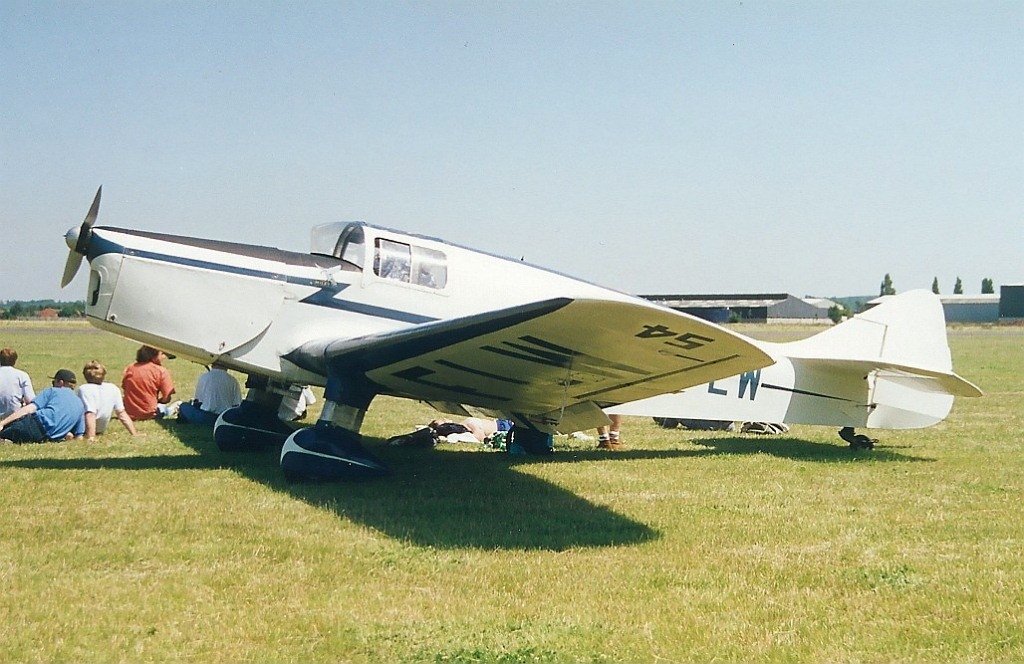
Development and Design Philosophy
The M.17 Monarch emerged from Frederick George Miles' ambition to refine the proven M.11 Whitney Straight formula. As technical director and chief designer of Phillips and Powis Aircraft, Miles recognized that operational experience with the M.11 revealed opportunities for enhancement, particularly in accommodation and comfort. The prototype's successful maiden flight on 21 February 1938 validated his approach of evolutionary rather than revolutionary design change.
Miles' decision to expand seating from two to three occupants reflected the growing demand for small aircraft capable of basic training duties while maintaining the economic operation that made the Whitney Straight series attractive to flying clubs and private owners. The retention of the reliable de Havilland Gipsy Major powerplant ensured continuity with established maintenance practices and parts availability.
Manufacturing Heritage
Phillips and Powis Aircraft (Reading) Ltd. represented a significant force in British light aircraft manufacturing during the late 1930s. The company's facilities in Reading, England, had established a reputation for producing practical, well-engineered aircraft that balanced performance with affordability. The M.17 entered production in 1938 as part of a broader program that encompassed 50 aircraft across the M.11A, M.11B, and M.11C variants.
The company underwent substantial transformation during the war years. In 1941, Rolls-Royce divested its shareholding to Frederick George Miles, who assumed both chairman and managing director roles. This transition led to the formal renaming as Miles Aircraft Ltd. in 1943, with George Herbert Miles serving as chief engineer and chief designer. The wartime period saw dramatic expansion, including establishment of a specialized factory in Bambridge, County Down, Northern Ireland in late 1943, initially producing components for air-launched torpedoes before transitioning to complete aircraft assembly.
Wartime Requisition and Service
The outbreak of war in September 1939 immediately transformed the M.17's operational profile. The Royal Air Force recognized the aircraft's suitability for communication and liaison duties, requisitioning most Whitney Straights in Britain for military service. This mobilization encompassed 23 aircraft for RAF operations, with 21 remaining in the United Kingdom and two deployed to India, plus three additional aircraft allocated to the Royal New Zealand Air Force.
The M.17's five-year wartime service record demonstrated the aircraft's reliability under demanding operational conditions. Its combination of reasonable speed, economical operation, and three-seat capacity made it valuable for training duties, administrative flights, and communication missions throughout the British Commonwealth. The aircraft's ability to operate from modest airfields proved particularly advantageous as military aviation expanded to utilize numerous auxiliary and training bases.
Technical Specifications and Performance
The de Havilland Gipsy Major inline piston engine provided the M.17 with 140 horsepower, delivering a maximum speed of 145 mph while achieving fuel consumption exceeding 20 miles per gallon. This combination of performance and economy positioned the aircraft competitively within the light aircraft market, offering operators reasonable speed without excessive operating costs.
The three-seat configuration represented a practical compromise between the intimacy of two-seat training aircraft and the complexity of larger designs. This arrangement proved particularly suitable for basic instruction, where an instructor could accompany two student pilots, or for small group transportation where personal aircraft ownership was becoming increasingly popular among affluent civilians.
Post-War Transition and Preservation
The transition from military to civilian operation proved successful for surviving M.17 aircraft. At least one example returned to civil aviation following reconstruction after a 1942 accident, receiving registration G-AFJU in 1946. This aircraft operated in civilian hands until 1965, when it was broken up and its remains transferred to the Strathallan collection in Scotland, ensuring preservation of at least portions of this historically significant design.
The M.17's post-war civilian service demonstrated the aircraft's continued relevance in an era when flying clubs and private owners sought reliable, economical aircraft for training and recreational flying. The type's proven wartime record provided additional confidence for civilian operators seeking dependable aircraft with established maintenance procedures.
Legacy and Historical Significance
The M.17 Monarch occupies an important position in British light aircraft development, representing the maturation of design philosophy that emphasized practical utility over performance extremes. Frederick George Miles' approach of incremental improvement based on operational feedback established principles that influenced subsequent light aircraft development throughout the industry.
The aircraft's successful transition from civilian training and private flying to military communication duties, followed by return to civilian operation, demonstrates the versatility that characterized well-designed general aviation aircraft of the late 1930s. This adaptability proved crucial during wartime, when civilian aircraft frequently assumed military roles, and again during post-war demobilization when military aircraft returned to civilian use.
Today, the M.17 Monarch represents a significant chapter in the evolution of British light aviation, embodying the practical engineering philosophy that made Miles Aircraft a respected name in general aviation during the critical years immediately preceding World War II.